Geneva's History, Heritage & International Importance
Geneva’s History, Heritage & International Importance
This article contains advertising. Our booking links are routed through a partner that adds commission tracking automatically, so if you book through one we earn a commission from the provider, at no extra cost to you. It never affects what we recommend. Affiliate disclosure
Geneva is a small city with an oversized résumé. For a place of barely 200,000 people wedged between the Alps and the Jura, the things that started here are absurd: John Calvin rebuilt Protestant Christianity from a pulpit in the Old Town, Jean-Jacques Rousseau was born a few streets away, Henry Dunant invented the Red Cross after one terrible day on a battlefield, and the rules that are supposed to protect civilians in war — the Geneva Conventions — carry the city’s name for a reason. The history of Geneva is not background colour. It is the reason the United Nations, the WHO and 170-odd diplomatic missions all crowd into one lakeside town today.
This guide walks Geneva’s story in order, from a Celtic river crossing to the global city it became, and I have tried to keep it honest about what is actually worth seeing versus what is just a plaque. If you want to turn the reading into a day on foot, pair it with the things to do in Geneva list and the Geneva museums and culture guide, both of which I link back to throughout. For a deeper single-topic dive, there are dedicated pages on the full history of Geneva and the city’s famous residents.
01 — Geneva history at a glance: a timeline
Two thousand years is a lot to hold in your head. Here is the short version — the dates I would actually anchor a visit around, in the order they happened.
| When | What happened | Where to see it today |
|---|---|---|
| 58 BC | Caesar names Geneva in his Gallic Wars; Roman town of Genava grows up at the Rhône crossing | Archaeological site under St. Pierre Cathedral |
| 4th century | Christianity arrives; Geneva becomes a bishop’s seat | Cathedral foundations, baptistery |
| 12th century | Bishops and the Dukes of Savoy fight over the city for 300 years | Maison Tavel, the oldest house in town |
| 1536 | Geneva adopts the Reformation; Calvin arrives the same year | St. Pierre Cathedral, Reformation Wall |
| 1559 | Calvin founds the Genevan Academy, today’s University of Geneva | Parc des Bastions |
| 1602 | The Escalade: Geneva repels a night attack by Savoy | Old Town ramparts; December festival |
| 1712 | Rousseau born at 40 Grand-Rue | Grand-Rue, Old Town |
| 1864 | First Geneva Convention signed at the Hôtel de Ville | City Hall; Red Cross Museum |
| 1920 / 1946 | League of Nations, then the UN, make Geneva a world capital | Palais des Nations, Palais Wilson |
02 — Roman Geneva: a river crossing worth fighting for
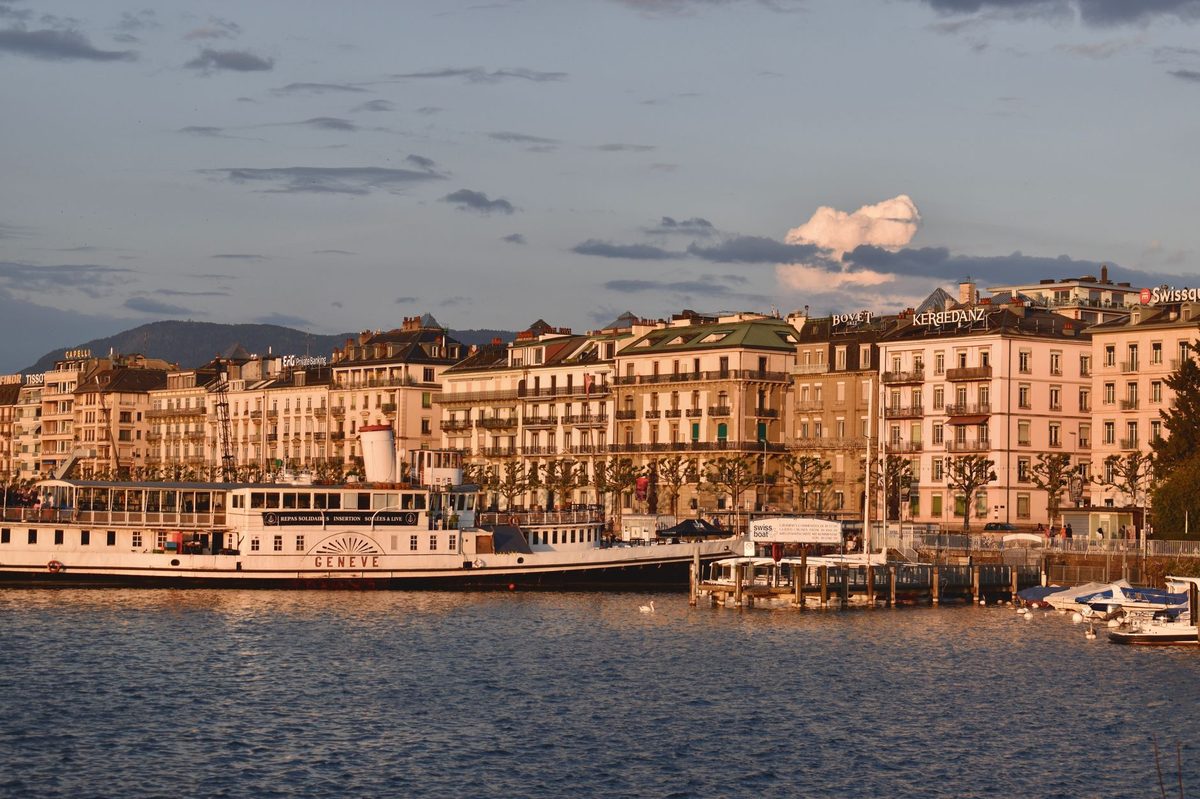
Geneva exists because of geography. The Rhône leaves Lake Geneva at exactly the point where the lake narrows to a river you can bridge, and that crossing sits on the natural corridor between the Alps and the Jura. Control the bridge and you control who moves between Italy, France and the north. The Allobroges, a Celtic tribe, settled the spot first, and the place was already strategic enough that Julius Caesar bothered to mention it.
In his account of the Gallic Wars in 58 BC, Caesar calls Geneva the last town of the Allobroges before Helvetian territory, and records that he had the Rhône bridge destroyed to stop a mass Helvetian migration. That is roughly Geneva’s first appearance in the written record — as a chokepoint. Under Roman rule the town, then called Genava, grew into a respectable settlement with temples, baths and a harbour on the lake.
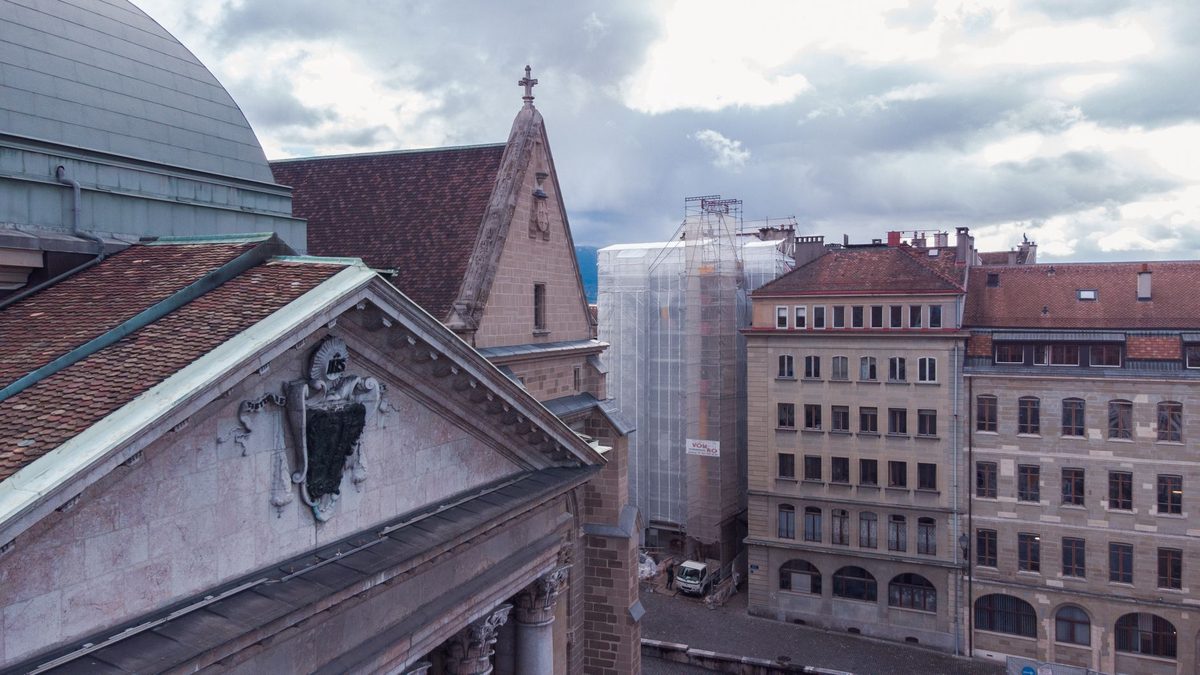
The single best place to feel this layer is the archaeological site beneath St. Pierre Cathedral. Excavations there uncovered a 4th-century baptistery and the stacked foundations of church after church built on the same ground for more than 1,600 years. You walk a raised metal path through Roman walls, early Christian mosaics and medieval crypts, all underground, all under the cathedral you can still climb. It is the rare archaeological site that is genuinely legible rather than a field of stumps, and I would put it near the top of any history-minded itinerary — the museums and culture guide covers tickets and the cathedral tower climb.
03 — Medieval Geneva: bishops, the Dukes of Savoy, and the Escalade
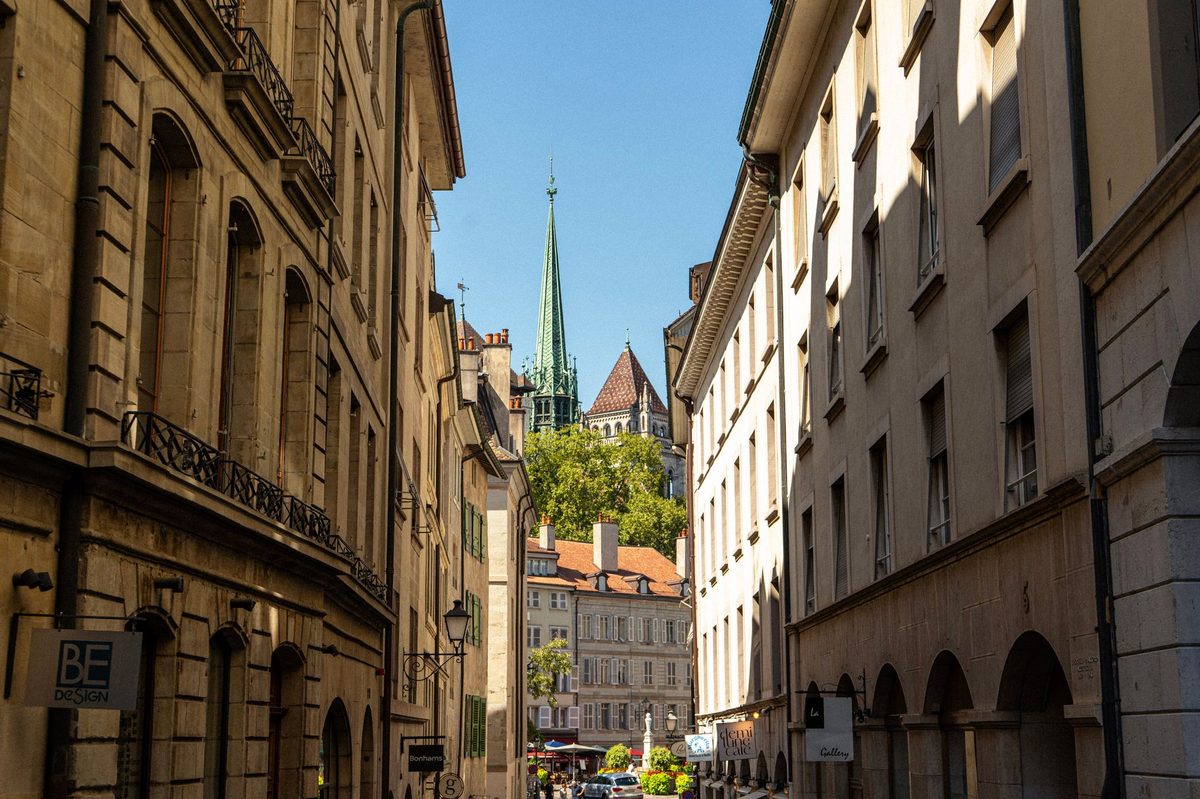
For most of the Middle Ages, Geneva was a prize two powers kept reaching for: the prince-bishops who governed the city, and the ambitious Dukes of Savoy who wanted it. Sitting on trade routes linking France, Italy and northern Europe, the town got rich on its merchant fairs, which pulled in traders from across the continent. If you want a feel for ordinary medieval life rather than just power politics, go to Maison Tavel — the oldest private house in Geneva, parts of it 12th-century, now a free city museum with a scale model of the town as it looked before the 1850s fortifications came down.
The defining night of medieval Geneva came on 11–12 December 1602. The Duke of Savoy sent troops to scale the city walls in a surprise assault, and the Genevans threw them back. The episode became known as the Escalade — literally “the scaling” — and it is still the city’s most heartfelt festival, with torchlit processions through the Old Town every December and chocolate cauldrons, marmites, that you smash and eat in memory of a townswoman said to have emptied a pot of boiling soup onto an attacker’s head. Locals care about the Escalade more than they care about Christmas, and the victory hardened Geneva’s stubborn independence, which is the through-line of everything that follows.
04 — The Reformation: how Geneva became the Protestant Rome
Nothing Geneva has ever done echoed further than the Reformation. In 1536 the city formally adopted Protestantism, broke with Rome, and pushed out the bishop. By coincidence the same year, a young French theologian named John Calvin passed through, was talked into staying, and went on to spend most of the rest of his life turning Geneva into the command centre of Reformed Christianity. Contemporaries started calling it the Protestant Rome, and they were not exaggerating.
Calvin’s Geneva was strict, organised, and intensely intellectual. In 1559 he founded the Genevan Academy — now the University of Geneva — to train pastors and missionaries who then carried Calvinist theology across Europe and eventually to the Americas. His insistence on literacy, discipline and individual moral accountability spilled well beyond church doctrine; historians have spent two centuries arguing over how far Calvinist values fed into modern capitalism, work culture and even representative government. You do not have to settle that debate to notice that a remarkable amount of the modern West has fingerprints from this one small city.
The era is easy to visit. The Reformation Wall in the Parc des Bastions lines up five-metre statues of Calvin, William Farel, Theodore Beza and the Scot John Knox beneath the motto Post Tenebras Lux — “after darkness, light,” which is Geneva’s motto and the Reformation’s at once. A few steps away, the International Museum of the Reformation lays out the whole story in an 18th-century mansion with original documents and well-done multimedia. And St. Pierre Cathedral, where Calvin preached for more than 25 years from a plain wooden chair you can still see, is the symbolic heart of it all. For the full account there is a dedicated Geneva Reformation guide.
05 — The Enlightenment: Rousseau, Voltaire and a city of ideas
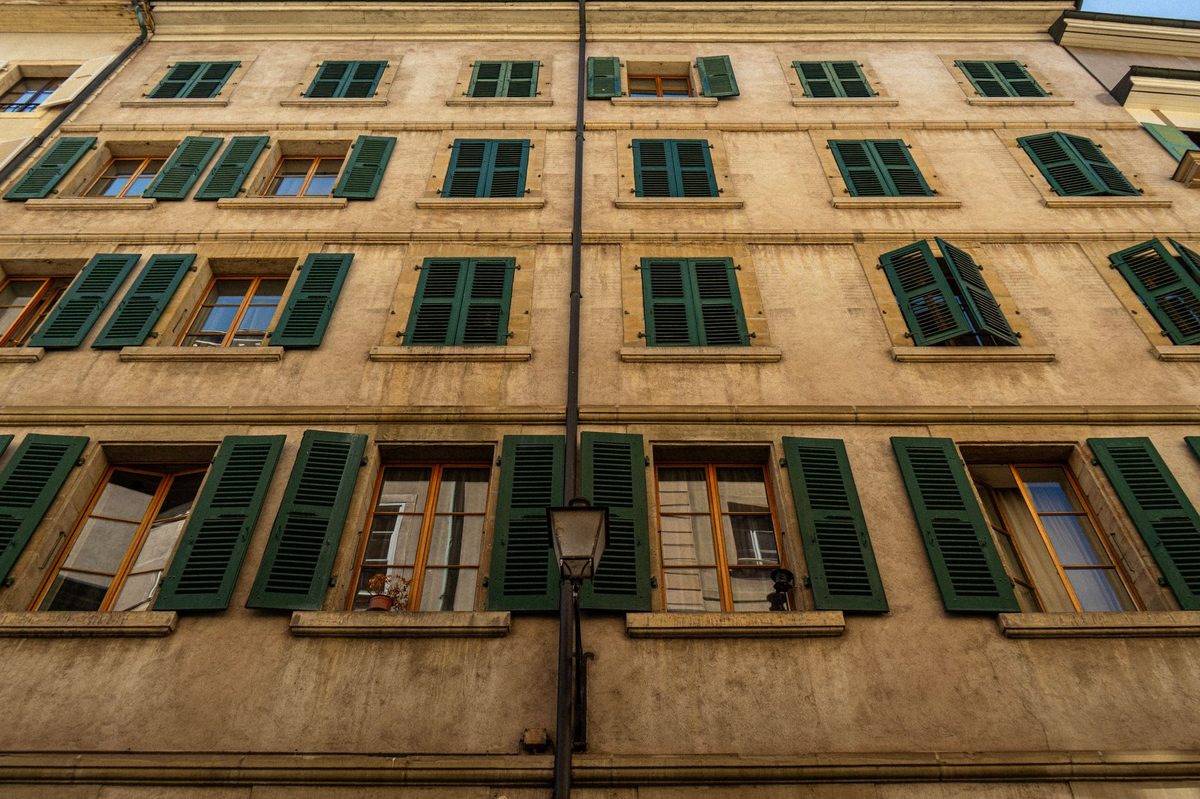
Geneva did not stop producing world-altering ideas when the Reformation cooled. In 1712, Jean-Jacques Rousseau was born at 40 Grand-Rue in the Old Town, and grew up to write some of the most consequential political philosophy ever put on paper. His arguments about the social contract and popular sovereignty fed directly into the French Revolution and still underpin how democracies justify themselves. He signed his most famous works “citizen of Geneva,” even after the city banned and burned them — a quarrel that tells you a lot about both the man and the town.
Voltaire, his great rival, was French but spent the last 20 years of his life just over the border at Ferney, close enough to needle the Geneva establishment and host half of Enlightenment Europe at his estate. The science came too: the Genevan naturalist Horace-Bénédict de Saussure sponsored and then made the second-ever ascent of Mont Blanc in 1787, and is counted among the founders of modern geology and meteorology. That scientific streak never really stopped — it runs straight through to CERN on the city’s edge, where physicists smash particles together to ask what the universe is made of. For more on these characters, the famous people from Geneva page goes person by person.
06 — The Red Cross and the Geneva Conventions
Here is the part of Geneva history that arguably mattered most to the most people. In 1859 a Genevan businessman named Henry Dunant happened to be near Solferino in northern Italy on the day after a vast battle, where roughly 40,000 men lay dead or wounded with almost no one to help them. Dunant did not have a medical background. He simply organised the local villagers to treat the wounded from both armies without asking which side they had fought for — a genuinely radical idea at the time — and then he could not let it go.
His short book, A Memory of Solferino, made two proposals: that every country should have trained volunteer relief societies ready for wartime, and that nations should sign a treaty protecting the wounded and the people who care for them. Both happened, and both happened in Geneva. In 1863 five Genevan citizens, Dunant among them, founded what became the International Committee of the Red Cross. In 1864 the first Geneva Convention was signed at the Hôtel de Ville by twelve nations, laying the cornerstone of international humanitarian law. Dunant went on to win the very first Nobel Peace Prize in 1901.
What started as one man’s reaction to one battlefield is now ratified by every country on Earth — the Geneva Conventions, expanded four times since, are about as close to universal law as humanity has managed. You can sit with the whole story at the International Red Cross and Red Crescent Museum, directly across from the UN, which is one of the more emotionally heavy museum visits in the city and well worth the climb up the hill. The deeper background lives on the dedicated Red Cross in Geneva page and the broader humanitarian capital guide.
07 — How Geneva became the watchmaking capital of the world
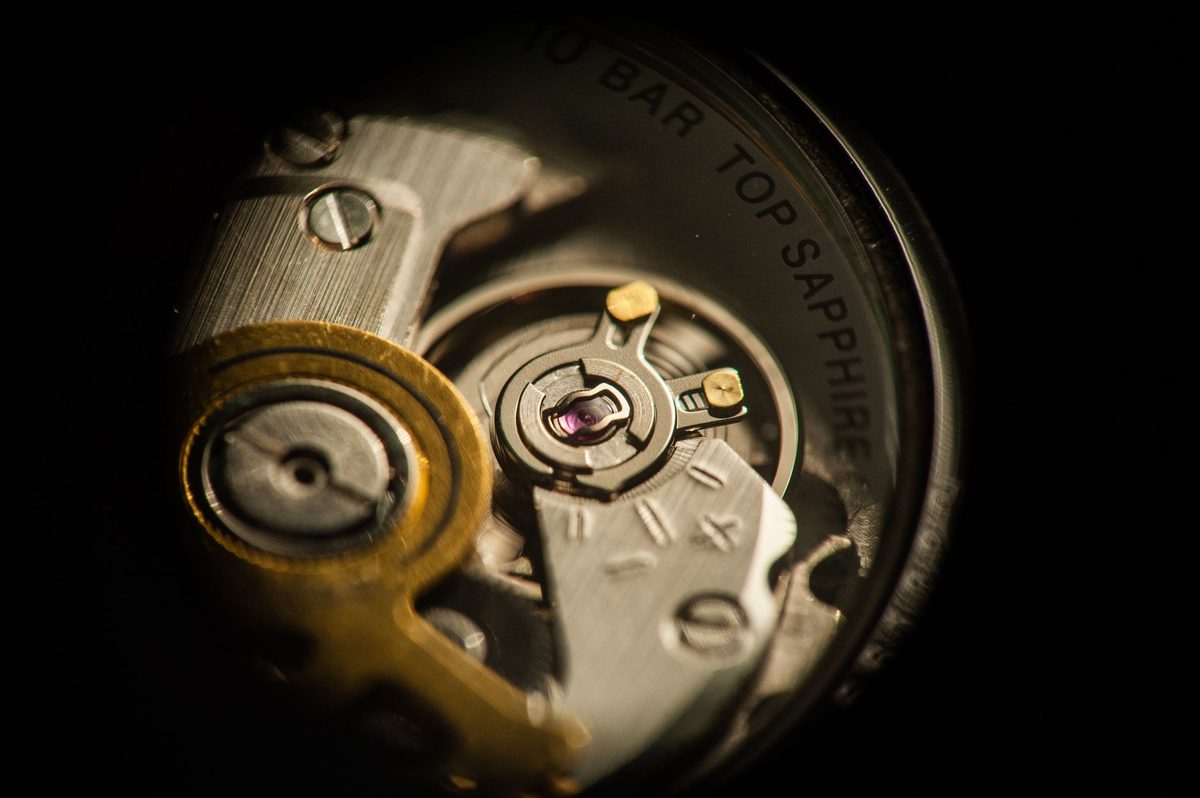
Geneva’s grip on fine watchmaking has a surprisingly direct cause: Calvin. When the reformer banned ornamental jewellery in 1541, the city’s goldsmiths and jewellers suddenly had skills and no market — so they redirected that precision into watches, which counted as useful rather than vain. It is one of history’s better unintended consequences. The trade got a second boost when Huguenot watchmakers fleeing persecution in France, after the St. Bartholomew’s Day massacre of 1572 and the revocation of the Edict of Nantes in 1685, brought their techniques north and settled in Geneva. The trade never left: the same streets now hold the boutiques in our guide to buying a watch in Geneva.
The numbers tell the rest. Geneva established the world’s first watchmakers’ guild in 1601. By 1760 some 600 master watchmakers worked in the city, and within three decades it was exporting more than 60,000 watches a year. The Geneva Seal, the Poinçon de Genève, was written into law in 1886 and is still the most demanding quality stamp in the business. Today Patek Philippe, Rolex and Vacheron Constantin all call the city home, and the Patek Philippe Museum holds more than 2,000 timepieces spanning five centuries — even if you do not care about watches, the craftsmanship is hard to dismiss. The full story sits on the Geneva watchmaking heritage page, and if you want to actually buy one, the luxury shopping guide covers where to go.
08 — International Geneva: the League of Nations to the UN
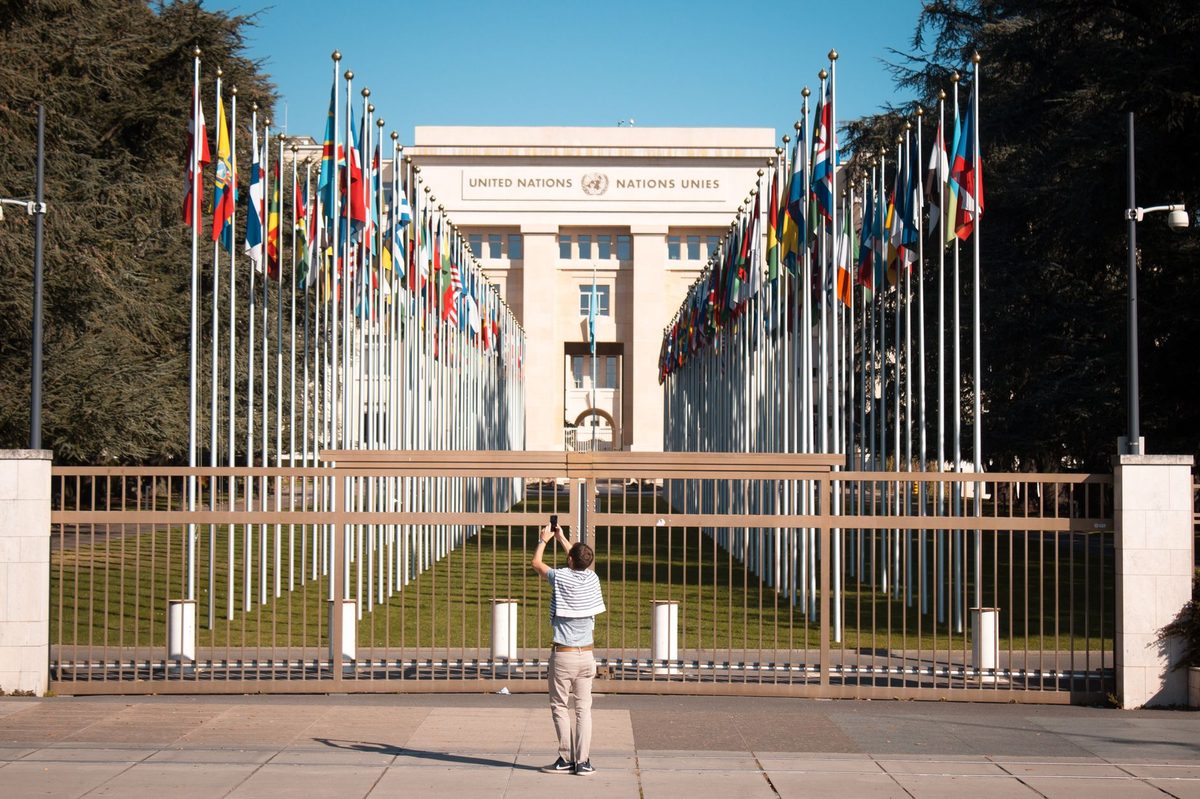
Geneva’s modern identity as the world’s diplomatic switchboard was sealed after the First World War. In 1920 the brand-new League of Nations chose the city for its headquarters, first in the lakeside Palais Wilson — named for US President Woodrow Wilson, the League’s main champion — and then in the purpose-built Palais des Nations, constructed between 1929 and 1938 in the Ariana park. The League itself failed to stop the next war, but the choice of Geneva stuck.
If anything, the failure reinforced the city’s role rather than ending it. The United Nations set up its European headquarters in the same Palais des Nations in 1946, and the decades since turned Geneva into an astonishing concentration of global institutions. The city now hosts more than 40 international organisations, some 750 NGOs and around 177 diplomatic missions; the WHO, the WTO, the International Labour Organization and UNHCR are all headquartered here. Over 34,000 international civil servants come to work each day in a city of roughly 200,000 residents — a ratio nowhere else comes close to.
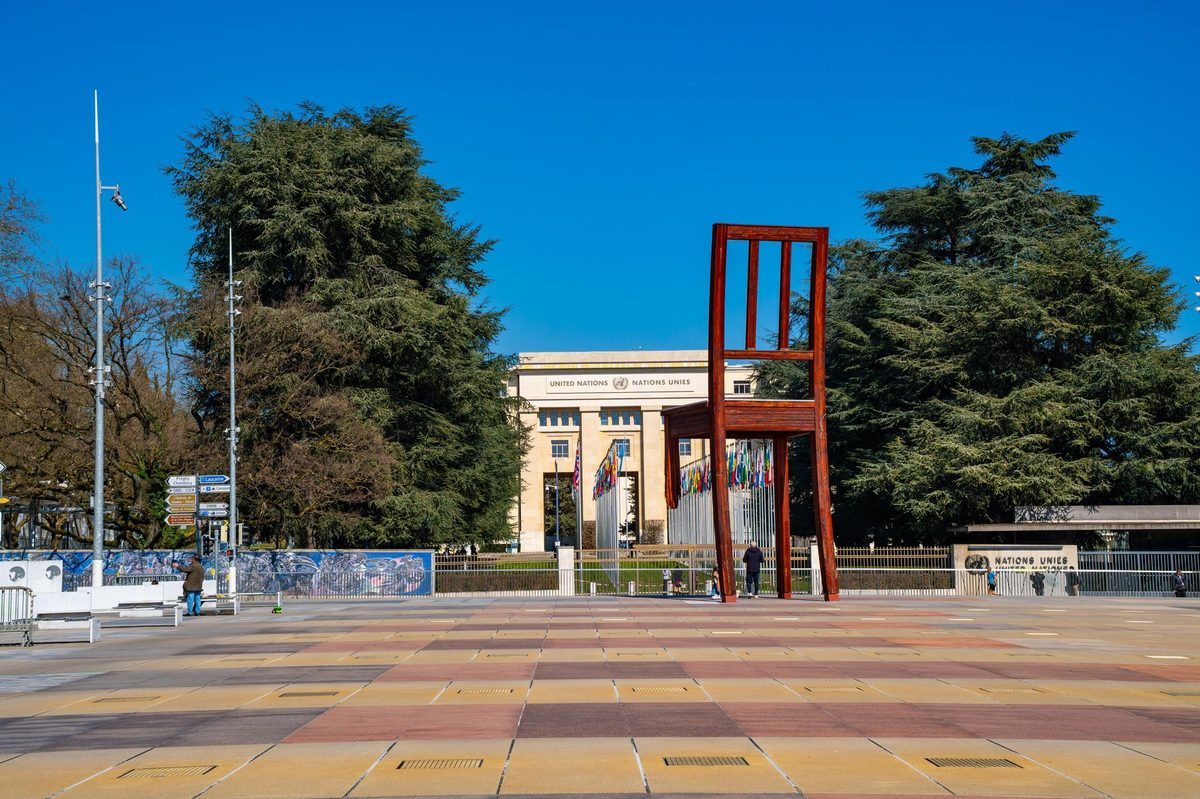
You can tour the Palais des Nations on a guided visit (bring your passport), stand in the Assembly Hall where real negotiations still happen, and photograph the Broken Chair sculpture on the square outside, a protest against landmines that has become an accidental city landmark. For the long version, see the United Nations in Geneva guide; the surrounding district sits in the neighbourhoods guide if you want to plan a half-day around it.
09 — The lake that made the city
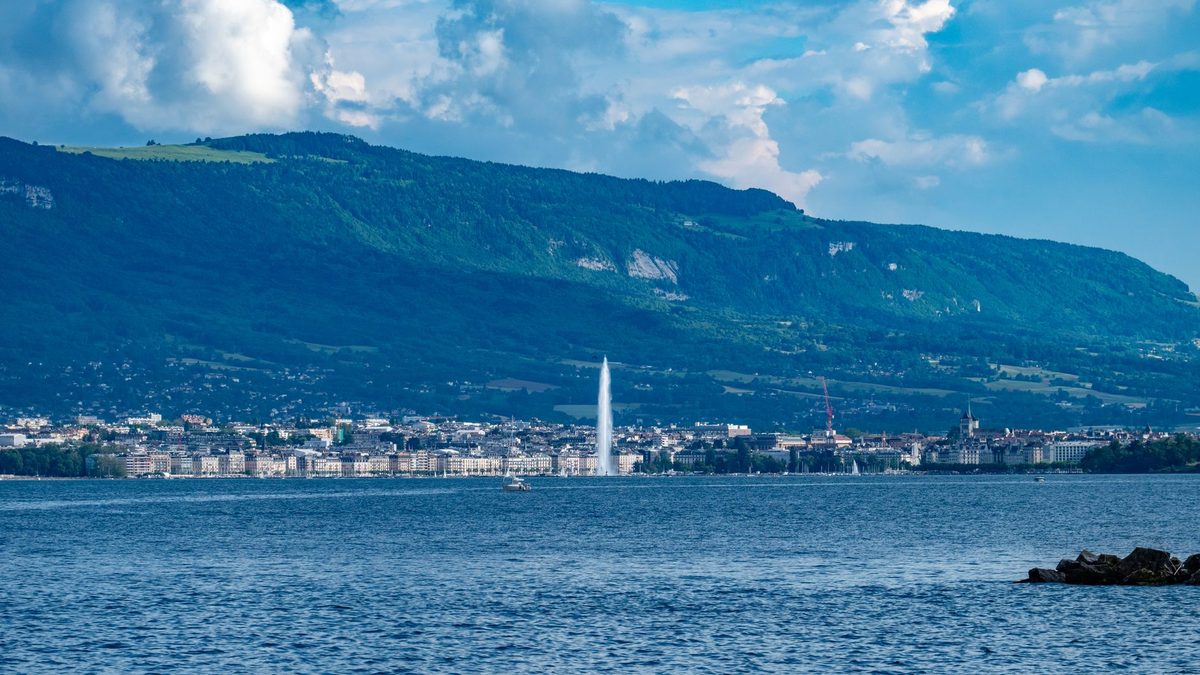
It is easy to treat Lake Geneva as scenery, but the lake is the whole reason any of this is here. It is the largest body of water in the Alps, it gave the city its harbour and its trade, and it draws the line that the Rhône finally bridges. The Jet d’Eau, the 140-metre water plume that has become Geneva’s emblem, began life as a plain pressure-release valve for the city’s hydraulic network before someone realised it looked far better than it had any right to and made it permanent. That is very Geneva: a piece of practical engineering quietly promoted to a monument. The lake’s own story, how it formed, why it matters and what lives in it, is its own subject on the Lake Geneva history and geography page.
10 — How to experience Geneva’s history in a day or two
The good news is that Geneva’s history is compact and walkable. The Old Town packs the Roman site, the cathedral, Maison Tavel, the Reformation Wall and Rousseau’s birthplace into an area you can cover on foot in a morning. Reserve the afternoon for the international quarter across the river, where the Red Cross Museum and the Palais des Nations sit a short tram ride apart on the hill above the lake. Getting between the two is painless; the Geneva transportation guide explains the free transport pass most hotels hand you at check-in.
If you are building an actual trip, sort the practical pieces first: the where to stay in Geneva guide will get you a base in the right neighbourhood, and the plan your Geneva trip page pulls the logistics together. History here is not roped off behind glass — it is the cathedral you climb, the cobbles you walk, the institutions still doing the work down by the lake.
Frequently asked questions
Why is Geneva so important historically?
Because an unusual number of world-changing things started here. Calvin made it the centre of the Protestant Reformation, Rousseau’s political philosophy helped shape modern democracy, Henry Dunant founded the Red Cross and triggered the 1864 Geneva Convention, and in the 20th century the League of Nations and then the UN made it a global diplomatic capital, and few cities of its size have anything close to that record.
How old is Geneva?
Very. Geneva was a Celtic settlement of the Allobroges before Julius Caesar named it in his account of the Gallic Wars in 58 BC, and it grew into a Roman town called Genava. So the city has been continuously inhabited for well over 2,000 years.
What is the connection between Geneva and the Red Cross?
The Red Cross was founded in Geneva. In 1863 five Genevan citizens, including Henry Dunant, created the International Committee of the Red Cross, and in 1864 the first Geneva Convention was signed in the city. The International Red Cross and Red Crescent Museum, opposite the UN, tells the story.
Why does Geneva have so many international organisations?
It started with the League of Nations choosing Geneva in 1920, building on Switzerland’s neutrality and the city’s existing humanitarian reputation. When the UN set up its European headquarters here in 1946, more organisations followed. Today the city hosts over 40 international bodies, including the WHO and WTO, and around 177 diplomatic missions.
What was the Escalade?
The Escalade was a failed night attack on Geneva by the Duke of Savoy’s troops on 11–12 December 1602. The Genevans repelled the assault, and the victory is still celebrated every December with torchlit processions and chocolate cauldrons, marmites, that people smash open and eat.
Can you visit the places where Geneva’s history happened?
Yes, and most are within walking distance. The archaeological site under St. Pierre Cathedral, Maison Tavel, the Reformation Wall and Rousseau’s birthplace are all in the Old Town, while the Red Cross Museum and the Palais des Nations sit together in the international quarter across the river.
11 — Related Geneva guides
Keep exploring with the things to do in Geneva overview, the Geneva museums and culture guide, the full history of Geneva, and the deeper dives on the Reformation, watchmaking heritage and the United Nations in Geneva. When you are ready to book, start with planning your trip and where to stay.