Geneva's History, Heritage & International Importance
Lake Geneva — Geography, Geology, History, and 50 Things to Know About Europe’s Crescent Lake
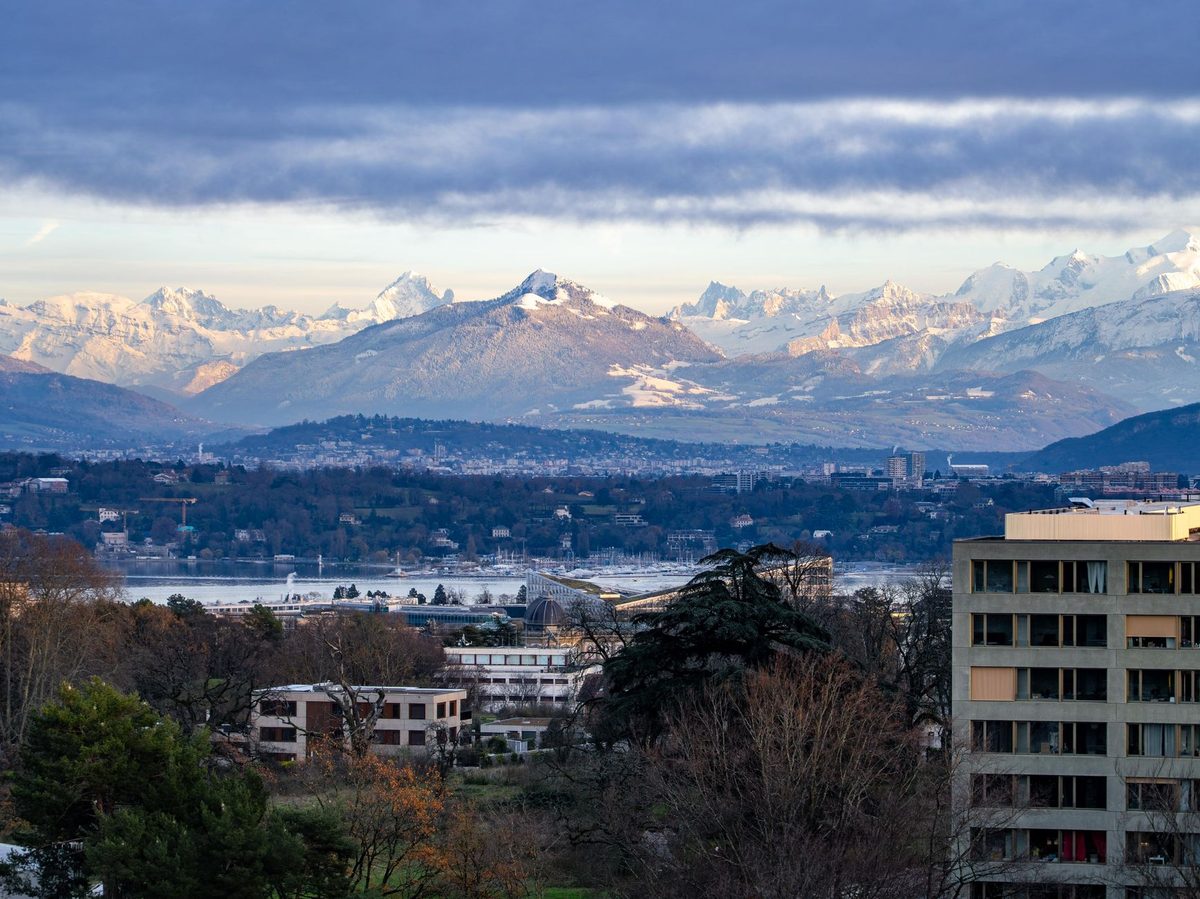
This article contains advertising. Our booking links are routed through a partner that adds commission tracking automatically, so if you book through one we earn a commission from the provider, at no extra cost to you. It never affects what we recommend. Affiliate disclosure
Lake Geneva geography is one of those subjects almost everyone half-knows and almost no one has straight. The lake is a 73-kilometre crescent hooked around the western edge of the Alps, one of the deepest lakes in Europe, and the site of the only documented tsunami in central European history. It has its own micro-climate and its own endemic fish, and a vineyard system on its north shore that has been worked continuously since the eleventh century. Most of it sits in Switzerland, the southern shore is French, and the international boundary runs invisibly under the water.
This is the long, useful version: how to understand Lake Geneva geographically, geologically, historically and culturally, and how to actually get out on it. It pairs naturally with our Geneva outdoor activities pillar and, for the human history, our history of Geneva.
01 — The basics: size, depth, shape, borders
Lake Geneva, known as Lac Leman in French and Genfersee in German, is the largest natural lake in Western Europe and the largest Alpine lake on the continent. The numbers that matter:
| Measurement | Value |
|---|---|
| Surface area | 580 km2 (224 sq mi) |
| Length (Geneva to Villeneuve) | 73 km |
| Maximum width | 14 km (between Morges and Amphion) |
| Maximum depth | 310 metres (Grand Lac, between Evian and Lausanne) |
| Average depth | 154 metres |
| Surface elevation | 372 metres above sea level |
| Total volume | 89 km3 |
| Catchment basin | 7,975 km2 |
| Mean residence time | 11.3 years |
| Shore length | 200 km total (Swiss 132 km, French 68 km) |
The shape is the defining feature. The lake is a crescent, what locals call a croissant, concave on its southern French shore and convex on its northern Swiss shore. Geographers split it into three. The Petit Lac is the narrow western arm from Geneva to Yvoire, with the city of Geneva at its tip. The Grand Lac is the wide central section between Lausanne and Evian, where you find the maximum depth. The Haut Lac is the eastern arm tapering to Villeneuve, where the Rhone arrives from the Valais.
The Rhone is the lake’s main inflow and its only significant outflow. It enters at Le Bouveret in the south-east, its silt settling out over weeks, and exits at Geneva in the south-west as cleaner, blue-tinted water, which makes the whole lake a vast natural settling basin for the upper Rhone catchment. About 60% of all the water entering comes from the Rhone. Roughly 60% of the surface lies in Switzerland (mainly Vaud and Geneva) and about 40% in France (Haute-Savoie). The boundary runs straight through the Grand Lac from Hermance on the southern shore to a point offshore of Saint-Gingolph, and crossing it by boat is unmarked and uneventful; small pleasure craft need no paperwork, and the big CGN steamers run cross-border routes as a matter of course.
02 — How Lake Geneva was formed
Lake Geneva is a glacial lake, gouged out by the Rhone Glacier, the massive Alpine glacier that flowed down from the Valais during successive Pleistocene ice ages and reached its furthest extent in the Riss glaciation roughly 200,000 years ago. At its peak the glacier was up to a kilometre thick over what is now the lake basin, and its frontal moraines reached as far west as Lyon. Advancing and retreating through multiple ice ages, it scoured out the deep basin the lake now fills.
The most recent retreat, at the end of the Wurm glaciation around 15,000 years ago, gave the lake its modern shape; as the ice melted, the basin filled with water. The terminal moraines are now the rolling hills west of Geneva, and the steep north shore between Lausanne and Villeneuve is essentially the lateral moraine where the glacier dumped rock as a long ridge. The bedrock beneath is Molasse sandstone, the same rock under most of the Swiss Plateau, capped by thick glacial till and post-glacial sediment; seismic surveys show layers up to 200 metres thick at the bottom of the Grand Lac, laid down over the past 15,000 years.
03 — The 563 AD Tauredunum tsunami
In late 563 AD a massive rockfall in the mountains above the eastern end of the lake, at a place called Tauredunum near today’s Le Bouveret, sent millions of cubic metres of rock and sediment crashing into the upper Rhone delta. The sudden displacement of water generated a tsunami that surged westwards down the entire length of the lake. Two near-contemporary chroniclers, Gregory of Tours in his History of the Franks and Marius of Avenches in his Chronicle, describe waves striking lakeshore villages, sweeping away the bridges of Geneva and drowning people in the lower town. Gregory writes of the waters rising with great violence and destroying men, cattle, houses and bridges.
For centuries the story was treated as exaggeration or confused folk memory. It was not. In 2012 a University of Geneva team led by Katrina Kremer published a study in Nature Geoscience presenting sediment-core evidence that confirmed a major mass-movement event in the second half of the sixth century. Modelling suggested a tsunami of up to 13 metres at the eastern end, 8 metres at Lausanne and 13 metres at the western end where Geneva sits. The chroniclers were right, and the evidence shows similar but smaller events have happened repeatedly over the lake’s history. It remains the only documented tsunami in central European history.
04 — Why it is called both Lake Geneva and Lac Leman
The lake has two names, both used interchangeably and both correct. In English it has been Lake Geneva since at least the seventeenth century, after the city at its western tip. In French it is almost always Lac Leman, from the Latin Lacus Lemannus the Romans used; Julius Caesar himself used the name in De Bello Gallico. The Romans took it from the Celtic root Lem, possibly meaning great water. Almost all French speakers around the lake say Leman in conversation and switch to Lake Geneva only in English. The two names mean exactly the same body of water, with no political loading either way.
05 — The lake’s micro-climate
The lake is large enough, and deep enough, to make its own local climate. The mass of water acts as a thermal flywheel: slow to warm in spring, slow to cool in autumn, resistant to short-term shocks. It almost never freezes; the last full freeze was in 1573 per the chronicles, with partial freezes of the Petit Lac in 1830, 1880 and 1956. Summer surface temperatures typically reach 22 to 24 degrees in July and August, and winter surface temperatures rarely drop below 5.
That thermal stability softens the shores. Lakeside winters run noticeably milder than 50 km inland, with average January minimums in Lausanne about 1 to 2 degrees above Bern at similar elevation, and summers slightly cooler. The reflective surface also intensifies sun on the south-facing north shore, which is the whole secret of the Lavaux vineyards: locals say the slopes get three suns, from the sky, off the water, and re-radiated from the stone terrace walls. Wind comes in two flavours. The bise blows from the north-east, mostly in winter, often clearing the sky into the stable cold sunny days that are great for skiing and photography. The vent du sud-ouest blows up the lake from the south-west, warmer and damper. Genevans watch the wind closely; sailors plan their afternoons around it, and an evening bise can drop the temperature by several degrees.
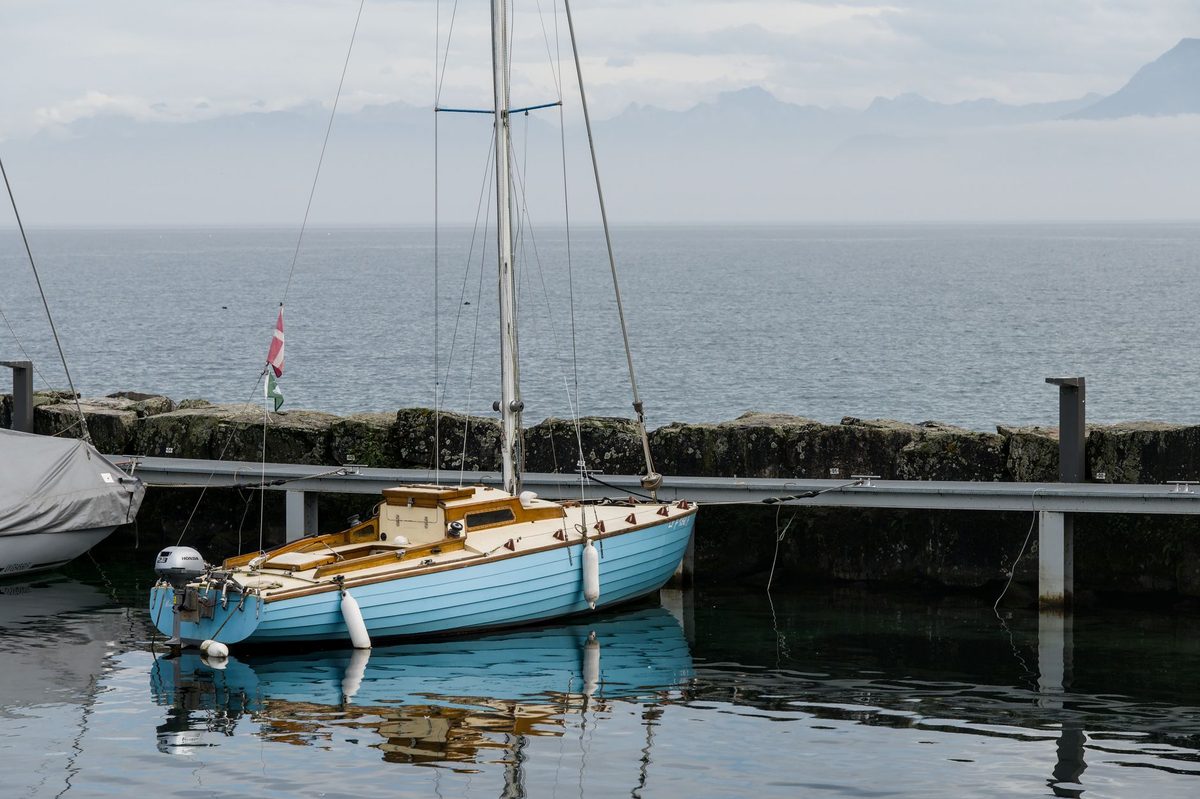
06 — Wildlife, fish and the famous Leman trout
Lake Geneva supports about 25 species of fish, several of them commercially important, and one, the fera (a whitefish), is locally endemic. The fera is the staple on Genevan menus, usually lightly grilled with lemon and a Lavaux white. Other big names are perch (perche du Leman, almost always served as small filets meuniere), pike, brown trout, char, and the introduced lake trout that grows to real size in the cold deep water of the Grand Lac.
The wildlife runs well beyond fish. Up to 50,000 wintering waterbirds use the lake each year, including pochard, tufted duck, coot and great crested grebe, and the Rhone delta at Le Bouveret is a Ramsar-listed wetland and one of Switzerland’s most important inland bird reserves. Beavers, reintroduced in the 1950s, now have a stable population along the tributaries. The lake’s ecological story has been mixed: severe phosphorus pollution in the 1960s and 1970s caused algal blooms and fish collapses, but phosphate bans in detergents in the 1980s plus regional wastewater treatment have cut phosphorus by about 80% since the peak. The lake is now classified as oligotrophic and the water is generally swimmable. Current challenges are microplastics, invasive quagga mussels (established since 2015) and climate-driven shifts in thermal stratification.
07 — Towns and villages around the lake
Driving the full perimeter is a 200-km round trip that eats most of a day, past a near-continuous chain of towns and villages with distinct characters.
On the Swiss northern shore, west to east: Geneva (the western tip and international hub), Versoix (a commuter town with a good Saturday market), Coppet (a tiny village with the chateau where Germaine de Stael held her salon in the 1810s), Nyon (Roman origins, a fortified castle, the Paleo festival in July), Rolle and Morges (wine country, with Morges famous for its spring tulip festival), Lausanne (the second-largest city on the lake, the Olympic capital, home of the IOC), then Vevey and Montreux at the eastern end (Chaplin lived in Vevey; Queen and Freddie Mercury recorded in Montreux, whose jazz festival is the most famous event on the lake’s calendar), finishing at Villeneuve.
On the French southern shore, east to west: Saint-Gingolph (a village split in half by the border, one side French and one Swiss), Evian-les-Bains (the spa town that names the water, still drawing wellness tourism), Thonon-les-Bains (the largest French town on the lake), and Yvoire (a medieval village on a small peninsula, one of the official Most Beautiful Villages of France, and a deserved tourist magnet in summer). For day-trip ideas from the city, see our day trips from Geneva pillar.
08 — Lavaux and the lakeside vineyards
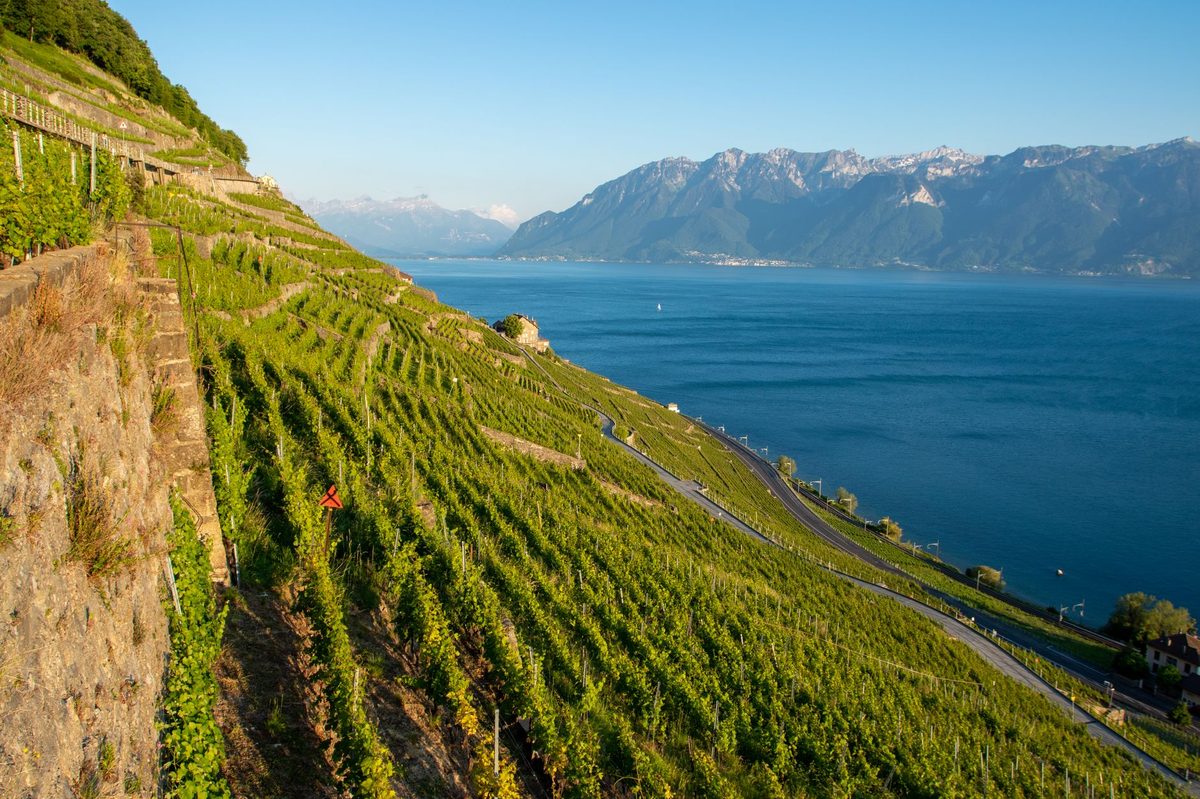
The Lavaux terraces, running 30 kilometres along the steep north shore between Lausanne and Vevey, are one of the great cultural landscapes of Europe and a UNESCO World Heritage Site since 2007. They have been worked continuously since the eleventh century, when Cistercian monks from the Abbey of Montheron planted the first vines, and now cover about 830 hectares producing some of Switzerland’s best whites, mostly from the local Chasselas grape.
They are also a feat of vernacular engineering. The slopes rise from the shore at gradients up to 100%, and the dry-stone walls that hold the terraces are reckoned to total over 400 km in cumulative length, built and rebuilt by hand for nearly a thousand years; damaged sections are still reconstructed every winter. The three suns of Lavaux give the vineyards an effective climate well above what the latitude suggests, ripening grapes that would struggle on flatter ground. They are easy to visit, too: the Train des Vignes runs between Vevey and Puidoux-Chexbres, the Lavaux Express tourist train trundles through the terraces from Lutry, and the walking trails linking Saint-Saphorin, Rivaz, Epesses, Cully and Lutry are among the most rewarding short hikes in Switzerland, with cellars open for tasting (often Saturdays only outside summer, so check ahead). For broader vineyard touring see our Geneva wine tasting guide.
09 — Lake Geneva in literature and music
Few stretches of water have drawn more writers. Jean-Jacques Rousseau set La Nouvelle Heloise (1761) on the eastern shores near Vevey, a novel whose popularity helped launch the European Romantic tradition. Lord Byron’s The Prisoner of Chillon (1816) came out of a visit to the castle’s dungeon, and his Childe Harold Canto III, from the same summer, holds some of his finest lake scenery. Mary Shelley wrote Frankenstein at the Villa Diodati in Cologny in the summer of 1816; for the full story see our famous people from Geneva guide. John Polidori began The Vampyre, the first English-language vampire novel, at Diodati that same summer.
Later, Henry James set parts of Daisy Miller (1878) at Vevey, Hemingway wrote sections of A Farewell to Arms in Montreux, and Vladimir Nabokov lived at the Montreux Palace from 1961 until his death in 1977, buried at Clarens. Musically, Tchaikovsky composed much of Eugene Onegin at a villa in Clarens, Stravinsky wrote portions of The Rite of Spring there in 1912, and Deep Purple’s Smoke on the Water (1972) commemorates the burning of the Montreux Casino during a Frank Zappa concert, with a Freddie Mercury statue on the lakefront now looking out at the spot.
10 — The Chateau de Chillon
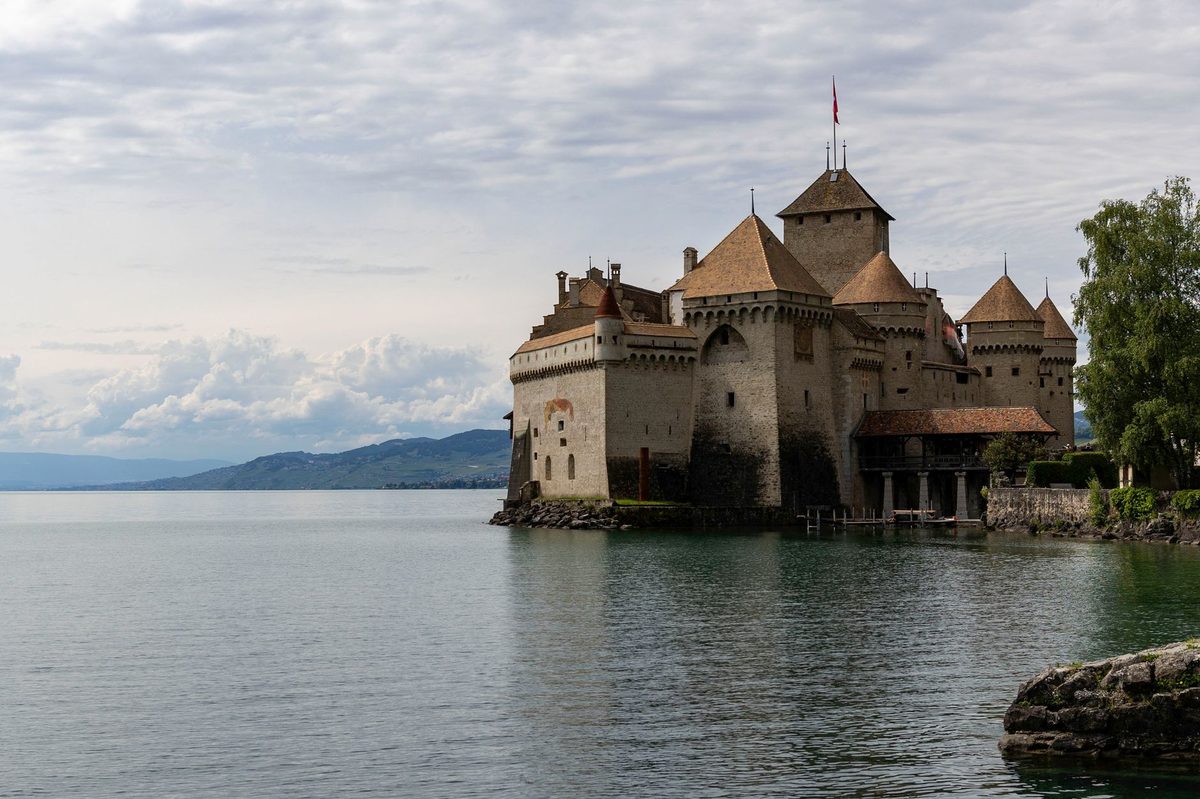
The most-visited historic monument in Switzerland sits on a small rocky island just off the eastern shore between Montreux and Villeneuve. The Chateau de Chillon is a medieval water castle, first documented in 1005, that controlled the road between the Alpine passes and the lake. The Counts of Savoy held it from the twelfth century until 1536, when the Bernese seized it during the campaign that pried the lake region from Savoy.
Its most famous chapter is the imprisonment of Francois Bonivard, the Genevan prior and reformer chained in the dungeon from 1530 to 1536. Byron’s 1816 visit and the resulting poem made the dungeon one of the great Romantic literary sites in Europe; you can still see the pillar where Bonivard was chained and Byron’s autograph carved into a nearby column (probably authentic, possibly an early forgery; historians disagree). Chillon is a 90-minute train ride from Geneva and a near-perfect day trip, adult admission around CHF 14, open daily, two hours minimum. For more ideas see our day trips guide.
11 — How to experience the lake as a visitor
Five ways, ranked by how much of the lake you actually see.
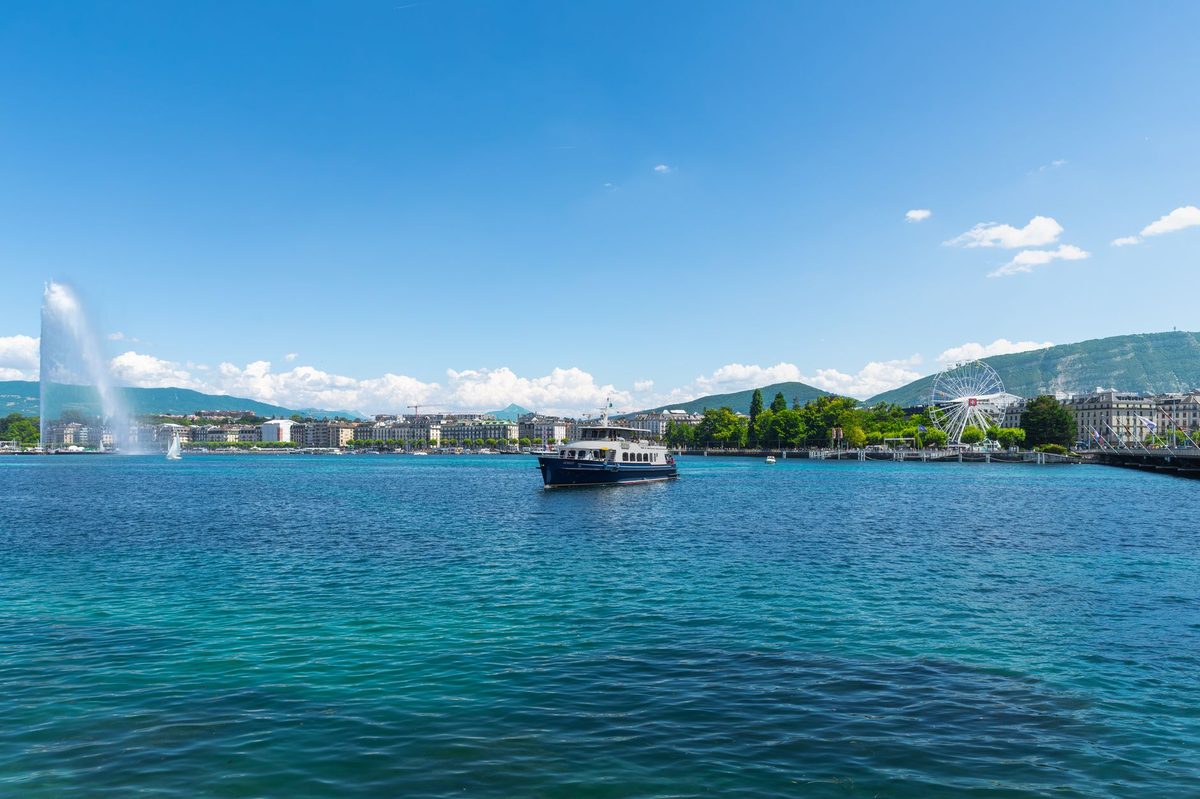
1. The CGN steamer cruise. The Compagnie Generale de Navigation runs scheduled passenger services around the lake, including five beautifully preserved Belle Epoque paddle steamers. The full Tour du Lac takes around 13 hours and is one of the most rewarding day-long experiences in Switzerland; shorter Geneva to Yvoire and Geneva to Nyon runs are easy and cheap, and Swiss Travel Pass holders ride free. See our Lake Geneva boat cruises guide.
2. The lakeshore cycle path. EuroVelo Route 17, the Rhone Cycle Route, follows the north shore from Geneva to Villeneuve, with extensions east and west. The full circumnavigation is around 200 km and a popular two- or three-day trip, while the flatter sections near Geneva are excellent for short rides. See our cycling routes around Geneva guide.
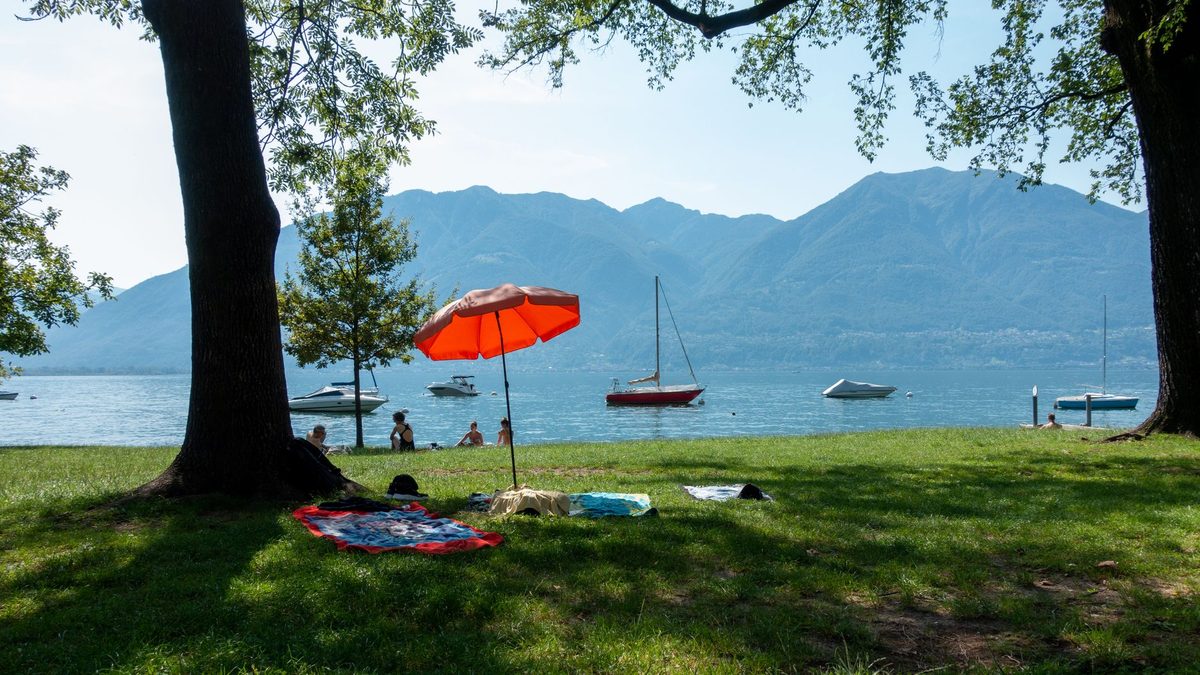
3. Swimming. Public swimming spots line the shore, the most famous being Bains des Paquis in Geneva itself, with lake swimming all year, summer beaches and a perpetually steamed Turkish bath. See our Bains des Paquis guide and our lake swimming beaches guide.
4. The Lavaux walk. The Lutry to Saint-Saphorin walk through the terraces is one of the great short hikes in Europe: 11 km, three hours, mostly downhill, finishing at lakeshore cafes. Take the train back. Best in late September when the leaves turn.
5. Water sports. Sailing schools, paddle-board and wakeboard rentals, windsurfing clubs and lake kayaking are all available around the shore, and Geneva itself has several Societe Nautique clubs. See our water sports on Lake Geneva guide.
For trip planning see our trip planning pillar, the getting around guide and things to do in Geneva.
Frequently asked questions
How big is Lake Geneva?
It is the largest natural lake in Western Europe: surface area 580 km2, length 73 km from Geneva to Villeneuve, maximum width 14 km, maximum depth 310 metres. About 60% of the surface is in Switzerland and 40% in France. It is large enough to take three days to walk around at a good pace.
Why is it called both Lake Geneva and Lac Leman?
The lake has had two names for centuries. The Latin Lacus Lemannus, used by Julius Caesar, gave the French Lac Leman, the standard local name on both shores. Lake Geneva, after the city at its western tip, has been the standard English name since at least the seventeenth century. Both are correct and refer to exactly the same body of water.
Is Lake Geneva swimmable?
Yes. Water quality is generally excellent and monitored regularly. Summer surface temperatures reach 22 to 24 degrees in July and August, so the swimming season runs comfortably from mid-June through mid-September, with cold-water regulars at the Bains des Paquis swimming year-round. See our beaches and swimming guide.
How deep is Lake Geneva?
Maximum depth 310 metres in the Grand Lac between Lausanne and Evian, average depth 154 metres. It is the second-deepest lake in Switzerland after Lake Maggiore, though Maggiore is shared with Italy.
Did a tsunami really hit Geneva in 563 AD?
Yes. The Tauredunum event, a massive rockfall above the lake’s eastern end, generated a tsunami that surged west, sweeping away the bridges of Geneva and drowning people in the lower town. Two near-contemporary chroniclers describe it, and sediment-core evidence published in 2012 by a University of Geneva team confirmed the geological event. It is the only documented tsunami in central European history, with modelling suggesting waves up to 13 metres at the western end.
What is the best time to visit Lake Geneva?
May to early October is the easy answer, for swimming, sailing, cycling and terrace eating. Winter from November to March is quieter but beautiful, with snow-covered Alps reflected in the dark blue lake on clear days. Late September is the best Lavaux time, with the vineyard leaves turning gold. See our best time to visit guide.
12 — Related Geneva guides
Keep exploring the water and the wider region with the Geneva outdoor activities pillar, our boat cruises guide, the day trips from Geneva roundup, the trip planning pillar, and things to do in Geneva.