Geneva's History, Heritage & International Importance
Geneva and the Reformation — How Calvin’s Republic Changed the World
This article contains advertising. Our booking links are routed through a partner that adds commission tracking automatically, so if you book through one we earn a commission from the provider, at no extra cost to you. It never affects what we recommend. Affiliate disclosure
Most cities that went through the Reformation pulled down a few statues and moved on. Geneva built a whole republic around it. For nearly thirty years between 1536 and 1564, a town of perhaps 13,000 people (flooded with refugees, run by a council of fifty merchants, and theologically directed by a French lawyer named Jean Calvin) became the most ambitious religious laboratory in Europe. John Knox called it “the most perfect school of Christ that ever was in the earth.” His enemies called it a theocracy. The truth sits somewhere in between, and the legacy of the Geneva Reformation is still everywhere you look.
You can read it in the stripped-down cathedral you can still walk into, in the watchmaking trade that refugees founded here, in the Geneva Bible the Pilgrims carried on the Mayflower, and in a political tradition that runs from Calvin’s General Council to American constitutional democracy. This is the long story. For the wider sweep, start at the Geneva history and heritage pillar, and if it has you wanting to walk the sites yourself, the things to do in Geneva guide and the trip planner will get you out the door.
01 — Before the Reformation: a Catholic prince-bishopric
To understand what changed in 1536 you have to understand what Geneva had been before. The city was technically an imperial free city ruled by a prince-bishop, in practice a three-way wrestle between the bishop, the dukes of Savoy (who appointed the bishop more often than not), and an increasingly assertive citizenry organised in the General Council. The citizens elected four magistrates called syndics, ran their own courts, and had won a written charter of liberties, the Franchises of Adhemar Fabri, as far back as 1387.
By the early sixteenth century the political situation was untenable. Savoy wanted to absorb Geneva outright. The bishops had grown indistinguishable from Savoyard agents. Two patriotic factions emerged among the citizens: the Mamelukes, who accepted Savoyard influence as the price of peace, and the Eidguenots (the word that gave English “Huguenot”), who wanted to break free entirely. In 1526 the Eidguenots won out and Geneva signed a combourgeoisie, a mutual citizenship treaty, with the Swiss cities of Bern and Fribourg. Independence was on the table for the first time in centuries.
Religion at this point was almost irrelevant. Geneva was Catholic, like everyone around it. The Reformation reached the Swiss cantons through Huldrych Zwingli in Zurich (1519) and through Bern (which converted in 1528), but Geneva remained Catholic for nearly a decade longer. The fuse was lit in 1532, when a fiery French preacher named Guillaume Farel arrived in town.
02 — Farel’s rough preaching and the vote of 1535
Guillaume Farel was 43 years old when he first preached in Geneva. He had been born in the French Dauphine, converted to evangelical religion in Paris, and spent most of the previous decade as an itinerant missionary in French-speaking Switzerland, often one step ahead of a mob. Contemporary descriptions are unanimous on two points: he was physically small and rhetorically gigantic. A booming voice, a red beard, and no instinct for diplomacy whatsoever.
Farel preached in Geneva on and off for three years against violent Catholic opposition. He was attacked in the street, denounced from pulpits, expelled and readmitted. But his message (that the mass was an idolatrous betrayal of biblical Christianity, that priests had no special authority, that the only sources of religious truth were Scripture and individual conscience) found a receptive audience among the same Eidguenot faction that had pushed for independence from Savoy. Politically the two movements were inseparable: rejecting the bishop meant rejecting Catholicism, and vice versa.
In August 1535 the General Council suspended the mass and ordered the removal of Catholic images from the city’s churches. A formal vote on the Reformation was scheduled for the following spring.
03 — 21 May 1536: Geneva votes for the Gospel
On 21 May 1536, the General Council of Geneva, meeting in front of the Hotel de Ville with every adult male citizen present, voted by a show of hands to “live according to the Gospel and Word of God” and to abolish “all papal abuses.” The vote was effectively unanimous. Geneva had become, by formal democratic decision of its citizens, a Protestant republic.
The political timing was deliberate. The previous winter Bern had launched a war that drove Savoy out of the entire region around Lake Geneva, lifting the military threat that had hung over the city for decades. The bishop had already fled. The Catholic clergy had mostly left. The vote was a public confirmation of facts on the ground, but it was also a foundational political act, the moment when religious affiliation, citizenship, and republican identity fused into a single thing called Genevan.
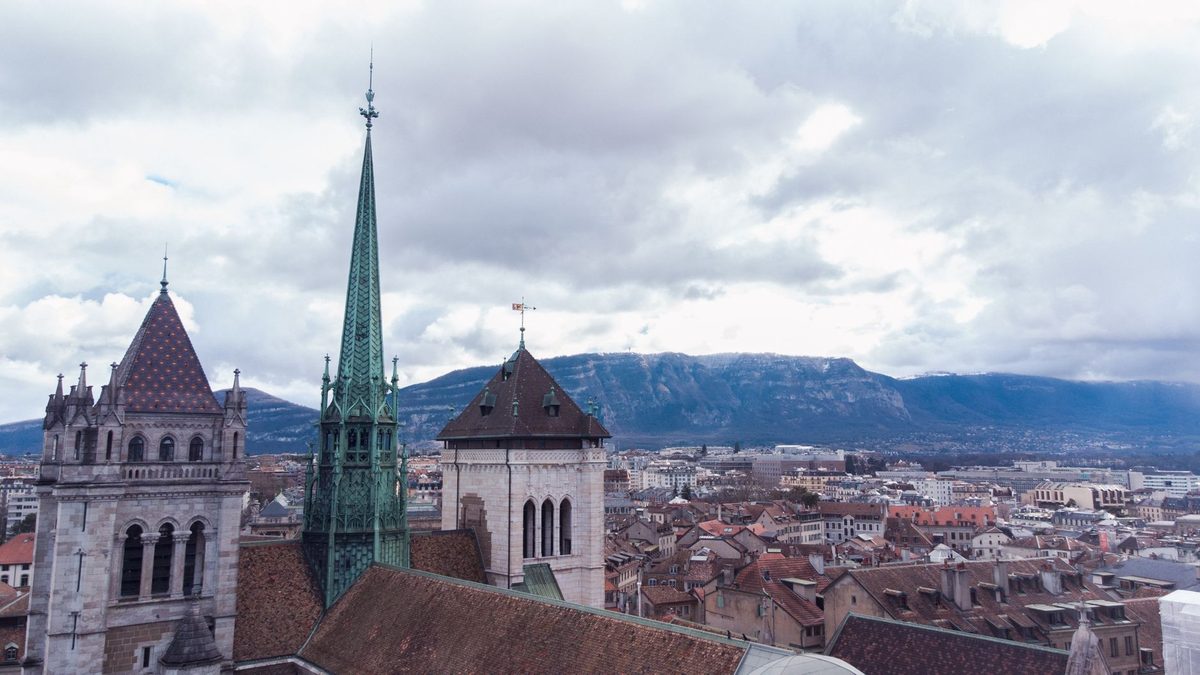
The visual revolution was just as dramatic. Within months the city’s churches were whitewashed inside and out. Statues of saints were removed, stained glass was smashed, altars were taken down, and pews replaced the open floors where worshippers had previously stood through mass. Walk into Saint-Pierre today and you are walking into a Reformation church: austere, stripped, focused on the pulpit rather than the altar. Even the modern stained glass installed in the nineteenth century is conspicuously plain.
04 — Enter Jean Calvin
In July 1536, two months after the Reformation vote, a 27-year-old French theologian was passing through Geneva on his way from Italy to Strasbourg. He had spent the previous year in Basel, where he had published the first edition of Institutio Christianae Religionis, the Institutes of the Christian Religion, the most systematic Protestant theology written to date. His name was Jean Calvin. He intended to stay in Geneva for a single night.
Farel found him at the inn. By Calvin’s own account, the older preacher delivered such a dramatic ultimatum (accusing Calvin of choosing scholarly comfort over the work of God, calling down divine curses on his plans) that Calvin felt physically unable to leave. He stayed. He would spend most of the next 28 years in the city, leading what became the most consequential urban Reformation in Europe.
Calvin was not a charismatic preacher in the Farel mould. He was a former law student, methodical, scholarly, and personally reserved. His tools were systematic theology, a relentless preaching schedule (often twice a day, working through entire books of the Bible verse by verse), and an extraordinary ability to organise. Within months of his arrival he had drafted a comprehensive constitution for the Genevan church, the Articles of 1537, covering everything from the order of services to the structure of pastoral authority to the moral discipline of members.
05 — The expulsion and return (1538 to 1541)
The first attempt to implement Calvin’s vision lasted barely 20 months. The 1537 Articles tried to enforce universal subscription to a confession of faith and to make the church, not the civil magistrate, the gatekeeper of who could take communion. The General Council balked. The political class, many of them old Eidguenots who had risked their lives for civic, not religious, reasons, was not prepared to hand spiritual authority to a 28-year-old French refugee. In April 1538 Calvin and Farel were both expelled from the city.
Calvin spent the next three years in Strasbourg, pastoring a French refugee congregation, marrying a widow named Idelette de Bure, and refining his theological method. He also kept writing to Geneva. When a faction unfavourable to the Reformation gained influence in 1539, the Genevan authorities tried to lure Calvin back. He resisted. By 1541 they were begging. In September of that year he returned, on his own terms, and immediately presented the council with a new constitution: the Ecclesiastical Ordinances of 1541.
The Ordinances created the framework that would define Calvinist church government for the next four centuries. They distinguished four orders of ministry (pastors, teachers, elders, and deacons) and established a body called the Consistory that would meet weekly to oversee the spiritual and moral life of the city. The Consistory was the most controversial institution of Calvin’s Geneva, and it deserves a section of its own.
06 — The Consistory, morals, and what living under Calvin actually meant
The Consistory was a hybrid body: roughly half pastors and half lay elders elected from the General Council. It met every Thursday and worked through cases referred to it by ministers, magistrates, or ordinary informers. Its jurisdiction was theoretically spiritual: it could call people in for questioning, rebuke them, and ultimately bar them from communion. It could not impose fines, imprisonment, or corporal punishment; those required the civil magistrates. But in practice the boundary between spiritual and civil discipline was porous, and the Consistory and the Small Council reinforced each other.
What did people actually get summoned for? Surviving Consistory records (the historians Robert Kingdon and Thomas Lambert published edited volumes of them in the late twentieth century, and they make sobering reading) cover an enormous range. Domestic violence (the Consistory consistently sided with battered wives, an unusual position for the era). Wife-beating husbands were frequently referred for civil prosecution. Drunkenness. Brawling. Dancing at weddings (forbidden). Saying mass in private (forbidden). Card games (forbidden). Giving children obviously Catholic baptismal names like “Claude” after a regional saint (technically forbidden, increasingly tolerated). Fornication and adultery (frequent, and dealt with relatively harshly). Speaking ill of pastors (specifically dealt with).
Some of this looks oppressive to modern eyes and was oppressive by any standard. But the records also reveal something easy to miss: the Consistory dealt with marital reconciliation more than any other single topic, and its handling of women was often more protective than the civil courts of the day. People appealed to the Consistory voluntarily to resolve disputes. The institution was not a one-way panopticon; it was an attempt (heavy-handed, sometimes appalling, sometimes effective) to build a functional civic morality in a city that had quadrupled in size in twenty years and was full of refugees who did not know each other.
07 — Michael Servetus and the dark chapter
No account of Calvin’s Geneva is honest without Michael Servetus. Servetus was a Spanish physician and theologian who had written a series of books denying the doctrine of the Trinity. He was already condemned to death in absentia by the Catholic Inquisition in Vienne when he arrived in Geneva in August 1553. He attended a service at the Madeleine, where Calvin was preaching, and was recognised. He was arrested.
The trial took two months. Servetus was found guilty of heresy and blasphemy and condemned to be burned alive. The sentence was carried out at Champel, on a hill south of the city, on 27 October 1553. Calvin requested that Servetus be beheaded instead, as a lesser punishment; the request was refused. The execution shocked Protestant Europe almost as much as Catholic Europe.
The Servetus case is not a footnote. It is the central moral problem of Calvin’s Geneva, and it provoked one of the first sustained Protestant arguments against the death penalty for heresy: Sebastian Castellio’s 1554 treatise Concerning Heretics, Whether They Are to Be Persecuted, written specifically in response. Modern Geneva has not tried to bury this. In 1903 a stone monument was erected at Champel publicly acknowledging the execution as “an error of his time” and asking forgiveness. The plaque is still there, on Rue Beau-Sejour. The Consistory of the Reformed Church publicly apologised again in 2011. It is a useful corrective to any romanticised reading of the period.
08 — The Geneva Academy and the export of Calvinism
Calvin’s most lasting institutional creation was educational. The Academie de Geneve, founded in 1559 with Theodore Beza as its first rector, was a two-tier school: a schola privata for boys aged 6 to 16, and a schola publica for advanced students, what we would now call a college and a university combined. The curriculum included biblical languages, theology, classical literature, mathematics, and law. Students came from across Europe. The Academy’s graduates fanned out to Reformed churches in France, the Netherlands, Scotland, the Palatinate, Hungary, and eventually New England.
The Academy is still operating. It became the University of Geneva in 1873, and it sits at the foot of Parc des Bastions, directly facing the Reformation Wall. If you want to see the through-line from Calvin’s school to a working modern research university, all you have to do is stand on Place Neuve and look in either direction.
09 — The Protestant refuge and what it did to the city
The most quantifiable effect of the Reformation on Geneva itself was demographic. Between 1542 and 1560 the city’s population roughly doubled, from around 13,000 to around 25,000, almost entirely through immigration. French Huguenots fleeing royal persecution made up the largest group, but the refugees included English Marian exiles (1553 to 1558, when the Catholic Mary I was on the English throne), Italian Reformed dissenters, Spanish converts, and a steady trickle from the Netherlands and Germany.
The economic consequences were extraordinary. Many of the refugees were skilled urban craftspeople: printers, watchmakers, jewellers, silk weavers, bankers. Catholic guilds across Europe were closed to them, so they invented new ones in Geneva. The watchmaking industry is the textbook case. Calvin had banned the wearing of jewellery as a vanity, but he had no objection to clocks and watches; the city’s existing jewellers and goldsmiths pivoted to the timepiece trade and were soon joined by refugee specialists. By 1601 there were enough watchmakers in Geneva to form a guild, the Maitrise des Horlogers, the first independent watchmaker’s guild in the world. For the full watchmaking story see our watchmaking heritage guide.
Printing did even better. By the 1560s Geneva was one of the most important printing centres in Europe, producing French-language Bibles, theology, polemic, and political works for export across the continent. The Geneva Bible, an English translation produced by the Marian exiles between 1557 and 1560, became the most widely-read English-language Bible until the King James Version of 1611, and the version that the Pilgrim Fathers carried with them to Plymouth in 1620. American Puritanism reads Calvin through Geneva-printed English text.
10 — After Calvin: Beza and the long Reformation
Calvin died on 27 May 1564, aged 54. According to his wishes he was buried in an unmarked grave at the Plainpalais cemetery; the modern marker reading “J.C. 1564” is purely symbolic, and no one is certain of the exact spot. His successor as the de facto leader of the Genevan church was Theodore Beza, a French nobleman-turned-theologian who had been at his side since 1558.
Beza ran Genevan Reformed Protestantism for the next four decades. He systematised Calvin’s theology, took the lead in the international Reformed church, and presided over the academy’s golden age. By the time of his death in 1605, Geneva’s Reformation was no longer a startup; it was an established institution exporting pastors, theology, and political ideas to half of Protestant Europe.
11 — The Reformation’s economic and political legacy
Max Weber’s Protestant Ethic and the Spirit of Capitalism (1905) famously argued that Calvinism, with its doctrine of vocation and its disciplined attitude to work and saving, was a precondition for the rise of modern capitalism. Historians have argued about this for more than a century. Whether or not the causal arrow runs the way Weber claimed, the correlation in Geneva is striking. By 1700 the city was producing more luxury timepieces per capita than anywhere in Europe and had one of the most sophisticated banking sectors on the continent. Genevan bankers became central figures in French royal finance under Louis XV and Louis XVI; Jacques Necker, the finance minister whose dismissal helped trigger the French Revolution in 1789, was a Genevan Protestant.
Politically, Calvin’s Geneva ran on a model that historians sometimes call republican Calvinism: a covenanted community of believers governing themselves through elected councils and answerable to a written constitution. That model travelled. The Scottish Presbyterian system, the Dutch Reformed Church, the New England Congregationalist colonies, and ultimately American constitutional democracy all owe direct intellectual debts to the Genevan model. James Madison studied under John Witherspoon at Princeton; Witherspoon was a Scottish Presbyterian whose theology came directly out of Calvin’s Geneva. The line from Geneva to Philadelphia is not metaphorical.
12 — Where to see the Reformation in Geneva today
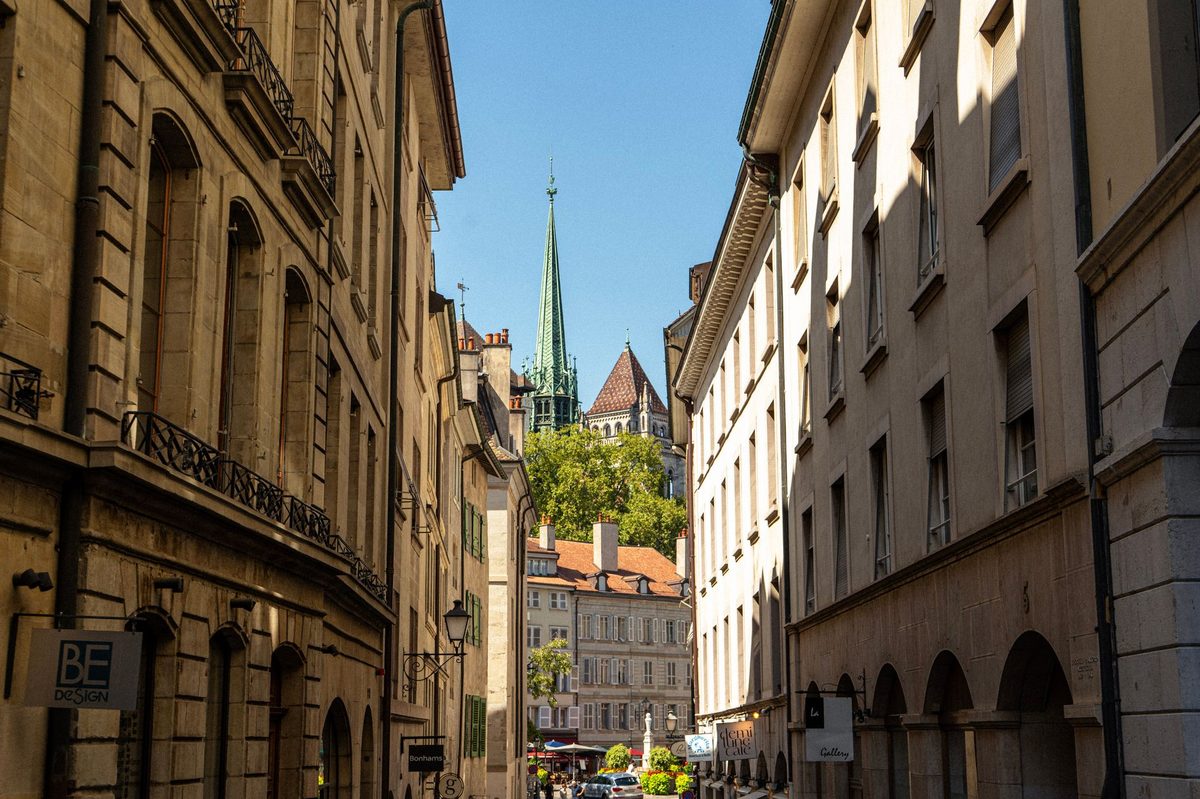
Five places in central Geneva tell the story without you needing a guidebook.
Cathedrale Saint-Pierre. Calvin’s pulpit church. The wooden chair he sat on is still in the nave, marked with a small plaque. The Archaeological Site below the cathedral (separate ticket, around CHF 8) shows the Roman, Burgundian, and medieval layers that the Reformation inherited and stripped.
Auditoire de Calvin. The small chapel just south of the cathedral where Calvin gave his weekday lectures and where John Knox preached to the English-speaking Marian exiles. Still in use as a place of worship for the English-speaking Reformed community. Usually open during cathedral hours.
International Museum of the Reformation (MIR). Built into a handsome old town building called the Maison Mallet, this museum is the single best introduction to the Reformation in Geneva. Original sixteenth-century prints, Calvin manuscripts, Genevan Bibles. Excellent English signage. Around CHF 13 admission. A combination ticket with the cathedral and the archaeological site is good value.
Reformation Wall (Mur des Reformateurs). The 100-metre-long monumental sculpture in Parc des Bastions, unveiled in 1909 for Calvin’s 400th birthday. Calvin, Farel, Beza, and Knox in the centre, each 4.5 metres tall, flanked by historical scenes and quotations. Free, open 24 hours. The park around it is one of the loveliest in central Geneva.
The Plainpalais cemetery. Where Calvin was buried, in an unmarked grave that is now marked symbolically with “J.C. 1564.” The Argentinian writer Jorge Luis Borges, who died in Geneva in 1986, is buried in the same cemetery, a quiet pilgrimage for literary travellers.
For the rest of Geneva’s old town and the broader sweep of history see our complete history guide, the museums and culture guide, and our Old Town walking guide. To turn it into an actual trip, sort where to stay in Geneva first.
Frequently asked questions
When did Geneva become Protestant?
The General Council voted to “live according to the Gospel and Word of God” on 21 May 1536, formally adopting the Reformation. The decision was effectively unanimous, taken by show of hands in front of the Hotel de Ville with every adult male citizen present.
Who was John Calvin?
Jean Calvin (1509 to 1564) was a French theologian, lawyer, and pastor who led the Reformed church in Geneva from 1536 to 1538 and again from 1541 until his death. His Institutes of the Christian Religion remains the most influential single work of Protestant systematic theology, and the church order he developed in Geneva became the template for Reformed churches across Europe and the Americas.
What did Calvin actually rule in Geneva?
Calvin held no political office. He was simply the senior pastor of the Genevan church and a member of the Consistory. Real political power lay with the Small Council, the Council of Two Hundred, and the General Council of all citizens. His influence came from preaching, writing, and personal authority. He was not even a Genevan citizen until 1559, five years before his death.
Did Calvin burn Servetus?
Calvin played the central theological role in prosecuting Michael Servetus for heresy in 1553, and the conviction and execution would not have happened without him. He did not light the fire (the city authorities carried out the sentence) and he requested that Servetus be beheaded rather than burned, which was refused. The Genevan Reformed Church publicly apologised for the execution in 2011, and a stone memorial at Champel has marked the site since 1903.
What is the Geneva Bible?
The English translation of the Bible produced in Geneva by Marian exiles between 1557 and 1560. It was the first English Bible to use verse numbers, the first widely distributed in Roman type rather than blackletter, and the most widely-read English Bible for the next fifty years. The Pilgrim Fathers carried it to America in 1620.
Where is the Reformation Wall?
In Parc des Bastions, immediately south of Place Neuve in central Geneva. The wall is 100 metres long, was unveiled in 1909, and features four central figures (Calvin, Farel, Beza, Knox) each 4.5 metres tall. Free, open 24 hours, accessible by tram 12 or 18 to Place Neuve.
13 — Related Geneva guides
Keep going with the Geneva history and heritage pillar, the full history of Geneva, the watchmaking heritage story, the museums and culture guide, the things to do in Geneva overview, and the practical trip planner and where to stay pages.