Geneva Airport to the Ski Resorts: Complete Transfer Guide
This article contains advertising. Our booking links are routed through a partner that adds commission tracking automatically, so if you book through one we earn a commission from the provider, at no extra cost to you. It never affects what we recommend. Affiliate disclosure
Geneva Airport sells itself as the gateway to the Alps, and the phrase is doing a lot of work. What it actually means is that GVA sits roughly an hour from some of the best skiing in France and roughly three hours from some of the most famous, and the difference between those two numbers is where most ski holidays go wrong. People book Val Thorens because they have heard of it, land at 14:00 on a Saturday, and reach the resort at 18:30 in the dark, having spent more time on the A41 than they will spend on a chairlift that day.
A Geneva airport ski transfer costs somewhere between €35 and €85 per person each way on a shared shuttle, or roughly €150 to €550 per vehicle for a private one, and takes anything from about an hour to Les Houches to around three hours to Val Thorens, longer on a bad Saturday. Shared shuttles win on price for one or two people, private transfers win from about four people upwards, the scheduled weekend coaches start at £36.50 one way if your flight times cooperate, and for exactly three destinations — Chamonix, Verbier and the Tarentaise resorts above Bourg-Saint-Maurice — the train is genuinely competitive rather than a compromise.
This guide covers every route out of Geneva Airport into the Alps, with real road distances, honest journey times that assume winter traffic rather than an empty motorway, and the specific cases where the option everyone books is the wrong one. It sits alongside our guides to skiing near Geneva, which helps you choose the resort in the first place, and where to stay near Geneva for skiing. This page is about getting there and nothing else — no resort reviews, no hotel lists, just the logistics.

01 — Geneva airport ski transfers at a glance
| Option | Typical cost | Best for | The catch |
|---|---|---|---|
| Shared shuttle | €35–85 pp each way | 1–3 people, flexible timing | You wait for the vehicle to fill and stop at other resorts |
| Private transfer | €150–550 per vehicle | 4+ people, families, late flights | Fixed price whether the car is full or not |
| Scheduled coach | £36.50–51.50 pp each way on Ben’s Bus, before extras | Saturday and Sunday arrivals | Weekends only, and fixed departure times |
| Train | CHF 40–80 pp each way | Chamonix, Verbier, Tarentaise | Changes, and you carry your own skis |
| Hire car | €250–450 per week plus fuel | Touring several resorts | Winter tyres, chains, vignette, resort parking |
02 — The five ways out of Geneva Airport
Shared shuttle
A minibus with eight to sixteen seats that you book by the seat. The operator groups you with other passengers arriving in the same window and heading to the same valley. Alpybus and Mountain Drop-offs are two of the operators running shared transfers from Geneva Airport; compare a few before you book.
The economics are simple: a shared shuttle is the cheapest door-to-door option for one or two people, and it stops being the cheapest at roughly four. It is also the option with the widest gap between the advertised price and the experience. Check what that €39 headline fare covers for your date and your drop-off before you book, and expect the vehicle to make other pickups and drops on the way, which adds time.
- Point-to-point drops everyone at a single central stop in resort. Cheapest, and fine if your accommodation is walkable.
- Door-to-door takes you to your chalet or hotel. Costs more and adds time, because everyone else on board gets the same service.
- Express line is a scheduled shared service that runs to a timetable rather than waiting for your flight. Cheap, but a delayed flight means you buy a new ticket.
Private transfer
A vehicle booked for your group alone, meeting your specific flight and tracking it if you are late. Prices start around €150 per vehicle for Chamonix and climb to roughly €400–550 for Tignes or Val d’Isère, for a car or minibus carrying up to eight. You pay per vehicle rather than per seat, so the price falls per head as the group grows; operators such as Alpybus run several vehicle sizes, including eight-seaters.
The break-even point matters more than the headline number. If a shared seat to Val Thorens is €75 each way and a private minibus is €450, then four people pay €600 shared and €450 private. Four is the number. Below four, share; at four or above, book the vehicle. Families with small children should treat the break-even as three, because a private transfer is the only way to guarantee the child seats you need and the only way to leave when the toddler is ready rather than when the eleventh passenger clears baggage reclaim.
Scheduled coach
Ben’s Bus runs Geneva Airport transfers on Saturdays and Sundays through the 2026/27 season, and the fare depends on where you are going: £36.50 single or £63.50 return to Flaine and Les Carroz, £51.50 single or £96 return to Tignes and Val d’Isère, before extras. Season dates vary by route, so check the timetable for yours. It serves the Tarentaise widely — Val Thorens, Méribel, Les Menuires, Tignes, Val d’Isère, Les Arcs, La Plagne, Bourg-Saint-Maurice — and goes as far as Moûtiers for Courchevel, where you need separate onward transport. It also runs to Flaine and, new for this season, Les Carroz. Altibus runs the equivalent French domestic network, and its Alpski line connects Geneva Airport directly into the Tarentaise through the winter.
The trade-off is rigidity. These are timetabled coaches with a handful of daily departures, almost all on Saturdays and Sundays, and they will not wait for a delayed flight. If you are on a Saturday charter and your resort is on the list, this is the cheapest sensible way to travel and you should book it months ahead. If you land on a Wednesday evening, it does not exist for you.
Train
Almost every transfer company would rather you did not know how good the train is to three specific destinations. For Chamonix, Verbier and the Tarentaise, rail is not a worthy-but-slower alternative — it is competitive on time, cheaper for solo travellers, and immune to the Saturday traffic that turns a two-and-a-half hour road transfer into four. Details are in the section below on when the train genuinely wins.
For everywhere else — Morzine, Avoriaz, Les Gets, La Clusaz, Flaine, Megève, Val Thorens itself — there is no useful railway, and anyone telling you otherwise is describing a train to a valley town followed by a bus you will wish you had not attempted with skis.
Hire car
Worth it if you plan to ski more than one area, staying somewhere with parking. Not worth it for a single-resort week in a car-free resort like Avoriaz, or anywhere your accommodation charges €15 a night to park a car you will not move for six days. The legal requirements are real and enforced — see the driving section below — and our Geneva car rental guide covers the city side of hiring.
03 — Which side of the airport you are picked up from
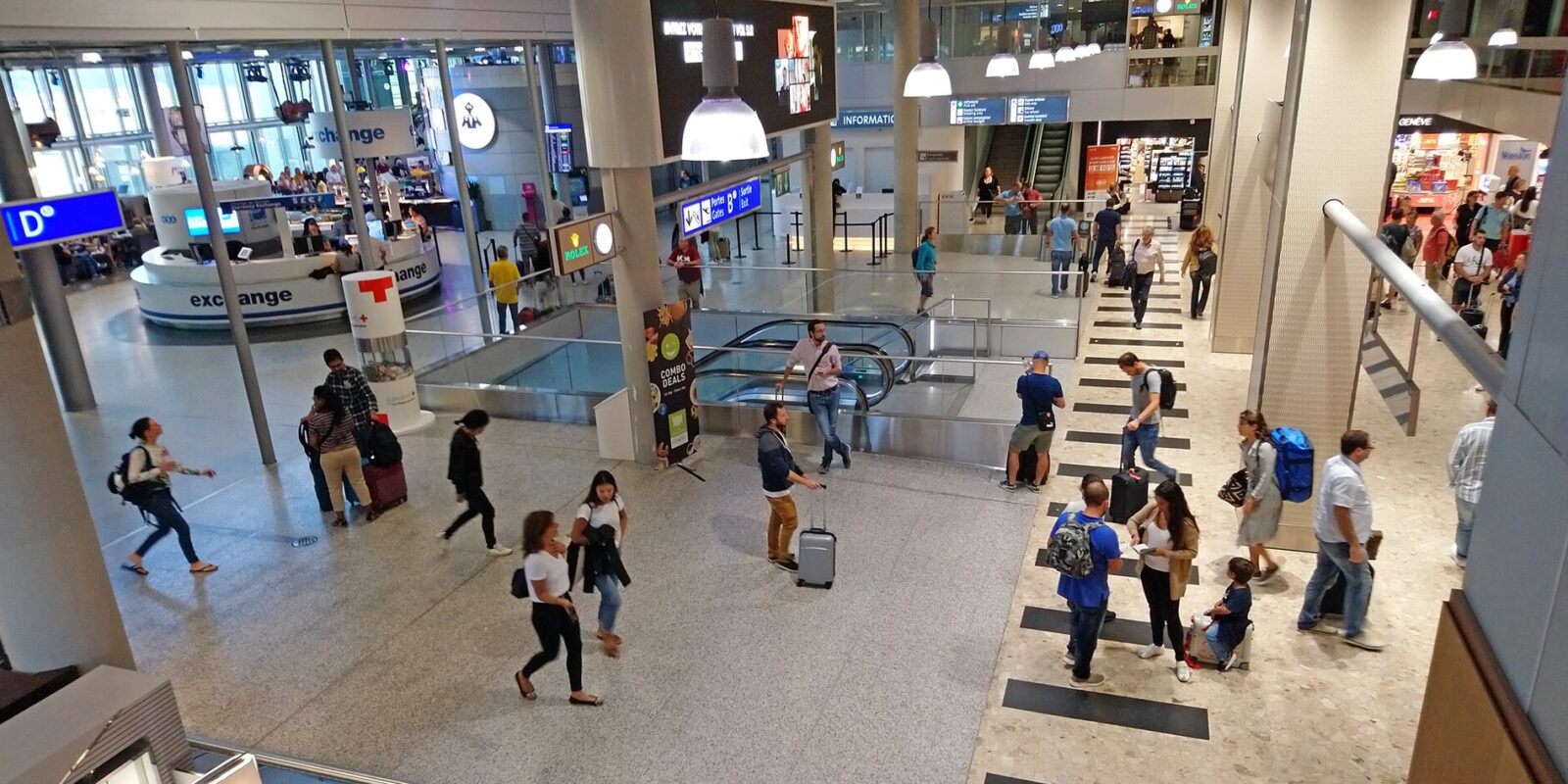
Geneva Airport straddles the border, with a Swiss sector and a French sector connected inside the building. This confuses a lot of first-time skiers, who reason that because their resort is in France they should exit into France.
Usually you should not. International arrivals normally pass through Swiss customs, while flights from France arrive directly in the France Sector, and taxis work on both sides. Ben’s Bus states explicitly that it collects on the Swiss side; with any other operator, confirm the collection point before you fly. Unless your booking confirmation says otherwise in writing, walk out of Swiss arrivals and find your driver there. The French sector matters for flights from France and for hire cars booked at the French desks, and almost nothing else on a ski trip.
One genuine consequence: if you hire a car from the French side you are on the French motorway network from the start and will not need a Swiss vignette, whereas hiring on the Swiss side and driving to Verbier means you do. That is the only decision the two sectors really affect for skiers.
04 — Resort by resort: distance, time and what to book
| Resort | Road distance | Typical transfer | Shared, one way | Best alternative |
|---|---|---|---|---|
| Les Houches (FR) | 82 km | 1h00 | €35–45 | Train via St-Gervais |
| Chamonix (FR) | 88 km | 1h05–1h20 | €35–50 | Train — genuinely good |
| La Clusaz / Grand-Bornand (FR) | 70–75 km | 1h05 | €40–55 | Bus via Annecy |
| Les Carroz / Samoëns (FR) | 70–75 km | 1h05–1h10 | €40–55 | Ben’s Bus (weekends) |
| Morzine (FR) | 75 km | 1h15 | from €24.50 (Alpybus) | Train to Cluses or Thonon + bus or taxi |
| Les Gets (FR) | 63 km | 1h15 | €40–55 | Train to Cluses (Y92 bus) or Thonon (Y91 bus) |
| Megève (FR) | 70 km | 1h15 | €40–60 | Train to Sallanches + bus |
| Flaine (FR) | 85 km | 1h20 | €45–60 | Ben’s Bus (weekends) |
| Avoriaz (FR) | 90 km | 1h30 + cable car | €45–60 | No direct train; by road, then cable car |
| Verbier (CH) | 160 km | 2h00 | CHF 60–90 | Train — genuinely good |
| Courchevel (FR) | 185 km | 2h30–3h00 | €55–80 | Ben’s Bus to Moûtiers (weekends), then onward transport |
| Méribel (FR) | 180 km | 2h30–3h00 | €55–80 | Ben’s Bus (weekends) |
| Les Arcs / La Plagne (FR) | 195–200 km | 2h45–3h15 | €55–85 | Train + funicular |
| Val Thorens (FR) | – | About 3h | €60–85 | Ben’s Bus (weekends) |
| Tignes (FR) | 220 km | 3h00–3h30 | €60–85 | Train + Altibus S83 |
| Val d’Isère (FR) | 225 km | 3h00–3h30 | €60–85 | Train + Altibus S82 |
The one-hour ring: Chamonix, the Aravis and the Grand Massif
Everything within about 90 km of the airport shares a characteristic that changes how you should book: the journey is short enough that a shared shuttle’s detours barely hurt. A door-to-door shared transfer to Morzine that stops twice still gets you there in under two hours. The same service to Val Thorens can add ninety minutes.
Chamonix is 88 km from the airport, up the A40 and through the Mont Blanc valley, and Mountain Drop-offs puts the transfer at about 1h15, depending on traffic, weather and where you are staying. Rail is a real option too: around 2h40 from Geneva Cornavin, with connections. Our Geneva to Chamonix transport guide covers every option in detail, and the Chamonix day trip guide handles the there-and-back-in-a-day version.
La Clusaz and Le Grand-Bornand are the Aravis resorts, reached off the A40 at Bonneville or the A41 at Annecy Nord. Les Carroz, Samoëns and Flaine sit in the Grand Massif, where Flaine is the highest resort. Megève is approximately 70 km from the airport by Alpine Fleet’s reckoning, and skews wealthy enough that private transfers, and in a few cases helicopters, are a normal part of the market rather than a novelty.
Portes du Soleil: Morzine, Les Gets, Avoriaz
Morzine is 75 km from the airport by the tourist office’s figures and about an hour and a quarter away, and the road is not the only way in: you can take the train to Cluses or Thonon-les-Bains and finish by bus or taxi. Les Gets shares the same road and is often cheaper booked as a combined drop with Morzine, since the shuttle passes through anyway.
Avoriaz needs a warning. The resort is car-free and sits at 1,800 m above Morzine, reached by cable car from Les Prodains. Most transfers drop at the Prodains cable car station, not in the resort, and you then take the cable car up and a snowcat taxi or sledge to your accommodation. Budget an extra 30 to 45 minutes and check the cable car’s last departure against your flight arrival — a late evening landing can leave you sleeping in Morzine.
Verbier and the Valais
Verbier is the one major Swiss resort in easy reach of Geneva, 160 km and about two hours by road along the lake and up the Rhône valley. Swiss transfer pricing is noticeably higher than French, typically CHF 60–90 for a shared seat and CHF 300–450 for a private vehicle.
This is also the single best train route in the Alps from Geneva, and the transfer operators’ pages are quiet about it for obvious reasons. See below.

The Three Valleys: Val Thorens, Courchevel, Méribel
These three share a road, and that fact governs everything about transfers to them. You leave the A43 at Albertville, run up the Tarentaise to Moûtiers, and then climb one of three valleys. A shared shuttle carrying passengers for more than one of them will drop in sequence, and if you are last you can add an hour.
Val Thorens is the highest ski resort in Europe at 2,300 m, and Ben’s Bus puts it about three hours from the airport, longer in heavy traffic. Courchevel and Méribel are marginally shorter. Courchevel has a further trap: the resort is made up of several villages, and a transfer priced to one is not a transfer to another. Name the exact destination when you book, whether that is Le Praz, Village, Moriond or Courchevel 1850. Book the village, not the name.

The high Tarentaise: Tignes, Val d’Isère, Les Arcs, La Plagne
Among the longest of the standard Geneva routes, at three hours or more by road. These are the transfers where the Saturday problem bites hardest and where the train alternative is strongest, because the railway runs all the way to Bourg-Saint-Maurice at the foot of the valley.
From Bourg-Saint-Maurice station, Altibus line S83 runs up to Tignes and line S82 serves Val d’Isère by way of Séez and Sainte-Foy-Tarentaise; check the winter timetable on altibus.com for the stops you need. For Les Arcs, the Arc-en-Ciel funicular climbs from the station to Arc 1600 in about seven minutes. That funicular is the most under-appreciated piece of transport infrastructure in the French Alps: it turns a train into a genuine door-to-door option.
05 — When the train genuinely beats a transfer
On three routes, and only three, the train is the better bet than a booked transfer.
Verbier, via Martigny and Le Châble
Geneva to Martigny on the InterRegio takes about 1h36. Martigny to Le Châble on the regional line takes 26 minutes. The gondola from Le Châble into Verbier village takes four minutes and costs around CHF 6.40, though a through ticket usually covers it. Total: a shade under three hours, against two hours by road that becomes three on a Saturday.
For one person this is cheaper than a shared shuttle. For two it is close. It runs to a timetable that snow does not affect, it leaves from the airport’s own station, and it puts you in the middle of the village rather than at a car park on the edge. If you hold a Swiss Travel Pass, the whole journey to Le Châble is covered and the case becomes overwhelming.
Chamonix, via Martigny or Saint-Gervais
Two routes. The scenic one goes Geneva to Martigny, then the Mont Blanc Express through Vallorcine and down the valley, stopping at every Chamonix-valley hamlet. The practical one goes via Bellegarde and Saint-Gervais-Les Bains-Le Fayet, then the same line from the French end. Either way, expect around 2h40 or more from Cornavin with changes, against about 1h15 by road, so this is not a time win. The case for the train is that you need no road transfer at all; compare the rail fare with a shuttle seat for your dates.

Tignes, Val d’Isère and Les Arcs, via Bourg-Saint-Maurice
The honest caveat first: getting from Geneva to Bourg-Saint-Maurice by rail is awkward, routing via Annecy or Chambéry with at least one change, and it is slower than a good road transfer on a quiet day. What makes it worth considering is that it is immune to the thing that actually ruins these journeys. A three-hour road transfer to Val d’Isère on a February Saturday is routinely four and a half. The train is the train.
If you can arrive on a weekday, take the road. If you are locked into a Saturday changeover and the idea of four and a half hours in a minibus fills you with dread, price the rail option properly before dismissing it.
06 — The Saturday problem
French ski resorts run Saturday-to-Saturday changeovers almost universally. The result is that on roughly twelve Saturdays a year, the entire Tarentaise valley tries to change over at once, and the road from Albertville to Moûtiers becomes a car park. Peak weekends in February, coinciding with French and British half-terms, are the worst.
- Allow extra time on a February Saturday to a Three Valleys or Tarentaise resort: busy weekends and the French February school holidays can stretch any quoted time.
- Land before 11:00 or after 18:00 if you can choose.
- Sunday arrivals are dramatically better and often cheaper. If your accommodation allows a Sunday start, take it.
- Resorts within the one-hour ring barely notice. Morzine, Chamonix and La Clusaz do not use the Tarentaise road at all.
Busy winter weekends and holiday traffic can push any Alpine transfer well past its quoted time, and Ben’s Bus says as much, warning that journeys take longer at Christmas, New Year and over the French February holidays. Plan for the real number.
07 — Booking: when, and what to check
Book the transfer when you book the flight, not when you book the chalet. Shared shuttle seats on peak Saturdays sell out by November, and the operators that remain raise prices as the date closes. Ben’s Bus and the other scheduled coaches put the whole season on sale in July.
- Allow 90 minutes from landing before your booked departure on a scheduled service. Passport control plus baggage reclaim plus finding the meeting point eats an hour more often than people expect, and ski bags come out last.
- Check whether the price is per person or per vehicle. This is where comparison goes wrong. A €420 private quote and a €75 shared quote are not comparable until you multiply.
- Check the drop-off point precisely. “Val Thorens” can mean the bus station; “Courchevel” can mean the wrong village entirely.
- Check the flight-delay policy in writing. Private transfers usually track your flight. Shared and scheduled services usually do not.
- Declare ski and board bags at booking. Most operators need to know, some charge, and a minibus that arrives with no roof box for six sets of skis is a real and common failure.
- Book the return at the same time. Return legs leave resorts very early, and the good slots go first.
08 — If you drive yourself
Three legal requirements catch out hire-car drivers every season, and the fines are real.
French winter equipment. Under the Loi Montagne II, from 1 November to 31 March, vehicles in designated mountain zones across 34 departments, Haute-Savoie and Savoie among them, must either have four winter tyres or carry snow chains or socks for two driving wheels; the local prefecture decides which communes are covered. Since November 2024, tyres marked only M+S no longer satisfy the rule in many zones: you need the 3PMSF snowflake symbol. The fine is a class 4 offence at around €135. Hire cars are not exempt, and a car collected at Geneva is not guaranteed to be compliant — ask at the desk and check the sidewall yourself.
The Swiss motorway vignette. If any part of your drive uses a Swiss motorway — which it will if you are heading to Verbier, Crans-Montana or Zermatt, and may if you leave the airport on the Swiss side — you need a vignette. It costs CHF 40 whether you buy the sticker or the e-vignette, and the 2027 vignette is valid from 1 December 2026 to 31 January 2028. Buy the e-vignette through the federal Via portal at e-vignette.ch, or the sticker at any filling station or border post. Hire cars registered in Switzerland normally already carry one; cars hired on the French side do not, and do not need one unless you cross.
Swiss tyre rules are different. Winter tyres are not legally mandatory in Switzerland. But if you cause an accident or block a road on summer tyres in winter conditions, you are liable and will be fined. In practice, fit winter tyres for any Alpine driving regardless of which side of the border you are on.
09 — Skis, boards and oversize baggage
Whether you fly with your own skis is partly a transfer question, because oversize baggage is the most common reason people miss a booked shuttle.
- Ski bags arrive at the oversize belt, the airport’s special baggage carousel, not the standard one. Factor this into your connection.
- Airline ski-carriage fees run roughly €45 to €75 each way for a bag containing skis and boots, so a return trip costs €90–150 before you have skied anything.
- Resort hire for a week is typically €100–180 for decent all-mountain skis and boots. For a single week on your own gear, flying with skis usually loses on cost and always loses on hassle.
- Boot bags are the exception. Own boots, hired skis, is the setup most regular skiers converge on, and boots go in hold baggage without an oversize charge.
10 — The operators, and what each is actually good at
A dozen companies compete for this traffic and the comparison sites rank them by commission rather than by fit. Here is the honest shape of the market.
- Ben’s Bus — scheduled coach, weekends only, fares from £36.50 one way. Strongest in the Tarentaise and the Three Valleys, plus Flaine and Les Carroz. No flight tracking, no flexibility, sells out. Book in July or forget it.
- Alpybus — shared and private, with the broadest year-round coverage of the Chamonix valley and the Portes du Soleil. Runs Verbier, Val Thorens, Tignes and Megève in winter only. Its express lines are the cheapest shared product on the short routes.
- Alps2Alps — dynamic pricing, which means genuinely cheap midweek and off-peak fares and unremarkable Saturday ones. Worth checking first if your dates are flexible.
- Ski-Lifts — a broker rather than an operator, so it aggregates a lot of supply and covers obscure destinations others do not. Read who is actually driving you.
- Mountain Drop-offs — Chamonix-valley specialist with a long record and a loyal following. Not the cheapest.
- Altibus — the French domestic network, and the one to use for the Bourg-Saint-Maurice connections. Its Alpski line runs from Geneva Airport into the Tarentaise through the winter.
- Alpine Fleet, 3SIXTY, AlpyTransfers and similar — solid mid-market private operators. Compare on the specific route rather than on the brand, because coverage and pricing vary a lot by valley.
One structural warning about the comparison sites: many “from €X” prices are generated for a single midweek passenger travelling point-to-point in low season. That is a real price, but it is almost never your price. Put your actual date, actual party size and actual drop-off address into two or three operators directly before you decide anything.
11 — The return journey, which people plan badly
Almost everyone books the outbound carefully and the return as an afterthought, then discovers that getting back to Geneva is the harder half.
Resort pick-ups run early. A shared shuttle has to gather passengers from several villages and allow for the descent, so the further the resort, the earlier the start, and your operator confirms the exact pick-up time. Either way, you lose the last morning — so if the final day matters to you, book an evening flight rather than paying for a lift pass you cannot use.
- Allow three hours between resort pick-up and flight departure for the near resorts and four for the Tarentaise. Descending roads are the ones that ice.
- Return legs are more weather-exposed than outbound ones, because you have a hard deadline at the far end. Snow on a Saturday morning in the Tarentaise delays everything at once.
- Geneva Airport check-in queues on a winter Saturday are long, and oversize baggage drop is a separate, slower desk. Two hours before departure is the minimum, not the comfortable choice.
- Reconfirm the pick-up time 24 hours ahead. Operators reshuffle the schedule as the manifest fills, and the time on your original confirmation is often not the final one.
If the timings look ugly, a night near the airport before an early flight is often cheaper than the stress and sometimes cheaper than the transfer surcharge for a dawn pick-up. Our guide to the best hotels near Geneva Airport covers that option.
12 — Taxis, ride-hailing and helicopters
Three options people ask about, with short answers.
Taxis from the rank at Geneva Airport will take you to a French resort, and the fare will horrify you — expect CHF 400–600 to Chamonix and considerably more to the Tarentaise, because the driver returns empty and charges you for it. A pre-booked private transfer does the same job for less than half. Never take an airport taxi to a ski resort unless something has gone badly wrong with your plans.
Uber operates in Geneva, but a long cross-border run into the mountains in winter is a lot to hang on an app request made outside arrivals with skis. For this journey, book a transfer confirmed in advance.
Helicopters are a genuine product from Geneva to Courchevel, Megève and Val d’Isère, all of which have altiports. Reckon on €2,500–4,000 for a machine carrying five or six, and note that they do not fly in poor visibility, which is correlated with exactly the weather that makes the road slow. It is a luxury purchase, not a reliability purchase.
13 — Summer transfers, which work differently
Geneva Airport is a mountain gateway in summer too — for the Tour du Mont Blanc, for Chamonix’s hiking and climbing season, for Annecy and for the Portes du Soleil bike parks — and the transfer market changes shape completely.
- Fewer operators run. Alpybus keeps Chamonix, Morzine, Les Gets and Megève going; Verbier, Val Thorens and Tignes are winter-only on most schedules.
- Prices fall and frequency drops. A shared seat can be cheaper than in winter, but there may be three departures a day rather than one an hour.
- The Tarentaise is poorly served. If you are heading to Tignes or Val d’Isère in July, the train to Bourg-Saint-Maurice plus an Altibus connection goes from being an alternative to being the sensible default.
- Public buses become viable. Without snow and Saturday changeovers, scheduled services from Geneva to Annecy, Chamonix and Cluses are fast and cheap.
For the summer version of the Alps from Geneva, the Swiss Alps excursions guide and the hiking trails near Geneva guide are the places to start.
14 — Choosing, in one paragraph
One or two people, weekday arrival, resort within an hour: shared shuttle. One or two people to Chamonix, Verbier or the Tarentaise: check the train first, seriously. Three or more, or any group with children: private transfer, and the maths works out in your favour more often than you expect. Saturday arrival into the Tarentaise on a budget: scheduled coach, booked in summer. Skiing several areas from a valley base: hire a car, and sort out the tyres and the vignette before you land.
Frequently asked questions
How much is a Geneva airport ski transfer?
Budget €35 to €85 per person each way for a shared shuttle, depending on distance and how close to the weekend you travel, or €150 to €550 per vehicle for a private transfer carrying up to eight. Scheduled weekend coaches such as Ben’s Bus start at £36.50 per person one way, to Flaine or Les Carroz, before extras, and are worth a look if the timetable suits you.
How long does it take to get from Geneva Airport to the ski resorts?
Between about one hour and three and a half. Les Gets is about an hour by road, Morzine about an hour and a quarter, and Chamonix about 1h15 with Mountain Drop-offs; at the far end, Ben’s Bus allows about three hours to Val Thorens and about three and a half to Tignes Le Lac. Busy winter weekends and school holidays add time to all of them.
Which is the closest ski resort to Geneva Airport?
The small Les Brasses area is about 30 minutes from Geneva. Of the bigger resorts, Les Gets is among the nearest at 63 km and about an hour by road. Chamonix is 88 km from the airport, and Mountain Drop-offs puts the transfer at about 1h15 depending on traffic, weather and where you are staying.
Is a private transfer worth it?
From four people it is usually cheaper than buying four shared seats, and it is always faster because there are no other drop-offs. For families with young children treat the break-even as three, since it is the only way to guarantee child seats and to leave on your own schedule.
Can I get from Geneva Airport to the ski resorts by train?
To Verbier and Chamonix, yes, and well. Verbier takes just under three hours via Martigny and Le Châble with a four-minute gondola at the end. Chamonix takes around three hours via Martigny or Saint-Gervais. The Tarentaise resorts are reachable via Bourg-Saint-Maurice with Altibus shuttles or the Arc-en-Ciel funicular, though the rail route from Geneva is indirect. Morzine, Avoriaz, Les Gets, Flaine and Val Thorens have no useful rail option.
Do I need snow chains for a hire car from Geneva?
In France, yes, or four winter tyres carrying the 3PMSF snowflake marking, from 1 November to 31 March in designated mountain zones; check the local prefecture’s rules for the roads you will drive. The fine is about €135 and hire cars are not exempt. Switzerland does not legally require winter tyres but holds you liable if you obstruct traffic without them.
Which side of Geneva Airport do ski transfers pick up from?
Usually the Swiss side, even when your resort is in France. International arrivals normally pass through Swiss customs, while flights from France arrive directly in the France Sector, so confirm the collection point with your transfer operator. Only use the French sector if your booking says so in writing or you have hired a car from a French-sector desk.
When should I book a Geneva ski transfer?
When you book your flights. Peak Saturday seats sell out by November and scheduled coaches go on sale in July. Leave at least 90 minutes between landing and a booked departure, because ski bags come off the oversize belt well after normal luggage.
Verbier is the route where the train genuinely beats the road, and it deserves the detail: our Geneva to Verbier transfer guide works through the Le Châble rail option, the shuttle economics and the point at which a private car becomes cheaper.
Val Thorens is about three hours from the airport by Ben’s Bus, and changeover-day traffic bottlenecks near Moûtiers can add to that — our Geneva to Val Thorens transfer guide sets out the shuttle, private and coach options and is specific about what a February Saturday actually costs you.
Courchevel is four villages rather than one, and booking the wrong one costs an hour at the end of a long day — our Geneva to Courchevel transfer guide sorts out the naming and compares every route from the airport.
Méribel is the best-value shared transfer of the three big Tarentaise resorts, provided your vehicle is not touring the neighbouring valleys first — our Geneva to Méribel transfer guide explains the routing and compares every option.
One of the quicker transfers, and the one where a hire car genuinely earns its keep — our Geneva to Morzine and Avoriaz guide covers the 1h15 run and what car-free Avoriaz means for your bags.
One of the shorter transfers, 63 km and about an hour by road, and usually the first drop on the Portes du Soleil run — our Geneva to Les Gets guide covers the options and why to book it together with Morzine.
Megève is close enough that the helicopter transfers it is famous for rarely make sense — our Geneva to Megève and Combloux guide works through the road options, the Sallanches train and what the flight actually buys you.
A long run out of the airport, about three and a half hours to Tignes Le Lac by Ben’s Bus, and one where weather and traffic can both stretch the day — our Geneva to Tignes and Val d’Isère guide covers the road above Bourg-Saint-Maurice and the rail-plus-Altibus alternative.
One of the cheaper ski weeks from the airport, with a €20 public-transport option worth knowing about — our Geneva to La Clusaz and Le Grand-Bornand guide sets out how, and where the altitude catches you out.
One of the largest ski areas in the French Alps — our Geneva to Flaine and the Grand Massif guide covers the routing and which of the four villages to book.
Paradiski is the one corner of the Tarentaise where the transfer question has a genuinely different answer, because a funicular runs from the railway station into the resort: our Geneva to Les Arcs and La Plagne guide works through the road prices and the rail alternative village by village.
If you already know the resort and only need to settle the mode, our guide to choosing between a shared, private, coach or rail transfer works through the break-even group size and the two routes where the train simply wins.
Before any of that, there is the question of whether your skis should be on the plane at all — our guide to flying into Geneva with ski equipment covers airline carriage fees, hiring in resort, and the oversize baggage point that makes people miss their transfer.
The airport itself shapes how a transfer day goes, from the oversized baggage point to the kerbside pick-up rules: see our Geneva Airport guide for how the building works before you plan the drive.
If you do hire, the side of the airport you collect from changes the vignette, the winter tyres and the paperwork. Our Geneva Airport car rental guide explains the difference before you book.
15 — Related Geneva guides
- Skiing near Geneva — which resort to choose in the first place
- Where to stay near Geneva for skiing
- Geneva to Chamonix: every transport option
- The complete Geneva transport guide
- Geneva Airport to the city centre
- Renting a car in Geneva
- Geneva in winter
- Best hotels near Geneva Airport — for early departures and late arrivals