Geneva to Courchevel: Every Transfer Option

This article contains advertising. Our booking links are routed through a partner that adds commission tracking automatically, so if you book through one we earn a commission from the provider, at no extra cost to you. It never affects what we recommend. Affiliate disclosure
The most expensive mistake people make booking a transfer to Courchevel has nothing to do with which company they choose. It is typing the wrong village into the booking form. Courchevel is not one place; it is a string of villages stacked up a mountainside, and a transfer that drops you at the wrong one leaves you with a taxi fare, a shuttle bus wait, or a walk uphill in ski boots at the end of a three-hour journey.
A Geneva to Courchevel transfer takes two to three hours by road and costs from about €45 per person each way on a shared shuttle, or €400–580 per vehicle for a private car. There is no useful train option from Geneva. The decision that matters most is not the operator but the drop-off: confirm whether you are staying in Courchevel (1850), Moriond (1650), Village (1550) or Le Praz (1300), because operators still use both naming systems and a wrong drop-off means a second leg by taxi or shuttle bus.
This guide covers every way of making the journey, the village question in detail, and the Saturday traffic problem that Courchevel shares with the rest of the Three Valleys. For the wider picture across all the resorts within reach of the airport, start with our Geneva ski transfers guide.
01 — Sorting out the villages first
This is the section to read before you book anything.
Courchevel’s settlements were historically named for their altitude in metres. In the 2011/12 season the resort officially rebranded, on the reasonable grounds that a numbering system reads as a league table and nobody wants to holiday at the bottom of one. The old names never went away, though: transfer operators still use them alongside the new ones, so spell out your village when you book.
| Official name | Old name | Altitude | Character |
|---|---|---|---|
| Courchevel | Courchevel 1850 | about 1,747 m (resort centre) | The famous one: luxury hotels, designer shops, Michelin stars |
| Courchevel Moriond | Courchevel 1650 | 1,650 m | Sunny and family-friendly |
| Courchevel Village | Courchevel 1550 | 1,550 m | Quiet, residential, well connected by lift |
| Courchevel Le Praz | Courchevel 1300 | 1,300 m | A real Savoyard village; hosted the 1992 Olympic ski jumping |
All four are on the same access road, in that order, climbing from Le Praz at the bottom to Courchevel at the top. All four are lift-connected into the same ski area. The difference in transfer terms is that they are ten to twenty minutes apart by road, and a driver who has been told “Courchevel” when you meant “Courchevel Moriond” will take you to the top and leave you there.

What to do about it
- Book with the full address, not the resort name. Chalet name, street, village. Every reputable operator has a field for it.
- Use both naming systems in your booking. Writing “Courchevel Moriond (1650)” removes all ambiguity for a driver who learned the old names.
- Check what your accommodation calls itself. Listings on booking sites frequently say “Courchevel” when they mean Le Praz, because it sells better.
- Check for a supplement for the higher villages. Ask for a quote to your exact village rather than to “Courchevel”. Where a supplement applies, it is usually €5–15 per person and worth paying rather than being dropped low.
02 — The route options
Courchevel sits about 180 kilometres from Geneva Airport, in the Tarentaise valley, and the road journey takes two to three hours depending on how you travel.
| Option | Cost | Realistic door to door | Verdict |
|---|---|---|---|
| Shared shuttle | from €45 pp each way | about 3h00, plus the airport wait | The default for one or two people |
| Private transfer | €400–580 per vehicle | 2h30–3h00 | Cheaper per head from about five people |
| Weekend coach | €50–70 pp each way | 4h00–5h00 | Good value, Saturdays and Sundays only |
| Hire car | €280–450 per week plus fuel, tolls and parking | 2h30 | Rarely worth it for a Three Valleys week |
| Train plus Altibus | €45–80 pp | 5h00–6h00 | No — see below |
| Fly into the altiport | €3,000+ charter | 45 min | A different kind of holiday |
03 — Shared shuttles
A shared shuttle is the standard choice and, for a couple, the sensible one. You are quoted €60–85 per person each way, at the lower end midweek and off-peak, at the upper end on Saturdays in February.
Two things about shared transfers to Courchevel specifically. First, because the four villages are strung along one road, a vehicle carrying passengers for several of them will make several stops, and whether you are first or last off makes a twenty-minute difference. Ask before booking. Second, some operators serve Méribel on the same run, which adds a detour into the neighbouring valley from Moûtiers.

You will also wait at the airport while the vehicle fills — typically twenty minutes to an hour, occasionally more on a busy changeover day. The honest planning figure for a shared shuttle to Courchevel on a peak Saturday is around four hours from landing to your chalet door.
04 — Private transfers
A private transfer costs €400–580 each way for the whole vehicle. Your driver meets you in arrivals, tracks the flight, waits if you are late, and goes directly to your address in the correct village.
Given Courchevel’s guest profile, private transfers are more common on this route than on most, and the market is competitive enough that prices are reasonable for what they are. The crossover point against shared seats arrives at about five passengers.
| Party size | Shared (return, indicative) | Private (return, indicative) | Cheaper |
|---|---|---|---|
| 2 people | €240–340 | €800–1,160 | Shared |
| 4 people | €480–680 | €800–1,160 | Shared, narrowly |
| 5 people | €600–850 | €800–1,160 | Line-ball — private wins on time |
| 6 people | €720–1,020 | €850–1,250 | Private |
| 8 people | €960–1,360 | €950–1,400 | Private, comfortably |
The usual cautions apply: confirm the vehicle takes both the passengers and the ski bags, get the free waiting period in writing, and give the exact address rather than the resort name. On this route that last point is not a formality.
05 — Weekend coaches
Scheduled coaches run Geneva Airport to the Tarentaise on winter Saturdays and Sundays, priced at roughly €50–70 per person each way. For a solo traveller or a couple they are worth pricing against the shared shuttles for your dates, and they are built around the changeover-day traffic rather than defeated by it.
The trade-off is rigidity. Departures are at fixed times you must plan your flight around, the coach stops at several resorts, and total journey time runs four to five hours. If your flight is delayed past the departure, you are rebooking, not waiting. Good for a flexible budget traveller; poor for a tight connection.
06 — Why the train does not work from Geneva
Moûtiers-Salins-Brides-les-Bains station sits at the bottom of the valley, and Altibus runs buses from it up to the Courchevel villages. From Paris or London, arriving on a direct ski train, this is an excellent way to reach the resort.
From Geneva it falls apart. Trains towards the Tarentaise leave from Genève-Cornavin in the city centre rather than the airport, change on the way (at Aix-les-Bains on some services, Chambéry on others, so check the itinerary for your date on SNCF Connect), and take roughly three and a quarter to four and a half hours to reach Moûtiers — before you add the airport-to-Cornavin leg at the start and roughly forty-five minutes of bus at the end. Five to six hours, for a journey a minibus does in two and a half.
It is worth saying plainly, because rail is genuinely the right answer on some routes out of Geneva and it is not on this one. Our Geneva to Verbier transfer guide covers the route where the train really does beat the road, and the contrast is instructive.
07 — The Saturday problem
Courchevel shares its access route with Méribel and Val Thorens, and all three funnel through Moûtiers, a small town at a valley junction that was not designed to process the entire Three Valleys’ worth of changeover traffic in a single morning.
French resorts run Saturday-to-Saturday weeks. Departing guests come down in the morning, arriving guests go up in the afternoon, and during the February school holidays the effect is severe. Add an hour to any quoted journey time on a normal Saturday, and ninety minutes to two hours on a peak one.
- The fix that works: arrive on a Sunday, Friday or midweek if your accommodation allows it. Flights are cheaper too.
- The fix that half works: land before 11:00 or after 17:00 to travel either side of the worst of it.
- The fix that does not work: paying more. A private car sits in the same queue as a shared one. It just sits in it more comfortably.
08 — Driving yourself
The route runs A40 from Geneva towards Annecy and Albertville, then the RN90 up the Tarentaise to Moûtiers, then the climb through Le Praz, Village and Moriond to Courchevel. French motorway tolls apply. It is about 180 kilometres; allow two to three hours, depending on traffic.
The climb from Moûtiers is a good road with plenty of hairpins and a lot of altitude gained quickly. It is cleared thoroughly — the resort’s economy depends on it — but it is a mountain road in winter.
- Winter equipment can be a legal requirement. Where signs mark the zone, French law requires winter tyres, or chains or snow socks carried in the vehicle, from 1 November to 31 March. Specify winter tyres when you book.
- Check the parking tariff in advance. Look up the current rates for the car parks in the village where you are staying.
- You will not need the car. Free ski buses link the four villages continuously through the day and the Three Valleys lift network handles everything else.
- Hire on the Swiss side of the airport unless you have a specific reason to want a French-registered car.
For a straight week in the Three Valleys, a hire car is money spent on a journey you make twice. It earns its keep only if you are combining Courchevel with something else in Savoie.
09 — The altiport, and flying in
Courchevel has its own mountain altiport above 1850: a short, steeply sloped runway cut into the mountainside at 2,006 metres, served by helicopter and plane transfers.

Charter flights and helicopters run from Geneva in around twenty to forty-five minutes, for somewhere upwards of €3,000. It is a real service and a genuinely spectacular arrival. It is also entirely weather-dependent, and a cancellation on a snowy Saturday drops you back into the same road traffic as everyone else, several hours behind. If you are going to do it, keep a road booking in reserve.
10 — Getting between the villages once you are there
If your transfer does put you down in the wrong place, it is recoverable. A free shuttle network links the villages, though with luggage and at the end of a long journey it is not much fun. Local taxis between Le Praz and 1850 are short but not cheap.

On skis, none of this matters: the four villages share one lift network, and Saulire connects the whole thing to Méribel and onwards to Val Thorens. The village question is a transfer-day problem, not a holiday problem.
11 — Is the extra hour worth it?
It is a fair question, and worth asking before you book anything, because Morzine and Chamonix are each well over an hour closer. If the transfer is the part of the holiday you dread, there is a real argument for skiing somewhere nearer.
The honest answer is that Courchevel buys you two things the closer resorts cannot match, and one of them matters more than the other.
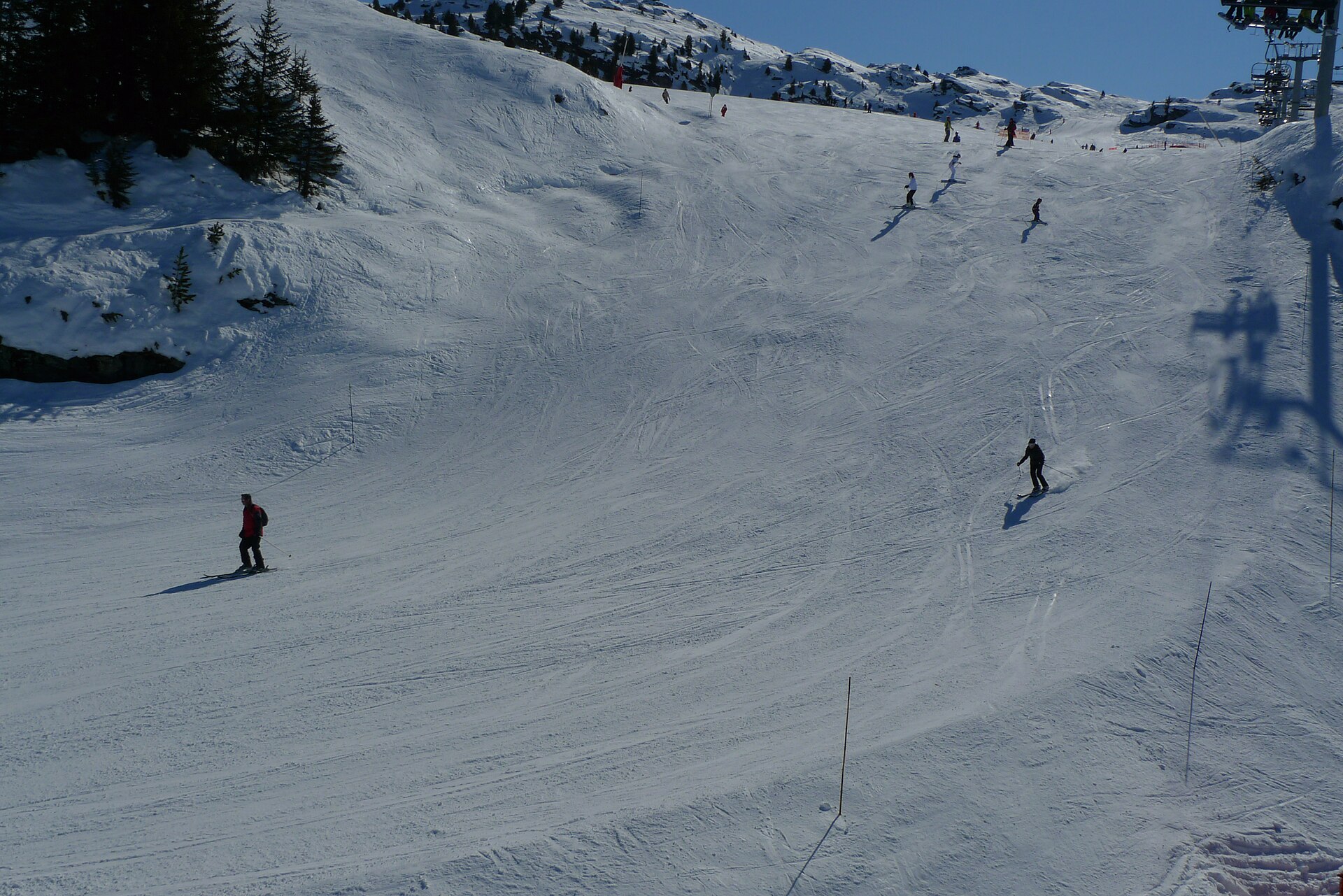
- Scale. Courchevel is part of the Three Valleys, the largest linked ski area in the world. You can ski for a week without repeating a lift, and the intermediate terrain in particular is on a scale nothing in the Portes du Soleil approaches. This is the real justification for the extra hour.
- Altitude and snow reliability. The lifts climb to 2,738 metres, and the resort advertises its 2026/27 winter season from 4 December 2026 to 18 April 2027. Height matters most at either end of the winter, in December and April.
What Courchevel does not buy you is better value. It is expensive, sometimes conspicuously so, and the closer resorts do a good week for markedly less money. If the priority is a straightforward, affordable ski week within ninety minutes of the airport, the Portes du Soleil is the more sensible answer and there is no shame in it.
Who should book the longer transfer
- Strong intermediates and above, who will actually use the Three Valleys’ extent rather than skiing one sector all week.
- Anyone travelling in early December or late April, when altitude is doing real work.
- Groups of mixed ability, because the area is big enough to keep everyone happy without splitting up for the day.
Beginners, families with very young children, and anyone on a tight budget will generally get more from a closer resort and a shorter transfer.
12 — How Courchevel compares with the other Geneva routes
| Resort | Road distance | Typical transfer | Saturday penalty |
|---|---|---|---|
| Morzine | 75 km | about 1h15 | Modest |
| Chamonix | Similar to Morzine | Similar to Morzine | Modest |
| Verbier | 160 km | 2h00 | Avoidable — take the train |
| Courchevel | 179–193 km | about 3h00 | High — the Moûtiers bottleneck |
| Val Thorens | Similar to Courchevel | Similar to Courchevel | High |
| Val d’Isère | Further than Courchevel | Longer than Courchevel | High |
For the neighbouring Three Valleys resort with the same bottleneck and a slightly longer road, see our Geneva to Val Thorens transfer guide. If you are still deciding between resorts rather than transfers, skiing near Geneva compares the terrain, and where to stay near Geneva for skiing covers accommodation.
13 — The verdict
For one or two people, book a shared shuttle with the full address of your accommodation, including both the modern and the old village name, and expect to wait at the airport. For five or more, book a private car; the per-head cost has already crossed over and you save an hour on a Saturday. For a couple arriving at the weekend on a budget, the scheduled coach is honestly good value if your flight has margin.
Skip the train from Geneva, skip the hire car unless you are touring Savoie, and if your accommodation gives you any choice at all, do not arrive on a Saturday afternoon in February.
Frequently asked questions
How long is the Geneva to Courchevel transfer?
Two and a half to three hours by road in normal conditions. On a peak-season Saturday, allow three and a half to four and a half hours door to door with a shared shuttle, because of changeover traffic through Moûtiers. Midweek journeys run close to the quoted time.
What is the difference between Courchevel 1850, 1650, 1550 and 1300?
They are four villages on the same access road at different altitudes, officially renamed Courchevel, Courchevel Moriond, Courchevel Village and Courchevel Le Praz respectively. All share one lift network. For transfers the practical difference is that they are ten to twenty minutes apart by road, so booking the wrong one is a real problem.
How much is a transfer from Geneva Airport to Courchevel?
Roughly €60–85 per person each way for a shared shuttle, €400–580 per vehicle each way for a private transfer, and €50–70 per person for a scheduled weekend coach. Private becomes cheaper per head at around five passengers.
Can I get a train to Courchevel?
Not directly, and not usefully from Geneva. The nearest station is Moûtiers, from which Altibus runs up to the villages, but the Geneva to Moûtiers rail journey leaves from the city-centre station, changes at Chambéry and takes three to four and a half hours. From Paris or London on a direct ski train it is a genuinely good route.
Do I need winter tyres to drive to Courchevel?
Plan on it. In mountain areas marked by signs, French law requires winter tyres, or chains or snow socks in the car, between 1 November and 31 March. Specify winter tyres when booking a hire car and check that chains are in the boot before you leave the airport.
Which Courchevel village is best value?
Start with Le Praz and Moriond. Le Praz is a real Savoyard village at the bottom with a lift into the network; Moriond is the sunny one and suits families. Courchevel 1850 is the famous one, and there you are paying for the shops and restaurants rather than the skiing, which is identical.
Is it worth flying into Courchevel altiport?
Only if the cost is genuinely immaterial to you. It is spectacular, it takes twenty to forty-five minutes from Geneva, and it starts at several thousand euros. It is also weather-dependent, so keep a road transfer booked as a fallback and treat the flight as the luxury it is.
The next valley along shares the same road as far as Moûtiers and the same changeover-day traffic: see our Geneva to Méribel transfer guide for how that route compares.