Best Geneva Attractions for First-Time Visitors (2026 Guide)
This article contains advertising. Our booking links are routed through a partner that adds commission tracking automatically, so if you book through one we earn a commission from the provider, at no extra cost to you. It never affects what we recommend. Affiliate disclosure
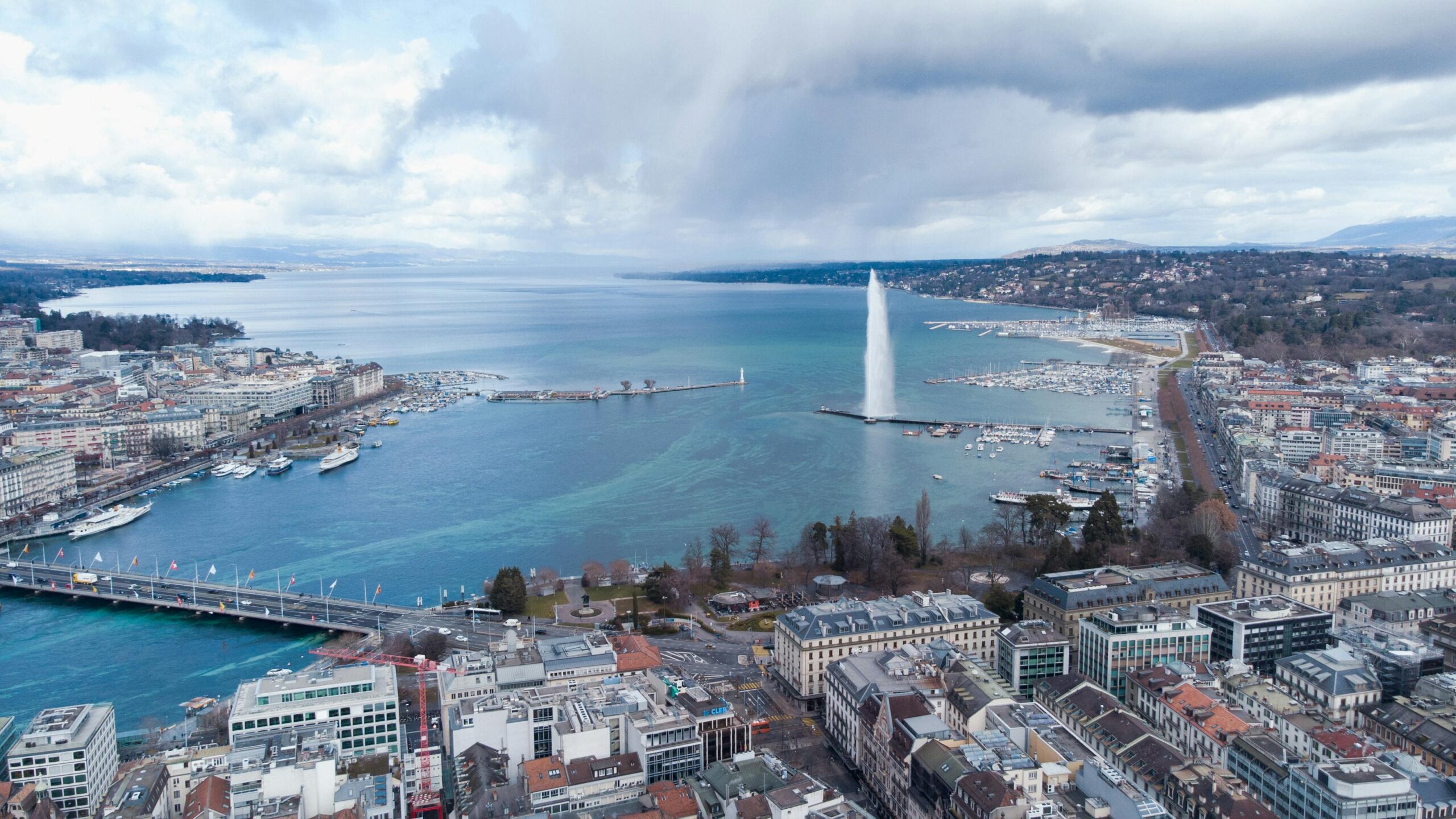
The best Geneva attractions cluster within a 30-minute walk of each other, which is exactly why this small city punishes nobody on a short trip. You can stand on the lakeshore at the Jet d’Eau in the morning, climb a 12th-century cathedral tower after lunch, and watch the sun drop behind Mont Blanc by evening, and you never need a car to do it.
If it is your first visit, the hard question is not what to see. Geneva packs an unusual amount into a small footprint. The real question is how to string the headline sights into one or two sensible days without missing the quieter moments that make the place stick. This guide is my first-timer’s playbook: the landmarks that earn your time, the practical details most travel guides skip, and the order I would actually walk them in. For everything around the sightseeing — arrival, the free transport card, etiquette and the mistakes that catch people out — see the first-time visitor’s guide to Geneva. For the wider picture, start with the master things to do in Geneva guide.

01 — How the best Geneva attractions fit together
Geneva’s old core is small enough to cross on foot in 25 minutes, so most first-timers can cover the major attractions in one or two days. The city sits where the Rhône River leaves Lake Geneva (Lac Léman to locals), and the lakefront is the axis you will keep returning to. Three districts hold almost everything you came for:
- The Old Town (Vieille Ville) — on a small hill on the south bank, this is Geneva’s medieval heart: St. Pierre Cathedral, Place du Bourg-de-Four, and the world’s longest wooden bench.
- The Lakefront and Eaux-Vives — where the Jet d’Eau, the Flower Clock, and most lake cruises sit. A flat promenade ties it together.
- The International Quarter (Pâquis and beyond) — north of the river: the Palais des Nations (the European headquarters of the United Nations), the Broken Chair, and the Red Cross Museum.
Stay at least one night and your accommodation emails you a link to a digital Geneva Transport Card before you arrive. It is free for every overnight visitor and covers buses, trams, urban trains, and the small yellow water taxis (Mouettes) that cross the harbour. Use it shamelessly. It makes Geneva feel half its size.
02 — 1. The Jet d’Eau, Geneva’s signature landmark

No first visit is complete without standing under the Jet d’Eau, the 140-metre column of water that is the city’s de facto emblem. It throws roughly 500 litres a second skyward at speeds near 200 km/h, and on a sunny afternoon you will catch rainbows in the mist. It started life as a pressure-release valve for the city’s hydraulic power network; since 1891 it has stood in for Geneva itself.
How to do it: walk out along the stone jetty (Jetée des Eaux-Vives) right to the base. Wear something you do not mind getting damp, because when the wind shifts the spray drifts straight back over the path. The best photos come from the opposite shore near the Mont-Blanc bridge, framing the fountain against the skyline.
Practical details: it runs year-round, weather permitting, and shuts off in heavy wind or when the lake freezes around the base. Hours run from 10:00 to dusk in winter and well into the evening in summer, with illumination after dark. It is free.
03 — 2. Geneva’s Old Town (Vieille Ville)

The Old Town is the largest historic centre in Switzerland and the densest run of sights in the city. Climb up from the lake along Rue de la Cité or Rue Calvin and you land on cobbled streets that have not fundamentally changed in 400 years, except now they are lined with antique shops, contemporary galleries, and cafés where lawyers, students, and watchmakers share the same outdoor terraces.
Start at Place du Bourg-de-Four, the oldest square in the city, which has been a market, a Roman forum, and a refugee gathering point during the Reformation. Today it is the best drinks terrace in town. From here every street climbs gently toward the cathedral.
Do not walk past Maison Tavel, the oldest private home in Geneva (rebuilt in 1334 after a fire) and now a free city-history museum whose standout piece is a hand-built 1850 scale model of pre-demolition Geneva. Across the street, the Old Arsenal (Ancien Arsenal) shelters five real cannons under its arches and a long mosaic of the city’s key moments.
04 — 3. St. Pierre Cathedral and its tower
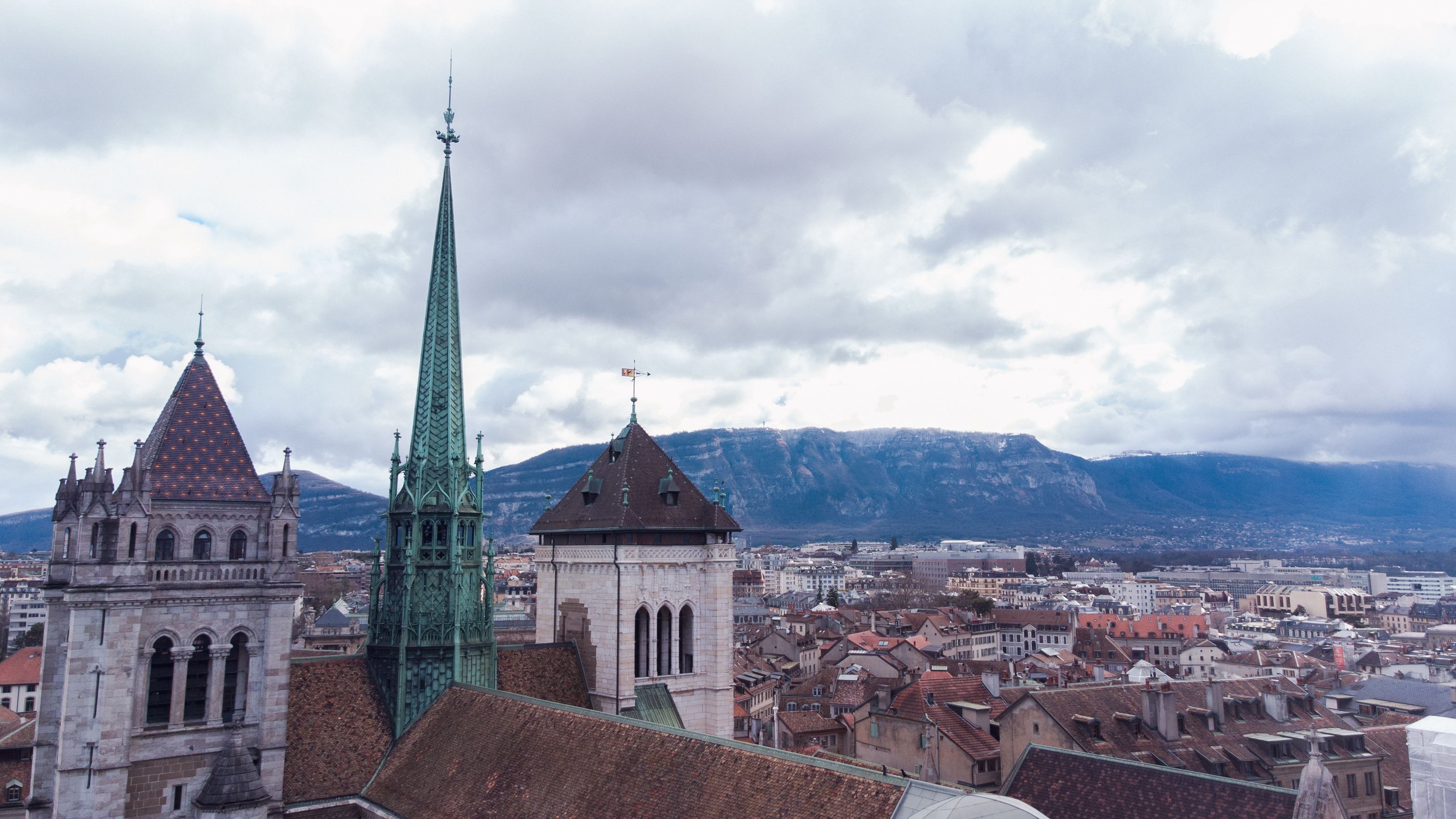
If you climb one set of stairs in Geneva, make it the 157 steps to the top of St. Pierre Cathedral’s north tower. The cathedral has been a place of worship since the 12th century, became John Calvin’s home pulpit during the Reformation, and is striking in its plainness. The Reformation stripped it of nearly all decoration, leaving a clean, soaring Romanesque interior with a Gothic facade bolted on in the 18th century.
The climb is the payoff. The view sweeps the full Old Town rooftops, the lake, the Jet d’Eau, and on clear days the white wedge of Mont Blanc 50 km southeast. Tower entry runs about 7 CHF for adults and earns it.
Do not skip the basement. Beneath the cathedral, the Site Archéologique lays out a cross-section of Geneva’s history: Roman foundations, an early Christian baptistery, a Carolingian crypt, and 4th-century mosaics, all preserved as they were uncovered. It is one of the most underrated paid sights in the city.
05 — 4. The Flower Clock and the English Garden
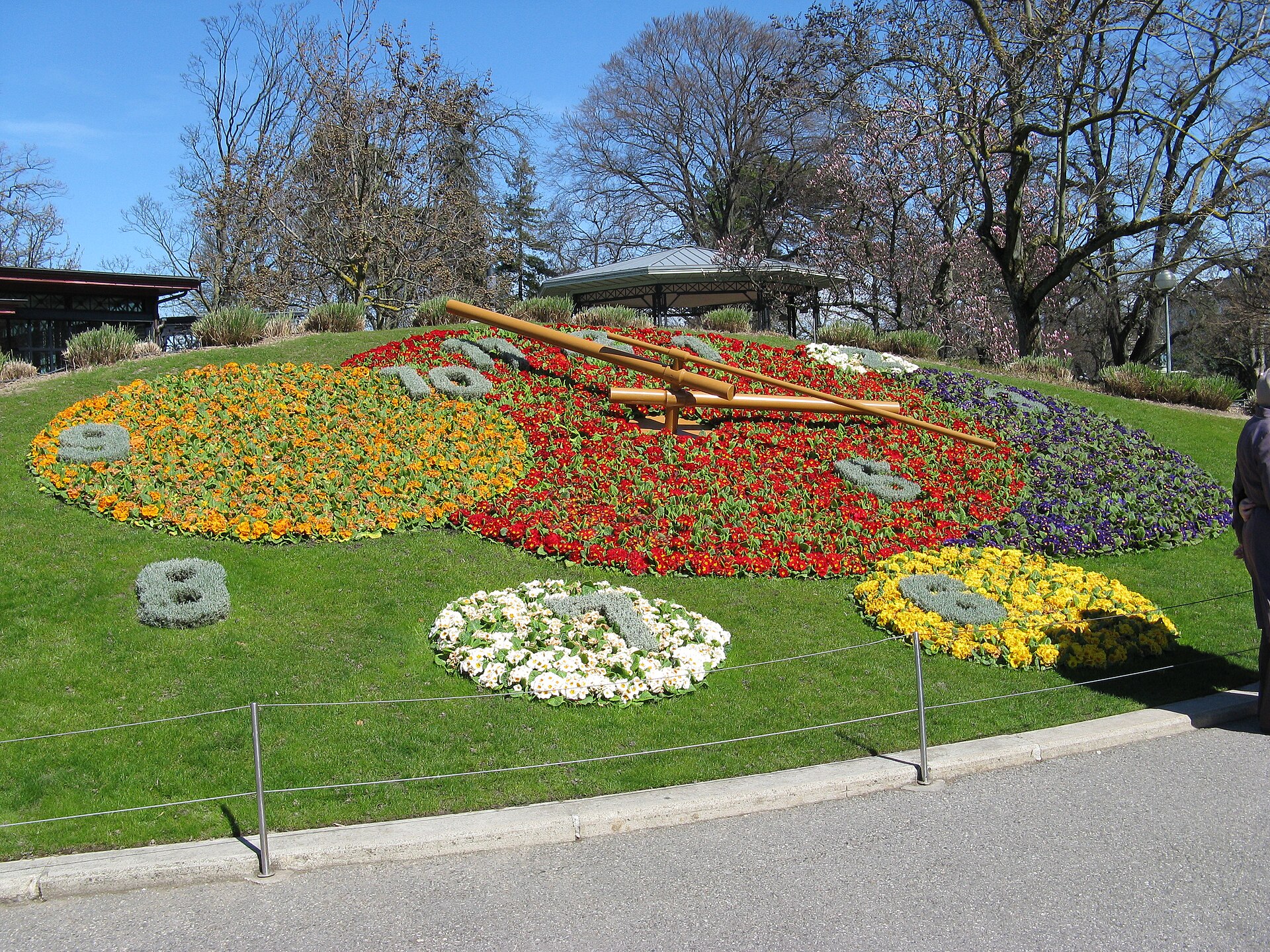
On the south bank, just beside the Mont-Blanc bridge, sits the Flower Clock (Horloge Fleurie), a working timepiece five metres across, planted with more than 3,000 plants that are renewed four times a year. It went in in 1955 as a nod to Geneva’s centuries-old watchmaking trade, and it still keeps accurate time. Its second hand, at 2.5 metres, is the longest anywhere.
The clock anchors the Jardin Anglais (English Garden), a small, easygoing lakefront park with benches, fountains, and a clean view back to the Jet d’Eau. It is the natural pivot between the Old Town and the lakefront promenades, and most first-timers cross it three or four times in a typical visit.
06 — 5. The Palais des Nations and Broken Chair

Geneva’s role as a diplomatic capital is concentrated in the International Quarter, a leafy area north of the lake built around the Palais des Nations, the European headquarters of the United Nations and the second-largest UN office in the world after New York. Put up between 1929 and 1936 to house the now-defunct League of Nations, it hosts more than 8,000 multilateral meetings a year.
You can see the inside on a guided tour (CHF 25 for adults plus booking fees, offered in 15 languages, about an hour). Tours run through the historic Assembly Hall, the Council Chamber with its Spanish frescoes, and rooms dense with diplomatic gifts from member states. Bring photo ID, because security is airport-grade.
Right outside the entrance, on the Place des Nations, stands the Broken Chair, a 12-metre wooden sculpture by Daniel Berset (1997) of a giant chair with one leg blown apart. Handicap International commissioned it to draw attention to anti-personnel mines and cluster munitions. Even if you skip the UN tour, the Broken Chair and the flag plaza around it are worth the walk.
07 — 6. The Reformation Wall and Parc des Bastions
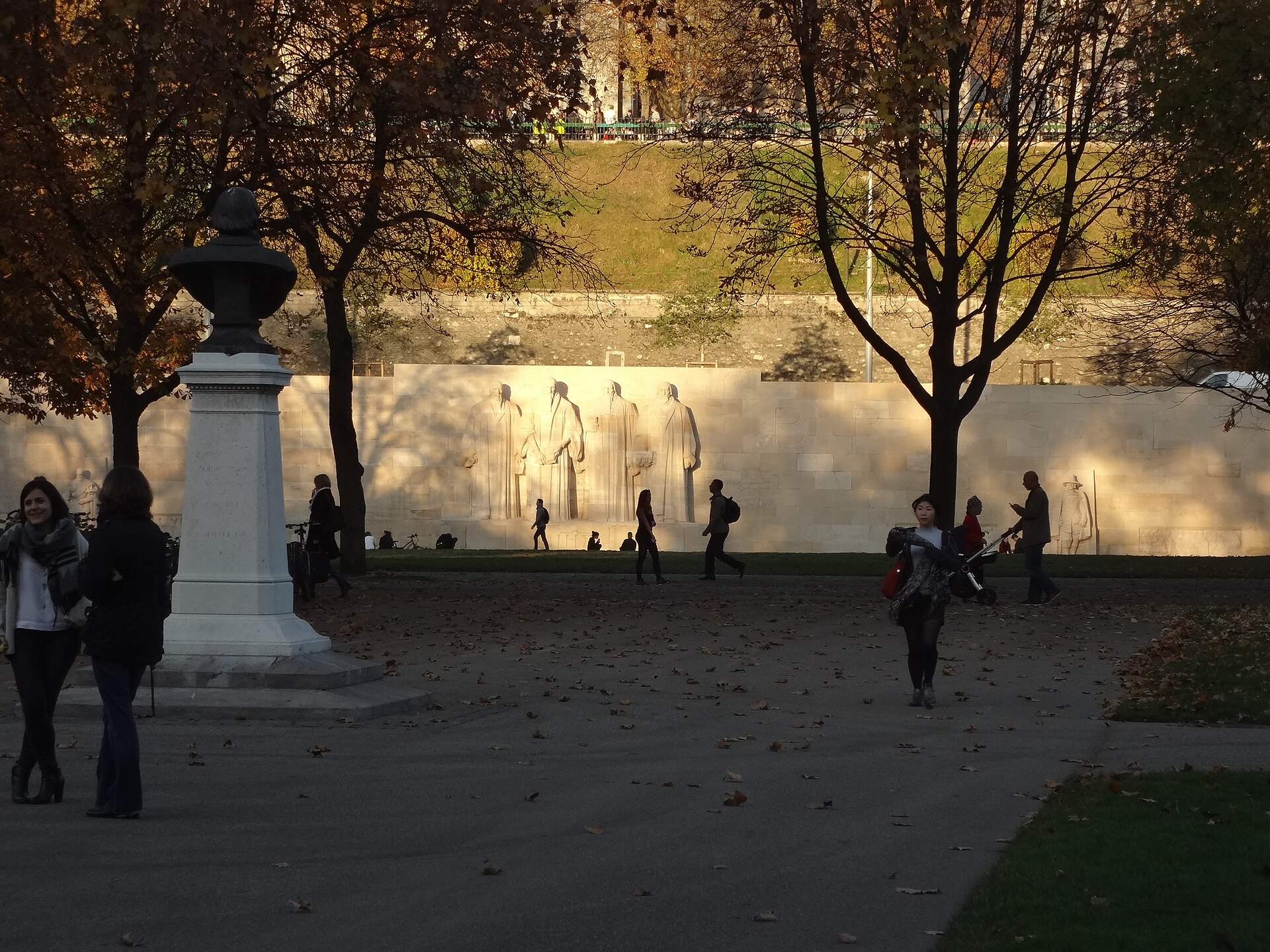
Below the Old Town walls is Parc des Bastions, a small, elegant park with giant outdoor chess sets at its main gate (locals will play anyone, all year) and the monumental Reformation Wall, a 100-metre stone tribute carved between 1909 and 1917 to the four giants of the Geneva Reformation: Guillaume Farel, John Calvin, Theodore Beza, and John Knox. Flanking statues honour figures including Oliver Cromwell, William the Silent, and Stephen Bocskay.
The wall is free, open around the clock, and sits right in front of the main University of Geneva building. Walk through the park, then carry on up Promenade des Bastions to the Promenade de la Treille, home to the world’s longest wooden bench (120 metres) and a wide view across the south of the city.
08 — 7. A Lake Geneva cruise

Lake Geneva looks good from the shore and better from the water. CGN (Compagnie Générale de Navigation) runs a fleet of historic Belle Époque steamers and modern boats, from a 30-minute harbour loop to full-day runs to Lausanne, Évian, and Montreux.
If your time is tight, the Tour du Petit Lac (around 90 minutes) runs out past the Jet d’Eau and back, with the parks on both shores, the villas of Cologny, and the Alps to the south. If your hotel handed you the Geneva Transport Card, you may also get a discount voucher at the CGN ticket booth on Quai du Mont-Blanc, so ask at reception.
Cheaper still: hop a Mouettes Genevoises, the small yellow shuttle boats that cross the harbour continuously in spring and summer. They are included in the Geneva Transport Card, take five minutes, and give you the same Jet d’Eau view as a paid cruise.
09 — 8. The Patek Philippe Museum
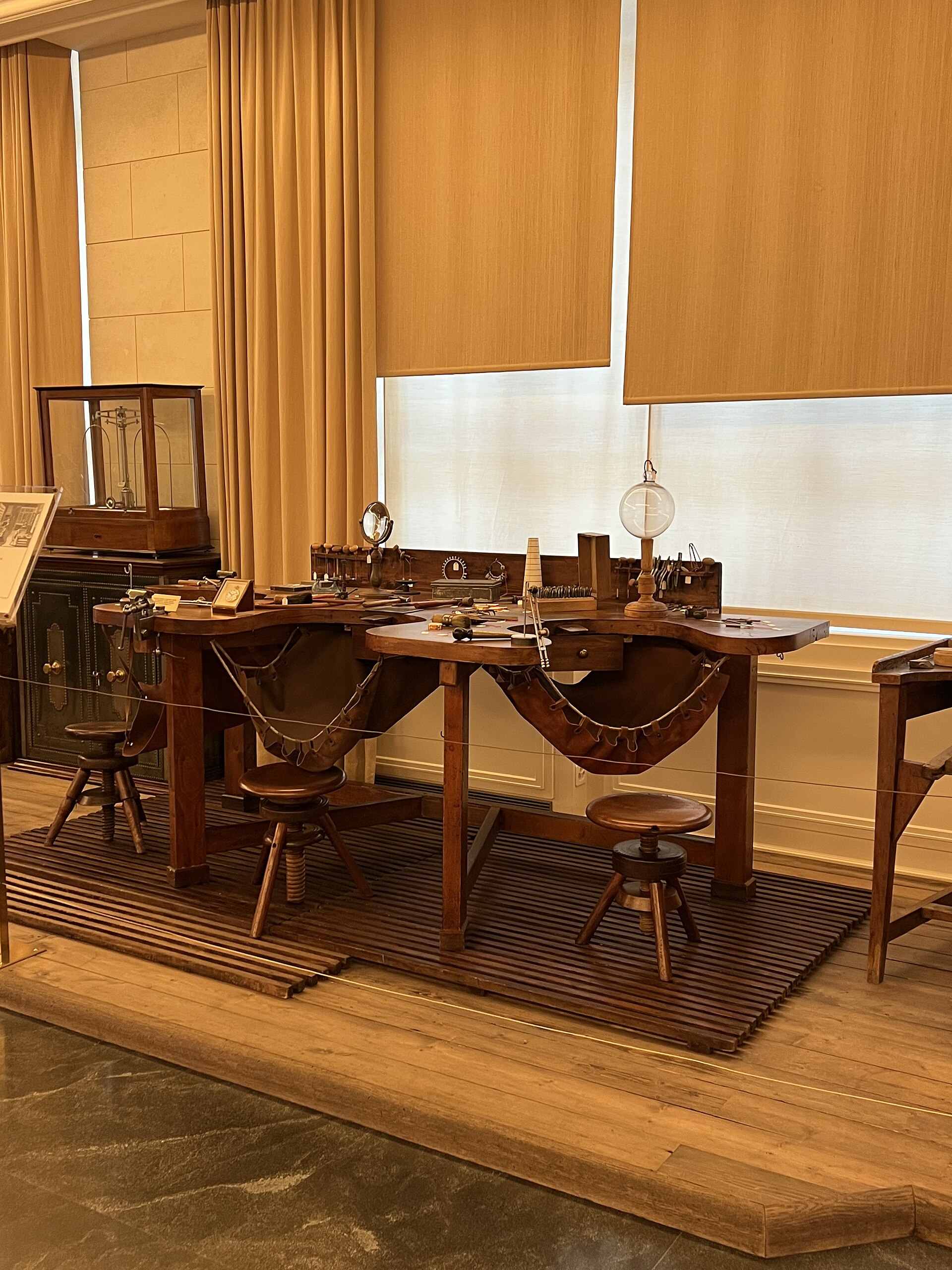
Geneva is the spiritual capital of Swiss watchmaking, and the Patek Philippe Museum in Plainpalais shows you why. The collection runs across 500 years of timekeeping, from 16th-century pocket watches in painted enamel to the dizzying technical complications of the 20th century. The Antique Collection upstairs holds early astronomical clocks, automata, musical watches, and rare singing-bird boxes.
Even if watches mean nothing to you, the museum is a lesson in craft, geometry, and patience. Give it at least 90 minutes. Entry is around 10 CHF for adults, and it closes Sundays and Mondays.
If watches genuinely grab you, the smaller Geneva Watchmaking Museum (Musée de l’Horlogerie), the boutique workshops around Quai du Général-Guisan, and the annual Watches and Wonders Geneva fair each spring are all worth chasing. For more of the city’s indoor culture, see the Geneva museums and culture guide.
10 — 9. Bains des Pâquis

Of all Geneva’s attractions, none catches the city’s everyday character like the Bains des Pâquis, a long pier and bathhouse jutting into the harbour just north of the Mont-Blanc bridge. In summer this is where Genevans swim, sunbathe, and meet for breakfast. In winter it turns into a Turkish bath and sauna with an open-air hot pool you can soak in while snow falls on the lake.
Entry is just 2 CHF in summer and CHF 22 for the winter wellness area (CHF 15 on Mondays), and the on-site restaurant, known simply as the Buvette des Bains, serves an excellent cheese fondue at prices that barely feel like Geneva. It is also a launch point for the Mouettes. First-timers who skip the Bains miss the city at its most relaxed.
11 — 10. Carouge, Geneva’s Little Italy
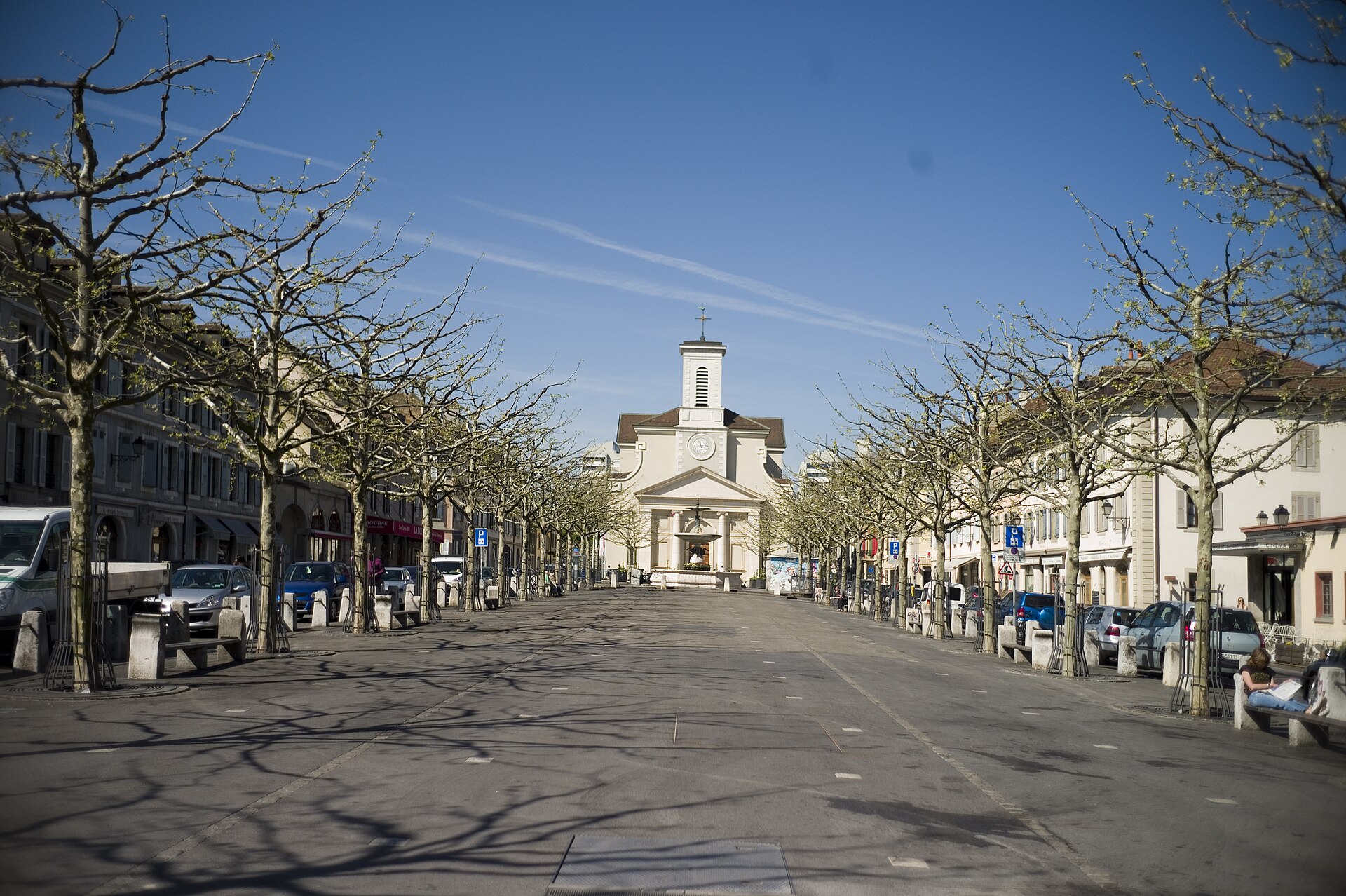
Take tram 12 about ten minutes south of the centre and you reach Carouge, a once-independent town annexed to Geneva in 1816. Built by the King of Sardinia in the 18th century to compete with Calvinist Geneva, it looks and feels distinctly Italian: pastel facades, low courtyards, internal gardens, and an easy cafe culture the rest of Geneva borrowed long ago.
Wander Rue Saint-Joseph for boutiques and antique dealers, hit the Wednesday and Saturday morning markets at Place du Marché, and stay for an aperitif on Rue Vautier. Carouge has long been Geneva’s liveliest evening district, which makes it the ideal half-day on a second day.
12 — 11. The International Red Cross and Red Crescent Museum
Across the road from the Palais des Nations sits the International Red Cross and Red Crescent Museum, a moving institution built around 160 years of humanitarian work. The Red Cross was founded in Geneva in 1863, and the museum tells the story through three zones: defending human dignity, restoring family links, and reducing natural risks.
This is not a casual stop. Plan about two hours, and brace for some heavy material. It is also one of the city’s most important museums, and free with the Geneva City Pass. Entry is around 15 CHF for adults, with student discounts and free admission for under-12s.
13 — 12. The Mont-Blanc Bridge and lakefront promenade
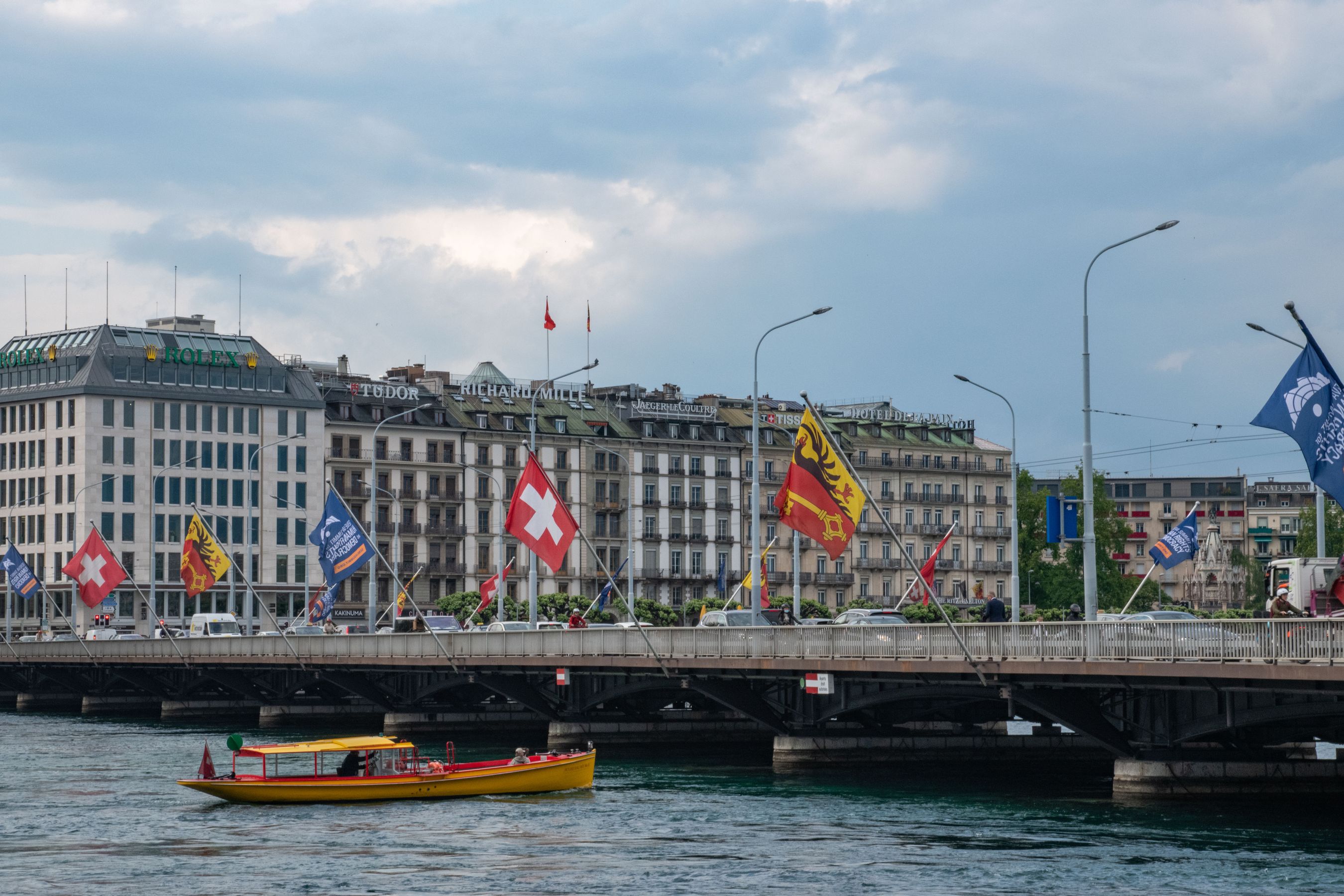
The Mont-Blanc Bridge (Pont du Mont-Blanc) spans the Rhône where the river leaves the lake, and after the Jet d’Eau it is the most photographed structure in the city. Its signature is the double line of international flags down both sides: one set for the Swiss cantons, one for UN member states. On a clear morning you can stand mid-bridge and see Mont Blanc 70 km away one way and the Jura mountains the other.
Do not just cross the bridge; walk both lakefront promenades in turn. Quai Wilson on the north bank is broader and more park-like; Quai du Général-Guisan and Quai Gustave-Ador on the south side are dotted with cafés and the lake’s main cruise piers. Either way, give it an hour of slow walking. The views are the entertainment. If you want more of this side of the city, the Geneva outdoor activities guide covers the lakefront paths and beyond.
14 — How much time you need for the best Geneva attractions
Here is a realistic time budget for a first visit, depending on how long you have:
| Time available | What you can realistically cover |
|---|---|
| Half a day (4-5 hrs) | Jet d’Eau, Old Town, St. Pierre tower, Flower Clock. The bare minimum, and a good airport layover plan. |
| One full day | Add a Mouettes shuttle, the Reformation Wall, and either the Patek Philippe Museum or a long walk to Bains des Pâquis. |
| Two days | Add the Palais des Nations, the Red Cross Museum, and a half-day in Carouge. |
| Three or more days | Room for a day trip: Lausanne, Annecy, or the Mont Salève cable car, all within 60 minutes. |
For hour-by-hour plans, see the Geneva 1-day itinerary and the Geneva 2-day itinerary. With a spare day, the best day trips from Geneva guide sorts the options by travel time.
15 — Practical tips for visiting the best Geneva attractions
Getting from Geneva Airport to the centre
Geneva Airport (GVA) is only 6 km north, and the train into Cornavin (the main station) takes 7 minutes and runs every 12. There’s no longer a free transport ticket at the airport (the baggage-hall dispenser was withdrawn at the end of 2021), so buy a CHF 3 zone 10 ticket from the platform machine, or ride free if your hotel has already sent you the Geneva Transport Card. Full details in the Geneva transportation guide.
The Geneva Transport Card vs. the Geneva City Pass
These are two different things. The Geneva Transport Card is free for all overnight visitors and covers public transport only. The Geneva City Pass is a paid product (around 28 CHF for 24 hours, 38 CHF for 48 hours) that adds free entry to most museums, a free CGN harbour cruise, free walking tours, and shop discounts. Visit two or more paid museums plus a cruise and the City Pass pays for itself.
When to visit
Geneva works across all four seasons, but they are not the same trip. Late spring and early autumn (May, June, September) give you the most reliable weather, the lowest hotel prices, and terraces in full swing. July and August are warm and busy with festivals; the free Geneve Geneve festival last took over the quays in August 2024, with night-time sound-and-light shows over the harbour, so check geneve-geneve.ch for any future edition. December is cold but festive, with the Escalade celebrations on 12 December and outdoor ice rinks. January and February are the cheapest months and the best base for ski day-trips. For dates, see the Geneva events and festivals guide.
Money, tipping, and daily costs
Switzerland uses the Swiss franc (CHF). Euros are accepted at hotels and tourist sites, but the exchange rate is poor, so use cards or withdraw CHF. Tipping is built into restaurant bills by law; rounding up to the nearest franc is appreciated for good service but never expected. Budget roughly 100-150 CHF per person per day for a comfortable mid-range visit, excluding the hotel. Careful travellers can do it for around 60 CHF; the Geneva on a budget guide shows how.
16 — Best Geneva attractions: frequently asked questions
Is Geneva worth visiting for a first trip to Switzerland?
Yes, especially if you care about international history, watchmaking, alpine scenery, or fine dining. Geneva is more cosmopolitan than Zurich and easier to get around than Lugano, and it makes a strong base for day trips into France (Annecy, Chamonix) and the rest of Switzerland (Lausanne, Montreux, the Lavaux vineyards).
How many days do I need in Geneva for a first visit?
Two full days is the sweet spot. One day forces a choice between the Old Town and the International Quarter; three days buys you a day trip; two days gives you a complete first impression without rushing.
Are Geneva’s main attractions free?
Many are. The Jet d’Eau, the Old Town, the Reformation Wall, the Flower Clock, the Broken Chair, and most parks cost nothing. Big museums charge entry, but the city’s flagship, the Musee d’Art et d’Histoire, has pay-what-you-wish entry, so you can pay nothing. See the full guide to free things to do in Geneva.
Is Geneva walkable for a first-time visitor?
Very. The Old Town, the lakefront, and the International Quarter all sit within a 30-minute walk of one another. The free public transport that comes with the Geneva Transport Card is the backup for late returns and the longer hops to Carouge or the airport.
What is the one Geneva attraction I should not miss?
St. Pierre Cathedral’s tower. The mix of climb, view, and history (a Romanesque interior, Calvin’s chair, Roman archaeology in the basement) compresses the whole story of Geneva into a single spot.
What is the best way to photograph the Jet d’Eau?
Shoot it from the opposite shore near the Mont-Blanc bridge in the late afternoon, when the light is warm and you can frame the fountain against the skyline. For the dramatic angle, walk out along the jetty to the base, but keep your phone or camera dry, because the spray drifts back over the path whenever the wind turns.
17 — Official sources and further reading
For current opening hours, events, and official confirmations on the attractions above, these are the authoritative sources:
- Geneva Tourism Official Site — the City of Geneva’s tourism portal with event listings and pass details.
- MySwitzerland — Geneva — Switzerland Tourism’s national-level Geneva guide.
- United Nations Office at Geneva — tour booking and visitor information for the Palais des Nations.
- International Red Cross and Red Crescent Museum — hours, exhibitions, and tickets.
- CGN Lake Geneva Cruises — timetables and routes for the historic Belle Epoque steamers.
For the price of every major sight, what’s free, what’s worth paying for and whether the City Pass pays off, see our complete guide to Geneva attractions and tickets.
Before you head for the lakefront, check our Jet d’Eau visitor guide: the fountain is free, but it stops in strong wind and frost and for several weeks every autumn.
18 — Related Geneva guides
Once you have ranked the attractions that matter most to you, the rest of the planning falls into place. Keep going with the master things to do in Geneva guide, sort out a base with where to stay in Geneva, plan your meals with the Geneva food and restaurant guide, and pull the logistics together in planning your Geneva trip. For more first-timer reading, the hidden corners of Geneva and most photogenic spots in Geneva round out the picture.
The best Geneva attractions reward people who slow down. The Jet d’Eau is wonderful, but so is the third coffee on a sunny terrace at Place du Bourg-de-Four, the unexpected quiet inside St. Pierre Cathedral at 9 a.m., and the long blue-gold evening light over the lake in summer. Build a generous itinerary, leave room to wander, and the city fills in the gaps.