Geneva Airport (GVA): The Complete Guide
This article contains advertising. Our booking links are routed through a partner that adds commission tracking automatically, so if you book through one we earn a commission from the provider, at no extra cost to you. It never affects what we recommend. Affiliate disclosure
Geneva Airport is not really Geneva’s airport. A large share of the people who land here never set foot in the city — they walk out of the terminal, get into a minibus and are in France within twenty minutes, or in a Swiss ski resort within two hours. It is an Alpine gateway that happens to sit at the end of a Swiss city’s tram line, and understanding that is the key to using it well, because the airport is designed around two entirely different kinds of passenger and most guides only describe one of them.
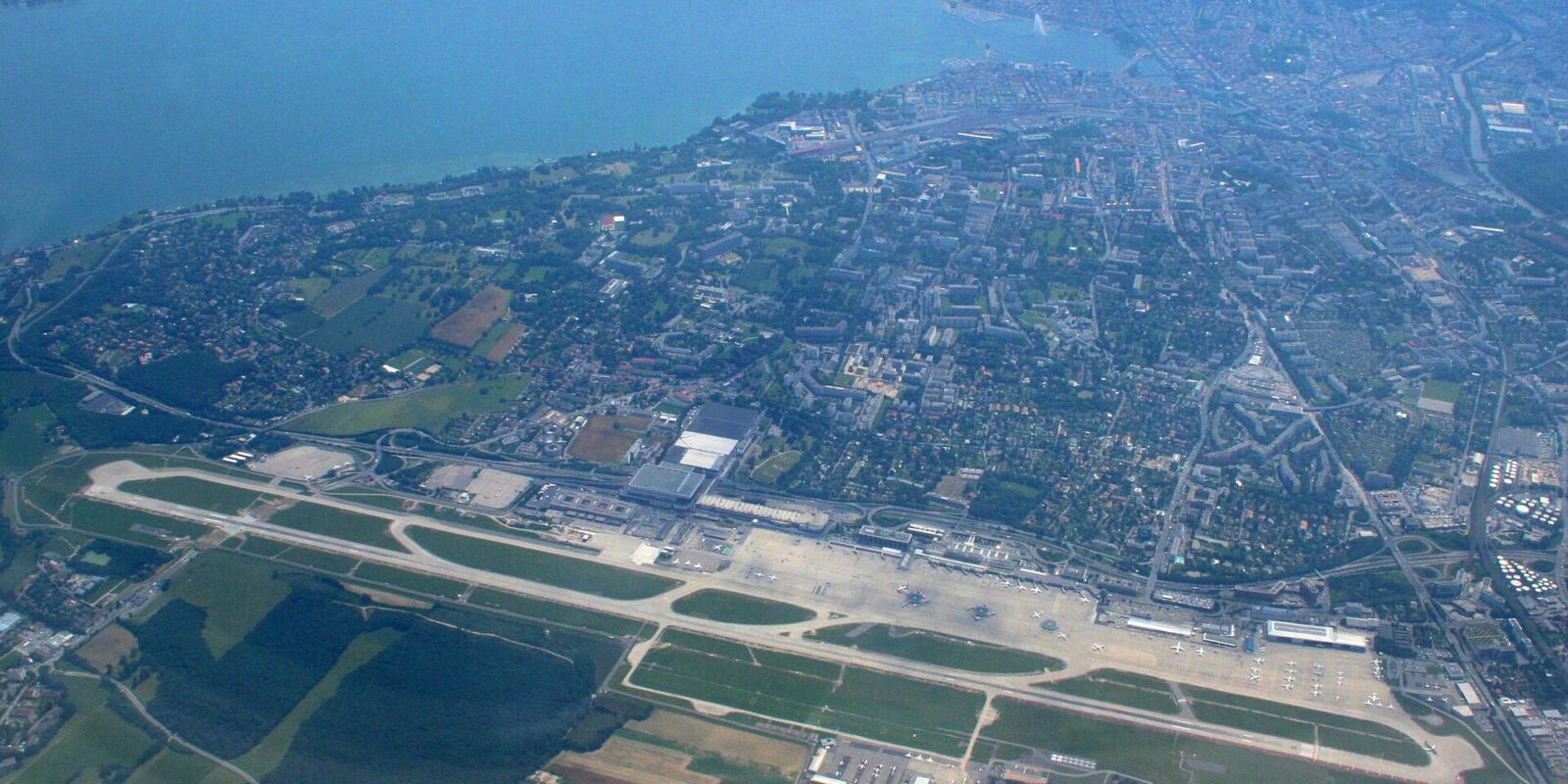
This Geneva airport guide covers the whole airport as it works in practice: one terminal building split into Swiss and French sectors, a railway station directly underneath it that reaches the city centre in about six minutes, and a road network built for ski transfers rather than commuters. The airport sits roughly 4 km from the centre of Geneva, and the walk from an arrival gate to a train departing for the Old Town can be done in under fifteen minutes if you have no hold luggage.
01 — The essentials in one place
| Detail | What you need to know |
|---|---|
| Codes and names | GVA / LSGG. Officially Genève Aéroport; still widely called Cointrin after the district it sits in. |
| Distance to the city | About 4 km. Six minutes by train, roughly 20 by bus, 10–15 by taxi off-peak. |
| Terminals | Terminal 1 handles almost everything, in a single long building divided into piers. Terminal 2 is a separate, older building used seasonally. |
| Sectors | A Swiss sector and a French sector, with separate arrivals, baggage halls and exits. |
| Railway station | Genève-Aéroport, directly beneath the terminal, on the mainline to Lausanne, Sion, Brig and beyond. |
| Airport telephone | +41 (0)848 19 20 20 |
| Currency | Swiss francs on the Swiss side. Euros are widely accepted but at poor rates. Cards work everywhere. |
| Busiest period | Winter Saturdays, December to April. The airport handles a colossal amount of ski traffic on a single day of the week. |
02 — Why the airport is shaped like this
Geneva Airport is an accident of geography that hardened into an institution. The canton of Geneva is a thumb of Switzerland poking into France, surrounded on three sides by French territory, and the flat land available for a runway happened to run right up against the border at Cointrin. When the airport expanded after the Second World War, the only way to lengthen the runway was to trade land with France — which is exactly what happened, and part of the price was a French customs sector inside the terminal so that French travellers could use the airport without entering Switzerland.
That arrangement is why the terminal has two of everything on the landside and why hire cars are cheaper on one side of the same building than the other. It is also why the airport road system is oddly elaborate for its size: there are two countries’ worth of access roads converging on one concrete apron.
The airport has kept growing into that awkward shape rather than out of it. There is one runway, and there will only ever be one runway, so almost all investment has gone into the terminal: the main hall was progressively extended along the airfield, and the East Wing opened in 2021 to give the long-haul carriers proper wide-body stands. The result is a building that is long rather than wide, which matters to you mainly as walking distance.
03 — One airport, several buildings
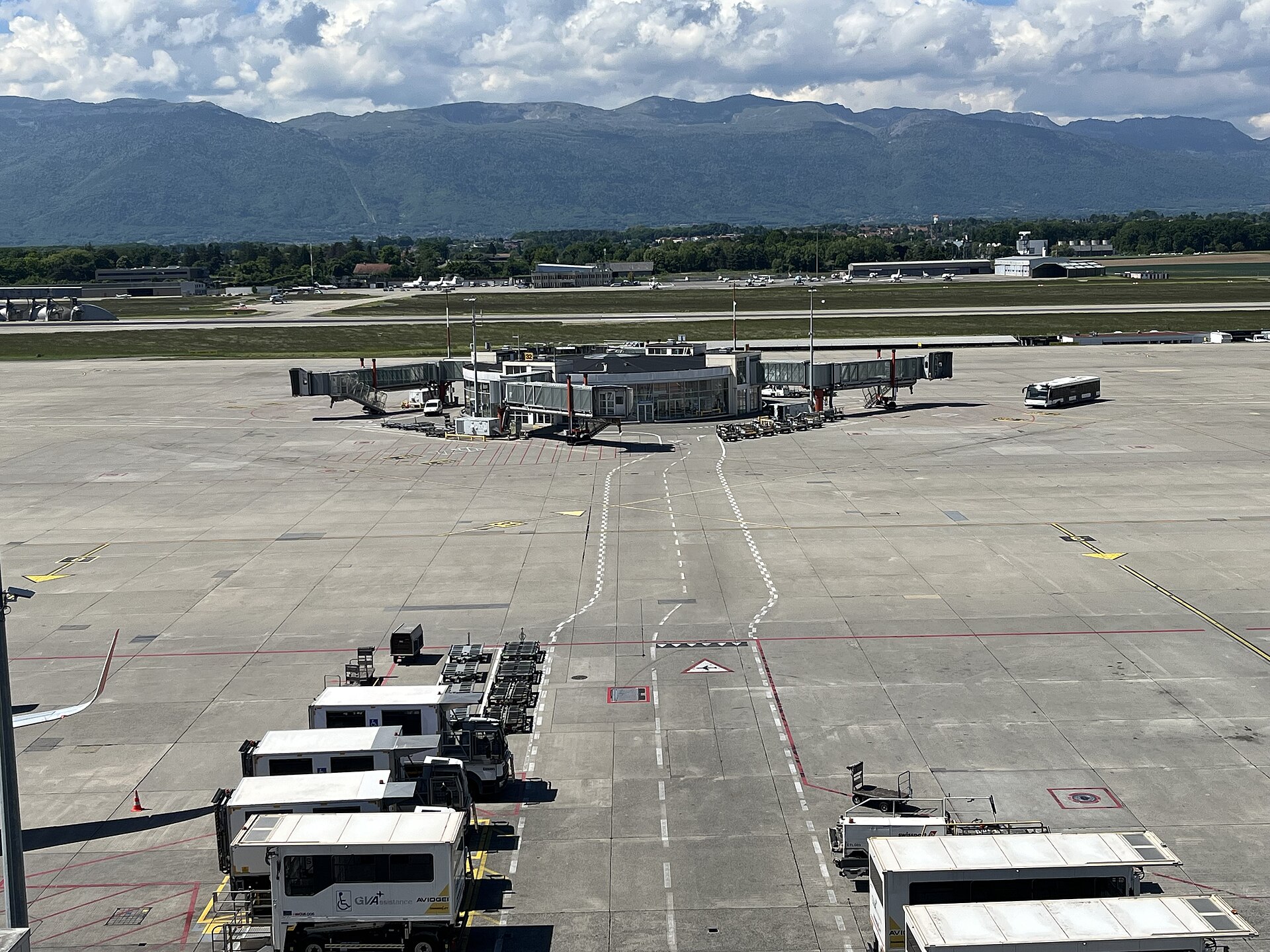
Geneva’s terminal reads as one enormous long building because that is essentially what it is. Rather than separate terminals in the London or Paris sense, it has a main check-in hall running the length of the landside, and airside piers reached from it. The newest of these, the East Wing, opened in 2021 and handles wide-body long-haul aircraft; the older piers handle the short-haul European traffic that makes up most of the airport’s business.
Terminal 2 is a different animal — an older, smaller building a short distance along the airport road, brought into use seasonally and for charter operations. Most visitors will never see it, but if your boarding pass says T2, plan for it: it is not a five-minute stroll from the main hall, and there is a shuttle.
The full layout, pier by pier, with walking times between gates, is in our Geneva Airport terminals and map guide.
04 — The French sector, which exists nowhere else
This is the genuinely unusual thing about Geneva, and it catches out even experienced travellers.
The airport straddles the Swiss–French border. Under a bilateral arrangement dating to the 1960s, part of the terminal is designated a French sector, with its own check-in, its own arrivals, its own baggage reclaim and its own exit — directly into France, on a dedicated road that bypasses Swiss customs entirely. If you fly on certain domestic French services you may arrive and leave without ever technically entering Switzerland.
The practical consequences are the ones nobody warns you about:
- The two sectors have separate exits on opposite sides of the building. A transfer driver waiting at the wrong one cannot simply walk round.
- The French sector has far fewer facilities — fewer shops, fewer places to eat, and a much less generous set of transport connections.
- There is a passage between the two sectors for those who need it, but it is not a free-for-all, and the direction of travel matters for customs purposes.
- Hire cars are cheaper on the French side, and this is why. It is the same building and a different country’s tax regime.
We have taken this apart properly in Geneva Airport’s French sector, explained, including when it saves you money and when it strands you.
05 — Arriving: from wheels-down to the door

Geneva is a fast airport most of the time and a slow one at exactly the moments most people use it. Here is the honest sequence.
- Disembarkation. Some stands are jet-bridge, some are bussed. Bussed arrivals add ten minutes and are common for short-haul.
- Passport control. Switzerland is in Schengen but not the EU. Schengen arrivals normally walk straight through; UK and other non-Schengen arrivals queue, and in winter that queue can be substantial.
- Baggage reclaim. Normally quick. In ski season it is not, because skis and boards are delivered to a separate oversized baggage point rather than the carousels, and the two do not arrive together.
- Customs. Green and red channels. Switzerland is outside the EU customs union, and duty-free allowances into Switzerland are meaningful.
- The exit. Straight into a broad arrivals hall with car hire, transfer desks, food and the escalators down to the railway station.
Budget an hour from touchdown to standing outside with normal luggage. Budget ninety minutes with skis, and two hours on a peak Saturday in February. People who book a transfer for “landing plus 45 minutes” are the ones you see running.
06 — Getting into the city
By train — six minutes, and the obvious answer
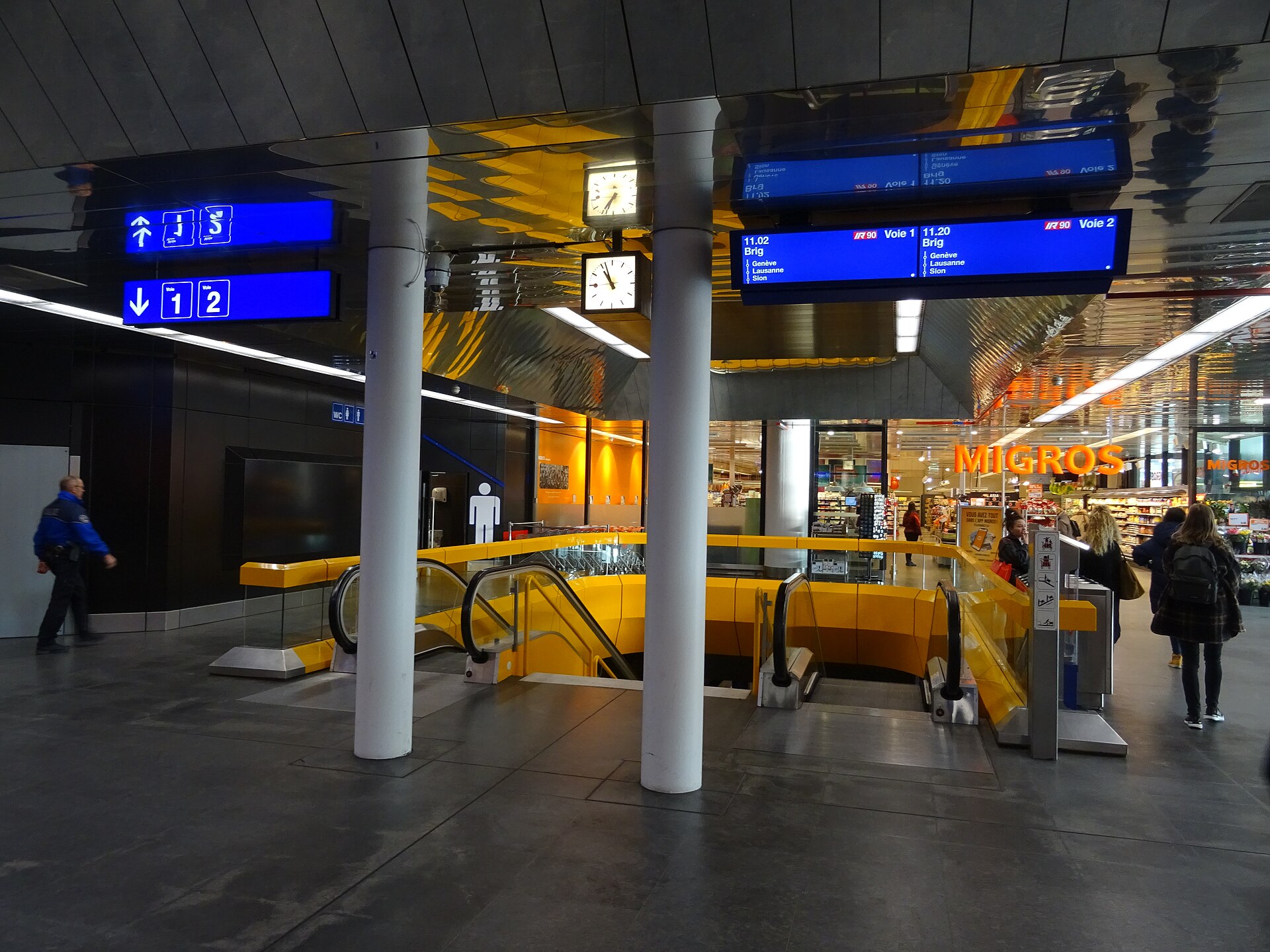
The railway station sits directly under the arrivals hall, down an escalator. Trains run to Genève-Cornavin, the city’s main station, in about six minutes, several times an hour from early morning until late evening. Cornavin puts you a ten-minute walk or a two-stop tram from the lake, and the Old Town is a further ten minutes uphill.
The same platforms serve the mainline to Lausanne, Montreux, Sion, Visp and Brig, which is why the departure boards look far grander than a six-minute airport shuttle would warrant. If you are heading to the Valais or the Lake Geneva shore, you do not need to go into Geneva at all — board here.
The free transport ticket, and what has changed
For years, Geneva Airport gave every arriving passenger a free 80-minute Unireso ticket from a yellow machine in the baggage hall, valid on the whole city network. It became one of the best-known travel tips in Switzerland. As of the 2026 season the airport no longer advertises that service, and reports of its availability are inconsistent — so do not build your arrival around it.
What is reliable is the Geneva Transport Card. Anyone staying in a Geneva hotel, hostel or campsite is entitled to one free of charge for the length of their stay, covering the whole of zone 10 including the airport link. Ask for it at check-in, and ask again if it is not offered — many properties issue it only on request, and some send it by email before arrival. It is worth several francs a day and it is the single best-value thing about visiting Geneva.
If neither applies, buy a ticket from the machines at the station or the bus stop. It is not expensive and the fine for travelling without one is.
By bus
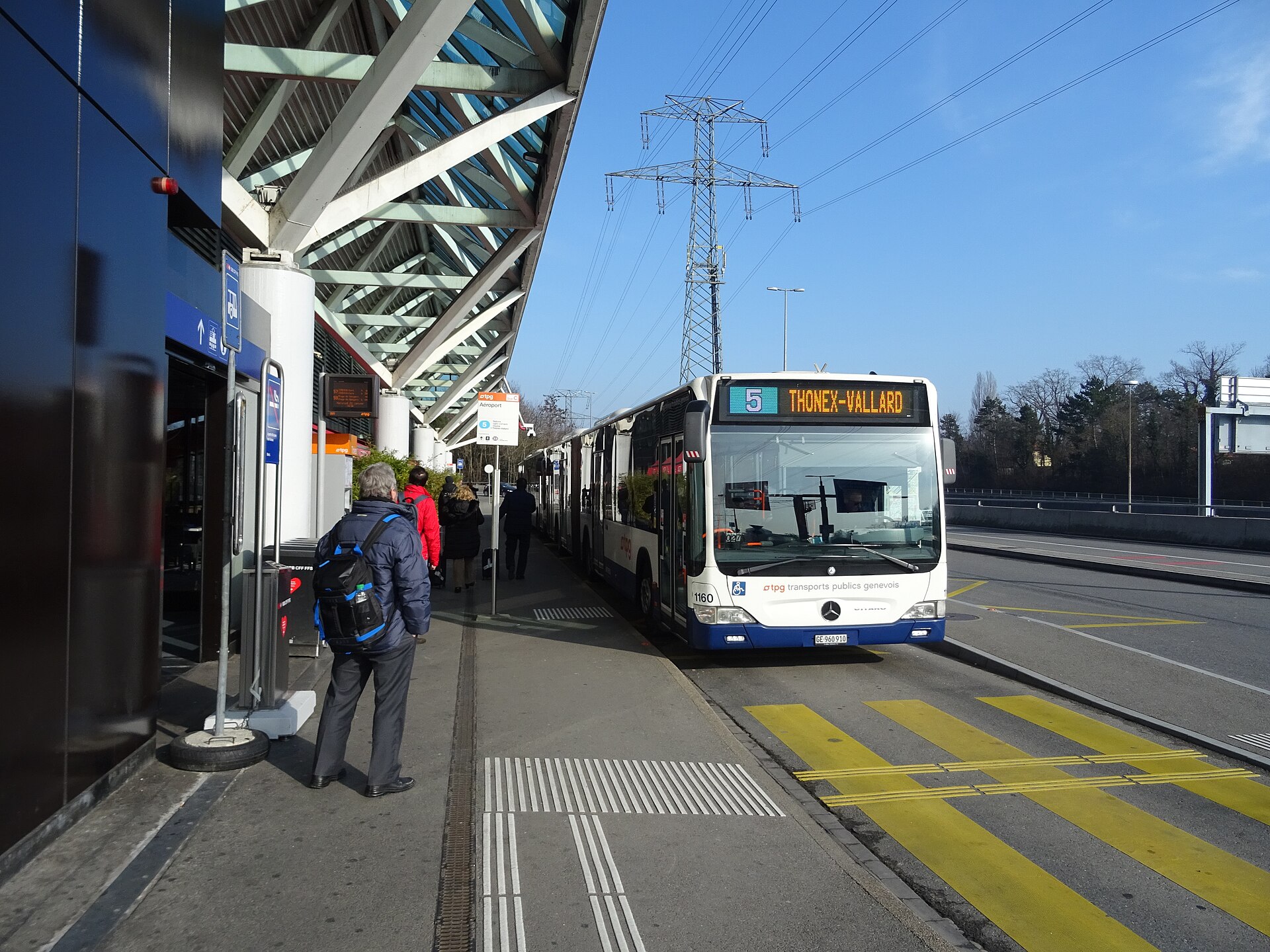
TPG runs several routes from the stop outside arrivals. They take around twenty minutes to the centre against the train’s six, so they are not the fastest way in — but they are the right answer if your accommodation is somewhere the train does not reach, particularly the international-organisations quarter, the lakeside north of the centre, or the suburbs.
There is also a free early-morning shuttle network, the tpgAérobus, for passengers arriving at the airport between 04:30 and 06:30 on production of a same-day flight ticket, running on several lettered routes from Geneva and neighbouring France. If you have an unpleasantly early departure, that is worth knowing before you book a taxi.
By taxi and ride-hailing
Taxis wait outside arrivals and reach the centre in ten to fifteen minutes off-peak. They are expensive — Swiss taxis generally are — and there is no scenario in which a taxi to the city beats the train on either time or money. They earn their keep with heavy luggage, small children, very late arrivals, or a hotel in an awkward spot.
On foot and by bike
You can walk out of Geneva Airport and be in the city in an hour or so along a perfectly reasonable route, and in summer people do. There are also public bikes in the city and a network of cycle paths along the lake. Neither is a serious airport transfer, but both are pleasant facts about how small Geneva is.
07 — Getting to the Alps
This is what most of the airport’s winter traffic is actually doing. Geneva is the gateway to more major ski resorts than any other airport in Europe: Chamonix and Morzine within an hour and a half, the Portes du Soleil, the Grand Massif, Verbier over the Swiss side, and the whole Tarentaise — Courchevel, Méribel, Val Thorens, Les Arcs, La Plagne, Tignes, Val d’Isère — within about three hours.
- Shared shuttles — €35–85 per person each way, door to door, but you wait for the vehicle to fill.
- Private transfers — €150–550 per vehicle, better value from about five people up.
- Scheduled coaches — cheapest reliable seat, weekends only.
- Train — genuinely competitive for Chamonix and Verbier, poor for the Tarentaise.
- Hire car — only if you intend to ski more than one valley.
Distances from the terminal to the resorts most people are heading for:
| Resort | Road distance | Typical drive | Best alternative to a road transfer |
|---|---|---|---|
| Les Houches, Chamonix (FR) | 82–88 km | 1h00–1h20 | Train — genuinely good |
| Morzine, Les Gets (FR) | 75–80 km | 1h15 | None — road only |
| Avoriaz (FR) | 90 km | 1h30 plus cable car | None — and no cars in the resort |
| Megève, Flaine, Samoëns (FR) | 70–85 km | 1h05–1h20 | Weekend coach, or train to Sallanches |
| Verbier (CH) | 160 km | 2h00 | Train to Le Châble plus gondola |
| Courchevel, Méribel (FR) | 180–185 km | 2h30–3h00 | Weekend coach |
| Val Thorens, Les Arcs, La Plagne (FR) | 195–200 km | 2h45–3h15 | Weekend coach; funicular for Les Arcs |
| Tignes, Val d’Isère (FR) | 220–225 km | 3h00–3h30 | Train to Bourg-Saint-Maurice plus Altibus |
The single most useful thing to know: almost every French Alpine chalet changes over on a Saturday, so Saturday is when the roads fill and the airport strains. A Sunday flight is usually cheaper, calmer and two hours faster to the resort.
08 — The winter Saturday
If you are going to understand one thing about Geneva Airport, understand its Saturdays between mid-December and mid-April. On those days the airport does something no other European airport of its size attempts: it handles a full week’s ski changeover in a single day, twice over, in both directions.
What that looks like on the ground:
- Arrival waves cluster in the late morning and early afternoon, and passport control backs up because most of the traffic is non-Schengen.
- The oversized baggage point becomes the bottleneck in the reclaim hall, with several ski-heavy flights landing within the same half hour.
- The kerbside and the transfer coach parks are full, and drivers are working to schedules that assume nothing goes wrong.
- Departures fill from early morning. Check-in queues and the ski-bag drop are at their annual worst between roughly 09:00 and 14:00.
- The road out towards Annecy and Albertville is heavily loaded from mid-morning, which is a problem the airport cannot solve for you.
Everything in this guide about timings assumes an ordinary day. On a peak Saturday, add an hour to arrival and an hour to departure and you will still occasionally be surprised. If your dates are flexible at all, flying on a Sunday or midweek changes the experience of this airport more than any other single decision.
09 — Where you can fly, and who flies it
Geneva punches above its weight on route choice because it serves three overlapping markets: a Swiss city, a cluster of international organisations, and the Alps.
- Swiss operates the flag-carrier network, feeding Zurich and the Lufthansa group’s hubs alongside a spread of direct European routes.
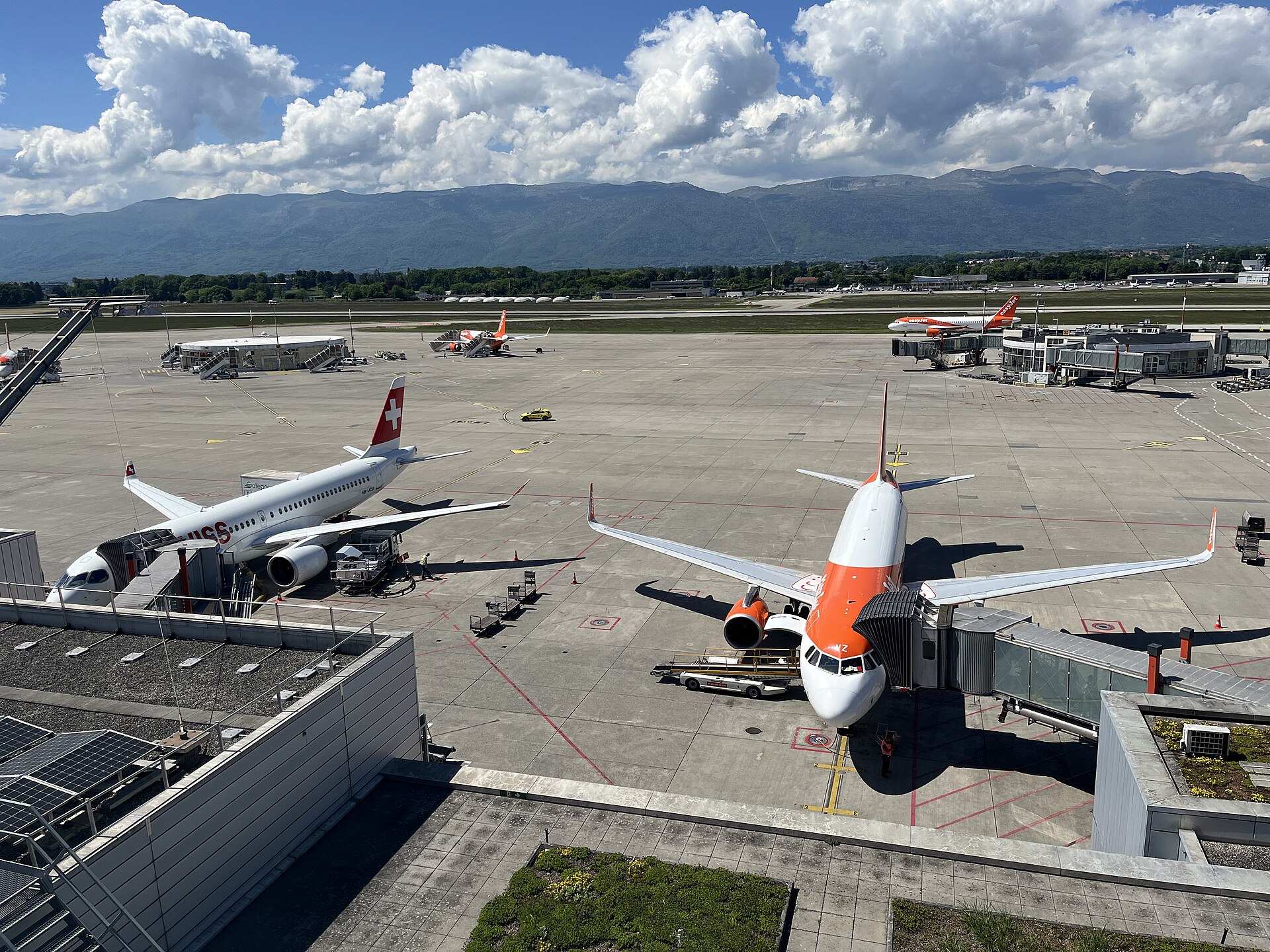
- easyJet runs a substantial base here and is the largest operator by movements, which is why the apron is so orange. It carries much of the UK ski traffic.
- British Airways, Air France, KLM, Lufthansa, Iberia, Austrian, Brussels, SAS, ITA and the rest of the European majors serve their own hubs, mostly year-round.
- Long-haul is modest but real, and the East Wing exists to handle it — Gulf carriers and a handful of transatlantic and Asian services.
- Winter charters swell the schedule dramatically from December, mostly weekend-heavy and mostly aimed squarely at the ski market.
The practical upshot for planning: from the UK and most of western Europe you will have a direct flight and a genuine choice of times. From further afield you will connect, most often through Zurich, Paris, Amsterdam, Frankfurt or London, and that connection is worth thinking about carefully if you are carrying skis.
10 — Connecting through Geneva
Geneva is not a hub in the Zurich or Frankfurt sense, and connections here are self-managed more often than not. A few things follow from that.
- If your two flights are on separate tickets, you must clear immigration, collect your bags and check in again. Allow three hours, not one.
- On a single ticket within the Schengen area, connections are straightforward and the minimum times are short — the building is long but not complicated.
- A connection between the Swiss and French sectors is a different proposition entirely and should never be attempted on a tight margin.
- If your layover is long enough to leave the airport, it very likely is worth doing: the city centre is six minutes away by train, which is an unusually good ratio.
11 — Departing from Geneva
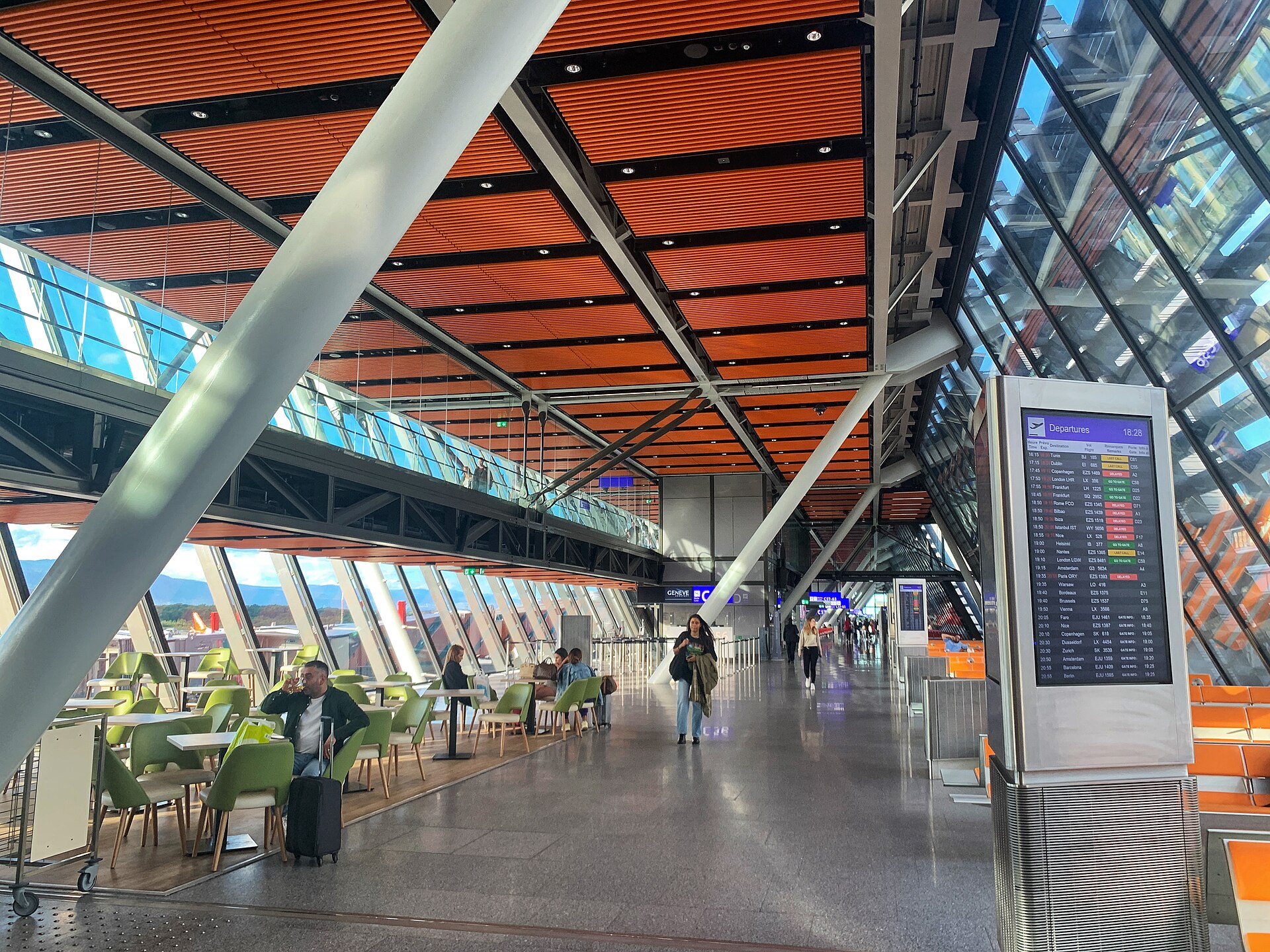
Check-in and security are generally efficient. The exceptions are, again, winter Saturdays, when the ski-bag drop-off queues are among the longest in the building and check-in halls fill from early morning.
- Two hours is enough for a European flight on an ordinary day.
- Three hours is the realistic figure for a peak-season Saturday with skis to check.
- The airport publishes live security waiting times — check them before you leave the resort, not when you arrive.
- Oversize baggage goes to a separate drop-off after check-in, not down the normal belt.
- Check which sector you fly from. If it says France, it is a different part of the building with a different entrance.
Airside: eating, shopping and waiting
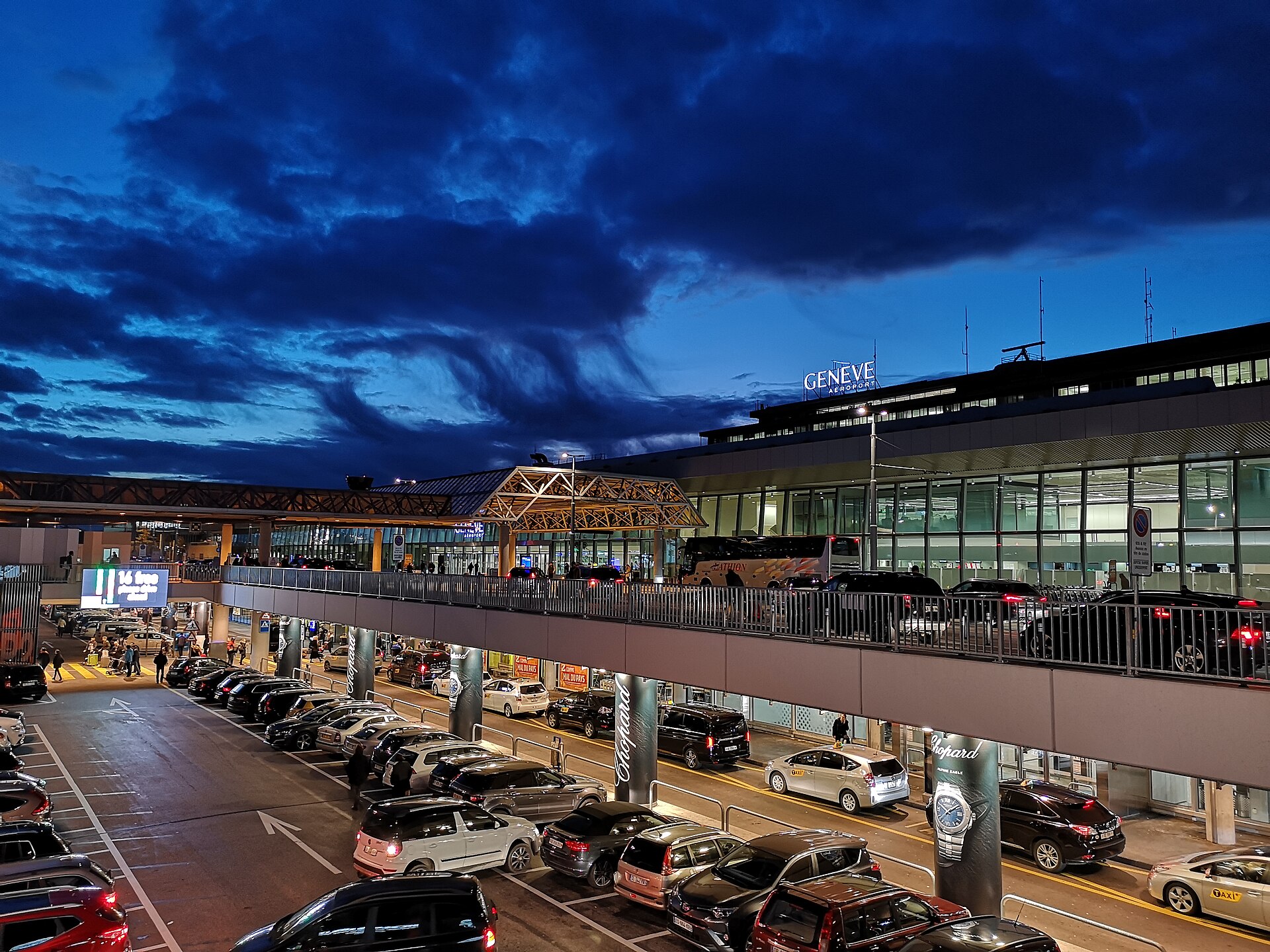
Geneva airside is decent rather than remarkable. There is a good spread of cafés, bakeries and restaurants, a heavy concentration of Swiss watch and chocolate retail — this is the airport where Chopard and Rolex advertise on the kerbside pillars — and a duty-free operation that does brisk business in the direction of France.
- Prices are Swiss. A coffee and a sandwich will cost meaningfully more than you expect.
- Tap water is drinkable and free, and there are fountains. Bring an empty bottle.
- Free wi-fi is available throughout, with a straightforward sign-in.
- Luggage storage is available at the airport, and the left-luggage office at the railway station takes skis — useful if you land early and want a day in the city.
- The airport has a viewing terrace with a genuinely good outlook over the apron and the Jura, which is a better way to kill an hour than another shop.
12 — Car hire, and the two-country trick
Every major rental company has a desk at Geneva, and most have two — one in the Swiss sector and one in the French sector, in the same building, quoting different prices for what is often the same car.
- French-side rentals are frequently cheaper, sometimes substantially, because of the different tax treatment. If you are driving to a French resort, this is nearly always the right desk.
- Swiss-registered cars normally carry the motorway vignette already, which French-registered ones do not. If you rent French-side and plan to use Swiss motorways, you need to buy one.
- Cross-border use is normally permitted but must be declared, and some companies restrict which countries you may enter. Read the terms rather than assuming.
- Winter equipment is legally required in designated French mountain communes from 1 November to 31 March: either four winter tyres marked 3PMSF, or chains or snow socks carried for the two driven wheels. Confirm what the car has; not every Geneva rental has winter tyres by default, and it is not always an automatic inclusion.
- Snow chains are a separate add-on almost everywhere. Take them for anything above valley level.
- Returning the car means finding the right sector’s return area, which is not the one you might drive past first. Allow extra time.
One thing to weigh honestly: a car is a liability in most Alpine resorts. Many are pedestrianised in the centre, parking runs to €60–120 a week, and one of the best resorts in the catchment, Avoriaz, does not admit cars at all. Rent if you want to move between valleys. Do not rent because it feels cheaper than a transfer, because once you count parking and equipment it usually is not.
13 — Very early and very late
Geneva’s operating day has firm edges, and they catch people out.
- The terminal is not open around the clock. There is an overnight closure in the small hours, and passengers who assumed otherwise end up outside.
- Trains to the city stop before the airport does. The last services from Genève-Aéroport run late evening rather than through the night, so a 23:30 arrival needs a bus, a taxi or a plan.
- Overnight bus services exist on some routes at weekends but are not a dependable airport link.
- The free tpgAérobus shuttle covers the other end of the problem, running for passengers reaching the airport between 04:30 and 06:30 on production of a same-day flight ticket.
- Airport hotels are a short walk or shuttle away and are the sane answer to both problems — they are not cheap, but neither is a night in a chair.
14 — Lounges, parking, sleeping and layovers
Four questions come up so often they have guides of their own.
Lounge access is more complicated here than at most airports, because the Swiss and French sectors have separate facilities and the pay-in-advance options vary: see Geneva Airport lounges for what you can actually get into.
Parking runs from the short-stay decks by the terminal to long-stay lots and the noticeably cheaper French-side car parks: our Geneva Airport parking guide compares every option and what each really costs for a week.
If you are considering a night in the terminal, read sleeping at Geneva Airport first — the building is not open around the clock, and that is a fact worth knowing before midnight rather than after it.
And if you have hours rather than a night, what to do on a Geneva Airport layover works out how much time you actually need to reach the Old Town and get back safely.
15 — Travelling through with children
Geneva handles families well by the standards of a busy short-haul airport, and the short distances help.
- Pushchairs can be taken to the aircraft door and are returned there on arrival by most carriers — worth confirming, because it is the difference between carrying a toddler through a long pier and not.
- There are baby-changing facilities in both landside and airside toilets, and family lanes at security at busier times.
- The six-minute train into the city is by some distance the easiest transfer with small children: lifts at both ends, no traffic, and no car seats to worry about.
- Transfer companies must legally provide appropriate child seats for road journeys in France. Private operators do this as a matter of routine; shared shuttles frequently cannot, which quietly rules them out for families with under-fives.
- The viewing terrace is a genuinely good way to absorb a delay if the weather is reasonable.
16 — Accessibility and assistance
Geneva runs a proper assistance service for passengers with reduced mobility, bookable through your airline at least 48 hours before departure. The terminal is step-free throughout, the railway station beneath it has lifts to both platforms, and the TPG buses are low-floor. Assistance meeting points are signposted at the kerbside, in the check-in halls and at arrivals.
The one thing to plan around is the sector split: assistance is arranged for the sector you are flying from, so if your booking is in the French sector, make sure that is what your airline has recorded.
17 — Practical answers
- Money. Switzerland uses the Swiss franc. Cards are accepted everywhere and contactless is universal. Euros are taken at many airport outlets but at rates that quietly cost you 5–10%.
- SIM and data. Swiss roaming is outside EU arrangements, so a UK or EU plan may not cover it. Check before you land or buy an eSIM.
- Smoking. Designated areas only, and they are not generous.
- Trolleys. Free in the baggage halls.
- Pharmacy and medical. Both available landside.
- Chapel and quiet room. Available; ask at an information desk.
18 — Money, customs and the border
Because the airport sits on a national frontier and Switzerland is outside the EU customs union, a set of questions arises here that would not arise at, say, Lyon.
- Customs allowances into Switzerland are their own regime, with limits on alcohol, tobacco and the total value of goods brought in per person per day. They are more generous than travellers expect on some items and stricter on others, and the red and green channels are real.
- Meat and dairy limits into Switzerland are enforced, which occasionally surprises people arriving with a picnic.
- VAT refunds on Swiss purchases are processed before you go airside; if you have shopped seriously in the city, allow extra time and do the paperwork before check-in, not after.
- Cash is rarely needed. Contactless cards work on TPG machines, in taxis and at every airport outlet. If you want francs, use a bank ATM rather than an exchange bureau.
- Crossing to France on foot from the French sector exit is normal and unremarkable, but you are crossing an international border. Carry your passport rather than leaving it in a hold bag.
One quirk worth knowing: prices at the airport are quoted in francs, but many outlets will take euros and give change in francs at a rate they set themselves. It is convenient and it is not free. Pay by card and let your own bank do the conversion.
19 — Baggage, lost bags and what to do when it goes wrong
Most things at Geneva work. When they do not, the sequence matters, and doing it in the terminal rather than from your resort saves days.
- Missing bag. Report it at the baggage service desk inside the reclaim hall before you go through customs. You need the reference number for any claim, and getting one afterwards is far harder.
- Give a resort address, not a home one. Airlines will forward a delayed bag to an Alpine hotel, and they do it routinely in winter — but only to an address they have been given.
- Damaged skis or a damaged bag. Report it at the same desk, with photographs, before leaving. Damage claimed later is almost never paid.
- Keep receipts for anything you have to buy or hire while a bag is missing. That is what gets reimbursed.
- Left something on the aircraft or in the terminal? The airport runs a lost property service; contact it through the airport rather than the airline for items lost landside.
The practical insurance against all of this is the same one that applies to ski carriage generally: put a change of clothes, any medication, and your boots or boot liners in the bag that stays with you.
Frequently asked questions
How far is Geneva Airport from the city centre?
About 4 km, which is remarkably close — the train takes six minutes to Cornavin and a taxi ten to fifteen off-peak. You can see the Jet d’Eau from the air on final approach.
Is there still a free transport ticket at the airport?
The machine dispensing free 80-minute tickets in baggage reclaim is no longer advertised by the airport and should not be relied on. The dependable free option is the Geneva Transport Card, issued by every hotel, hostel and campsite in the city for the length of your stay. Ask for it at check-in.
Can I fly into the French sector and skip Swiss customs?
On the specific services that use it, yes — that is precisely what the French sector is for. It exits directly onto a French road. But it serves a limited set of destinations, has fewer facilities, and puts you on the opposite side of the building from most transfers and from the railway station.
How early should I arrive for a flight from Geneva?
Two hours for a European departure on a normal day, three on a winter Saturday or if you are checking ski equipment. Check the airport’s published security waiting times before you set off.
Is Geneva Airport open 24 hours?
No, and this surprises people every winter. The terminal closes overnight for a period in the small hours. If you are planning to sit out an early flight in the building, read the detail before you commit to it.
Which airlines fly to Geneva?
Swiss and easyJet dominate the traffic, with easyJet operating a substantial base here, alongside British Airways, Air France, KLM, Lufthansa, Iberia and a long list of European carriers, plus seasonal charter operations that swell dramatically in winter and intercontinental services through the East Wing.
Where do I meet a transfer driver?
In the Swiss sector arrivals hall, unless you have specifically booked a French-sector flight. Most operators meet inside with a name board; some use the kerbside pick-up area, which is signposted and a short walk from the exit. Confirm which when you book, and give them your flight number rather than a clock time.
Can I store luggage at the airport?
Yes. There is luggage storage at the airport itself, and the left-luggage office at the railway station accepts skis and boards — the useful option if you land in the morning with a late flight out and want to spend the day by the lake.
If you want the building itself pier by pier, with the airport’s own posted walking times and where the oversize baggage drop hides, that is in our Geneva Airport terminals and map guide.
The border arrangement deserves its own explanation, because it decides where your driver waits and what your hire car costs: read Geneva Airport’s French sector, explained.
Hours between flights are an opportunity here rather than a sentence, because the city centre is six minutes away by train — what to do on a Geneva Airport layover works out exactly how much time you need.
One fact catches people out every winter, and it is worth knowing before midnight rather than after: the terminal is not open around the clock. Sleeping at Geneva Airport overnight sets out the closure and the alternatives.
Lounge access here turns on which side of passport control you depart from rather than on which card you hold — Geneva Airport lounges sets out all four buyable lounges, their hours and the sector rule.
If you are driving rather than being driven, the choice between the terminal decks and the long-stay lots is worth about CHF 65 a week — our Geneva Airport parking guide compares every car park by price, cover and walking time.
The choice between the two desks is less obvious than the price comparison makes it look, because a French-side car starts in Ferney-Voltaire and can cost extra to take into Switzerland. Our Geneva Airport car rental guide runs the numbers for the common trips.
If you need to leave bags for a few hours, note that the airport itself runs no left-luggage desk: the lockers belong to SBB and sit in the railway station below. Our Geneva Airport luggage storage guide covers the lockers, the ski counter and what to do about lost bags.
If you’ve read elsewhere that a machine in the baggage hall hands out free tickets into town, it went at the end of 2021. Our page on Geneva Airport’s free transport ticket explains what replaced it.
If you’re still choosing your flight, our guide to flights to Geneva covers who flies from where, the cheapest months and when Zurich or Lyon is the better airport.
20 — Related Geneva guides
- Geneva Airport to the city centre — every route into town, in detail.
- Hotels near Geneva Airport — for early departures and late arrivals.
- Geneva ski transfers — the complete resort-by-resort guide.
- Shared, private, coach or train? — choosing a transfer mode.
- Flying to Geneva with skis — carriage fees and the oversize baggage trap.
- Geneva transport guide — trams, buses, boats and the transport card.
- Planning a trip to Geneva — the starting point for everything else.
- Geneva for first-time visitors — what to know before you land.