Geneva Airport Terminals, Map & Facilities
This article contains advertising. Our booking links are routed through a partner that adds commission tracking automatically, so if you book through one we earn a commission from the provider, at no extra cost to you. It never affects what we recommend. Affiliate disclosure
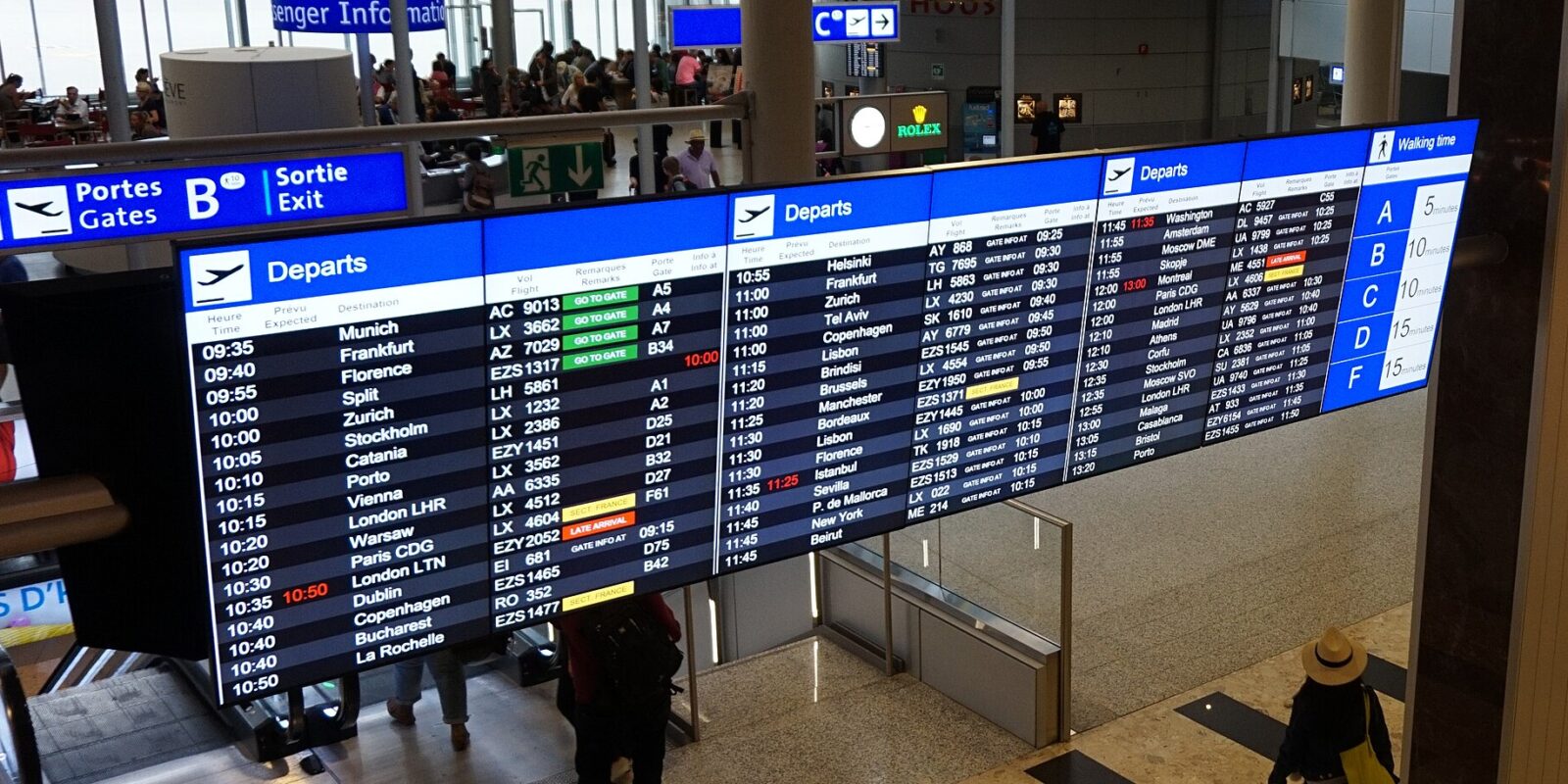
Geneva Airport publishes something most airports do not: a walking-time panel on its own departure boards, telling you how many minutes it takes to reach each pier. A, five minutes. B, ten. C, ten. D, fifteen. F, fifteen. It is a small, faintly Swiss piece of honesty, and it tells you more about how to use this building than any terminal map will.
Geneva airport terminals are simpler than the signage suggests: there is one terminal building, T1, which handles well over 90% of flights, plus a small Terminal 2 opened only at weekends in the winter ski season. T1 is divided by piers — A, B, C, D and F — and by sector, Swiss or French, rather than by airline. Nothing in T1 is more than about fifteen minutes’ walk from the central hall, which makes Geneva one of the least stressful airports of its size in Europe.
01 — How many terminals does Geneva have?
Two, but the number is misleading, because they are not comparable things.
- Terminal 1 is the airport. One long building running parallel to the single runway, with check-in along the landside and piers projecting airside. Around 200 check-in desks, roughly 17 million passengers a year, and every airline you have heard of.
- Terminal 2 is an older, much smaller building a few hundred metres along the airport road, opened only at weekends during the winter season for charter and overflow traffic. Outside the ski months it is closed to the public.
If your boarding pass says T1, which it almost certainly does, you can ignore the existence of T2 entirely. If it says T2 — and in practice that means a winter weekend charter — read the T2 section further down before you set off.
02 — The piers, and what actually flies from each
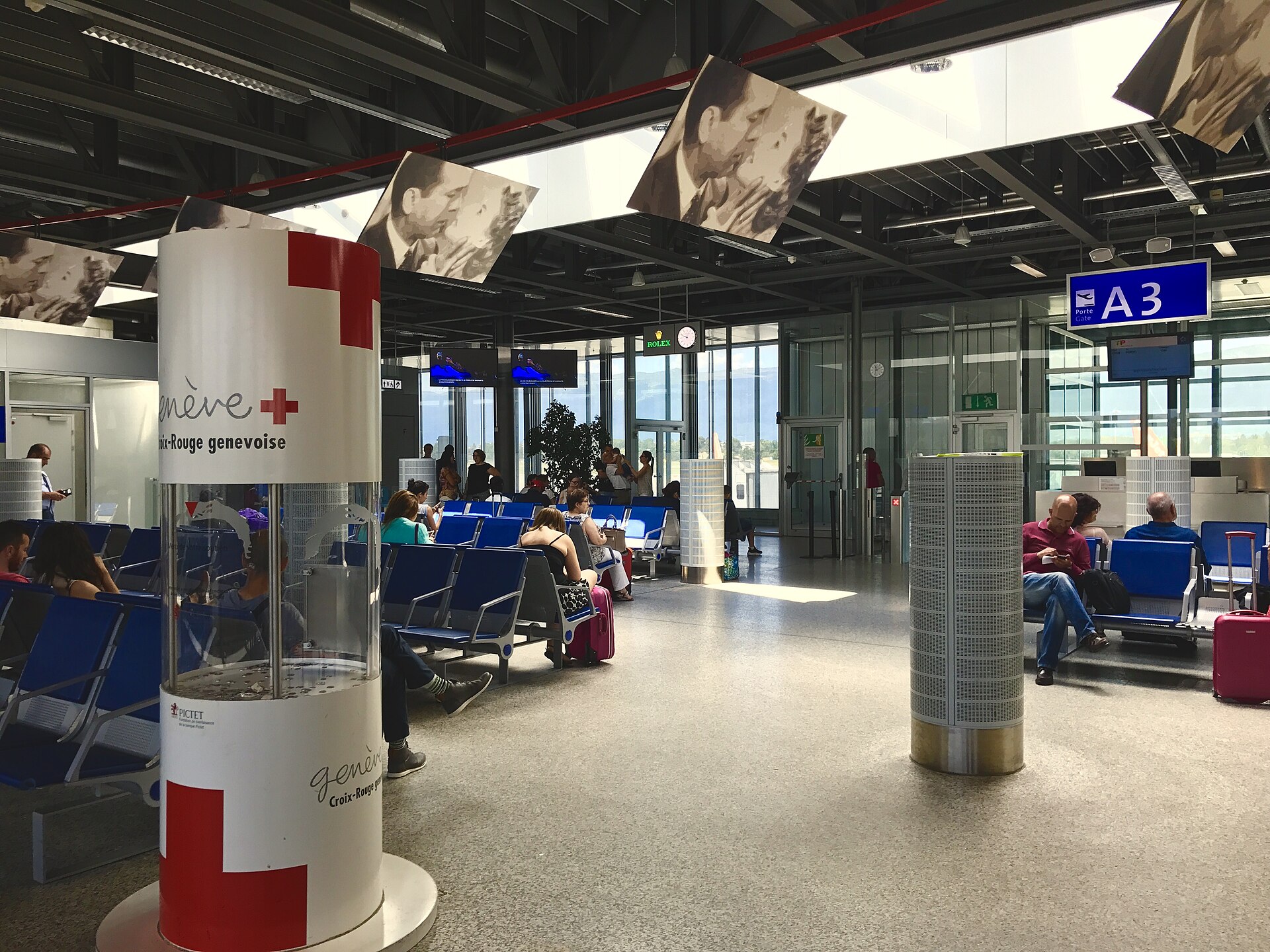
Geneva sorts its gates by pier letter rather than by terminal number, and the piers are organised around one question: is your flight inside the Schengen area or outside it? That determines whether you pass a passport check on the way to the gate, and passport checks in this building live in specific places.
| Pier | Typical traffic | Where it is | Posted walking time |
|---|---|---|---|
| A | Schengen short-haul, including the Zurich shuttle | Straight ahead from the main shopping area | About 5 minutes |
| B | Non-Schengen — UK and beyond | Satellite buildings reached by an underground tunnel with its own passport control | About 10 minutes |
| C | Non-Schengen and long-haul | To the right of Pier A | About 10 minutes |
| D | Mixed — Schengen upstairs, non-Schengen downstairs | Satellite plus bus gates, reached by tunnel from the left of Pier A | About 15 minutes |
| F | French sector departures | Separate part of the building with its own security and controls | About 15 minutes |
Gate numbers commonly run A1 to around A60 and B1 to around B40, with C, D and F gates numbered in their own ranges. Do not memorise any of this. Gate allocation shifts by season, by day and sometimes by hour, and easyJet in particular moves around. The board is the authority, and Geneva’s board tells you the walking time as well as the gate.
Pier B and the tunnel
The one part of the building that genuinely surprises people is Pier B. You do not walk to it along a concourse — you go down into an underground passage from near the main shopping area, pass through a passport control desk inside that tunnel, and come up in one of two satellite buildings out on the apron.
It is perfectly well signposted and takes about ten minutes, but if you are used to being able to see your gate from the shops, the descent feels like leaving the airport. It is also where the non-Schengen queue forms, so if you are flying to the UK on a busy morning, that ten minutes can become twenty.
Pier D and the bus gates
Pier D combines a satellite building with a set of bus gates, and it splits its traffic vertically: Schengen flights from the upper level, non-Schengen from the lower one. It is the furthest of the Swiss-side piers and the one where a bussed departure is most likely.
A bus gate is not a disaster, but it changes your timings. You board a bus at the stated gate time, ride out to a remote stand and climb steps. Allow the extra ten minutes and do not be the person still buying chocolate when the bus doors close.
03 — Swiss sector and French sector
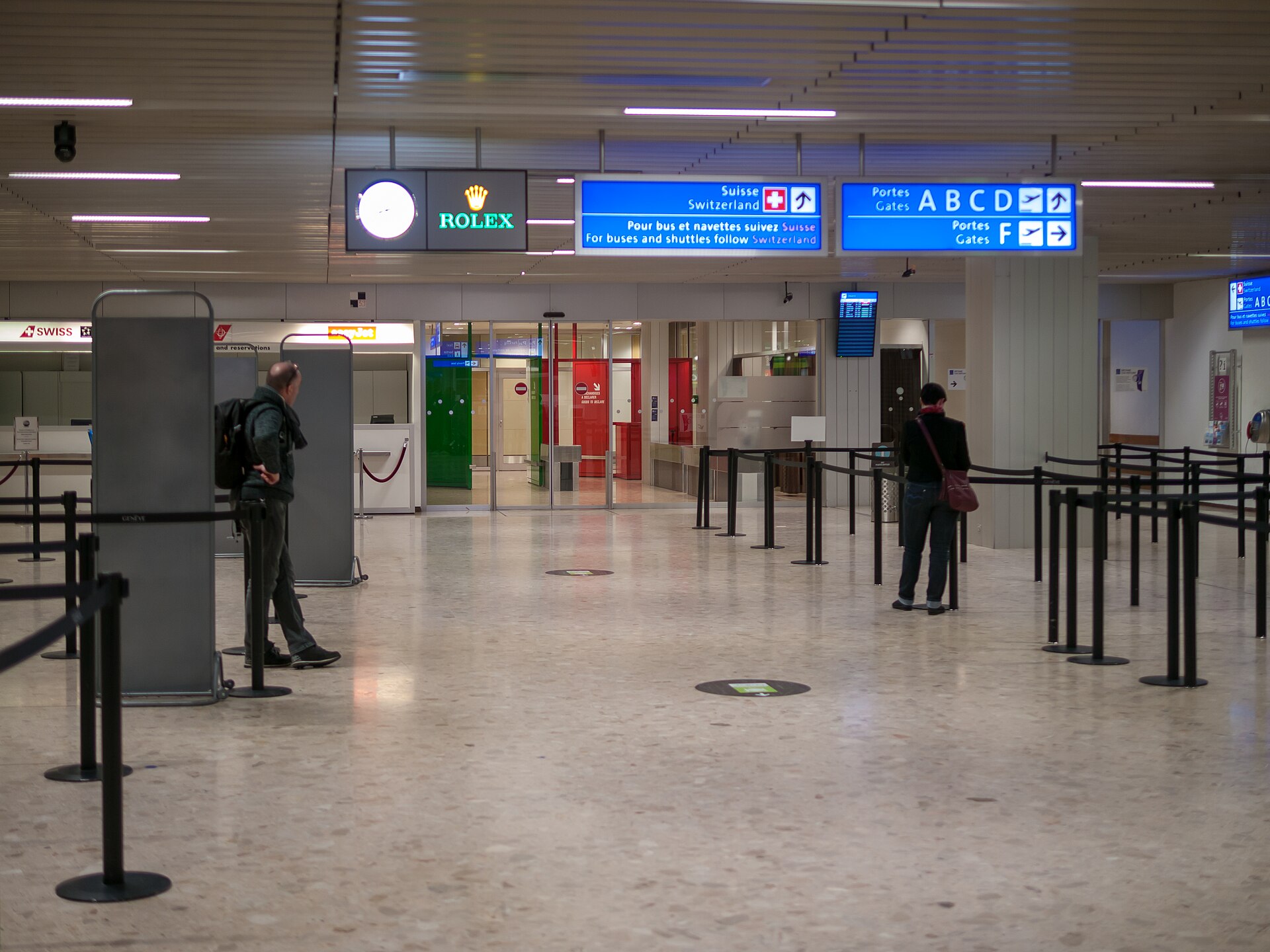
Running alongside the pier structure is a second, more consequential division. Part of Terminal 1 is a French sector with its own check-in, its own security, its own arrivals hall, its own customs channels and its own exit onto a French road. Gates F belong to it.
For most travellers this is simply a curiosity. It matters if:
- Your flight is marked SECT. FRANCE on the board — Geneva flags these explicitly, and it means a different part of the building.
- You are being met by a transfer driver, who will be on the Swiss side by default and cannot easily reach the French one.
- You are hiring a car, because the French-side desks are frequently cheaper.
- You are connecting between a French-sector flight and a Swiss-sector one, which is a border crossing, not a walk down a corridor.
The full explanation — how the arrangement came about, what it saves you and how it strands people — is in our guide to Geneva Airport’s French sector.
04 — Arrivals: one hall, two entrances

Arriving at Geneva is straightforward in the Swiss sector. You come down from the pier, clear passport control if you are non-Schengen, collect luggage, walk through customs and out into a broad hall with car hire desks, transfer meeting points, cafés and the escalators to the railway station.
Two details are worth knowing before you land:
- Oversized baggage does not come out on the carousels. Skis, boards, golf bags and bicycles arrive at a separate large-baggage point in the reclaim hall. In winter this is the slowest step in the whole process.
- The French-sector arrivals hall is a different room with a different exit onto a different road. If someone is meeting you, they need to know which.
05 — Security, passport control and where the queues really form
Distance is never the problem at Geneva. Queues are, and they form in three specific places.
Security
Central security serves the Swiss sector and is the main choke point on departure. It is efficient on an ordinary weekday and slow on a winter Saturday morning, when the ski charters and the scheduled short-haul peak together. The airport publishes live waiting times; check them before you leave your hotel or resort rather than when you walk in.
Standard Schengen rules apply to liquids and electronics, and Geneva enforces them without drama. Ski helmets, boots and poles go through the scanner without difficulty. Avalanche transceivers are fine; gas cartridges for airbag rucksacks are not, and that is an airline question rather than a security one.
Passport control on departure
If you are flying outside Schengen — to the UK, for instance — you pass a passport check on the way to the gate rather than at the entrance to security. For Pier B that check sits inside the underground tunnel, which means the queue forms below ground where you cannot see it from the shops. This is the single most common way to be surprised at Geneva: you clear security in six minutes, browse for twenty, and then find fifteen minutes of passport queue between you and your gate.
The fix is not complicated. If you are flying non-Schengen, go through to your pier first and shop on the far side of the control.
Passport control on arrival
Schengen arrivals walk straight out. Non-Schengen arrivals queue, and in the winter peak that queue is the airport’s least popular feature. There are automated gates for eligible passport holders, and using them saves real time when they are open.
06 — Terminal 2, and when you will meet it
Terminal 2 is a survivor from an older era of the airport, kept for the weeks when Geneva’s traffic simply will not fit in T1 — winter weekends, when ski charters arrive in waves.
- It sits roughly 300 metres from T1, around five minutes on foot along a connected route, with a shuttle for those who need it.
- Facilities are basic. Expect a check-in row, a security lane and a modest waiting area, not a shopping concourse.
- It is closed entirely outside the winter season, so an out-of-date guide telling you to check in there will send you to a locked door.
- Arrivals from T2 feed into the same broad arrivals area as T1, so a driver meeting you does not need a different plan.
The practical advice is simple: if your booking says Terminal 2, allow an extra twenty minutes and follow the signs rather than your memory of the airport.
07 — Getting between things: the real walking times
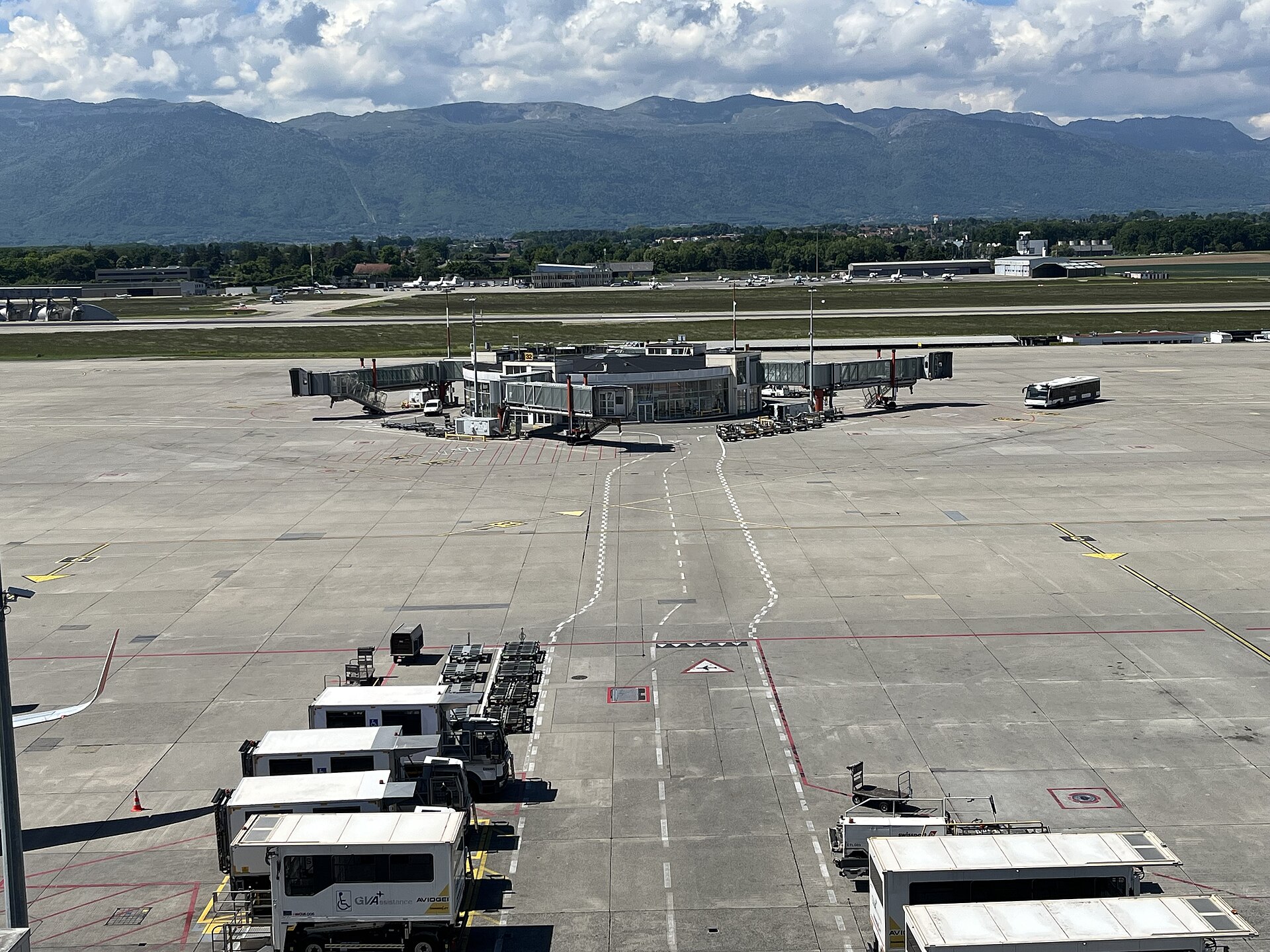
Geneva is small. That is its best feature and the thing most worth internalising, because it means your margins are about queues, not distance.
| Journey | Realistic time |
|---|---|
| Kerbside to check-in desk | 2–3 minutes |
| Check-in to security | 2 minutes plus the queue |
| Security to the nearest gate (Pier A) | About 5 minutes |
| Security to the furthest gate (Pier D or F) | About 15 minutes |
| Arrivals hall to the railway platform | 3–4 minutes, one escalator |
| Arrivals hall to the bus stop | 2 minutes |
| T1 central hall to T2 | About 5 minutes on foot |
| Swiss sector to French sector | Not a walk — a controlled crossing, allow much longer |
The corollary: if you are running late at Geneva, the thing to worry about is security and passport control, never the walk. Twelve minutes gets you almost anywhere in this building from almost anywhere else.
08 — What is where in Terminal 1
Landside, before security
- Check-in desks along the length of the departures level, with self-service bag drop for most carriers.
- Oversize and special baggage drop-off, separate from the main belts — the one to find early in ski season.
- Car hire desks, in both the Swiss and French sectors.
- A pharmacy, cash machines, luggage storage and a supermarket-style shop for anything you have forgotten.
- Escalators down to the railway station, and out to the bus stops and the kerbside pick-up area.
Airside, after security
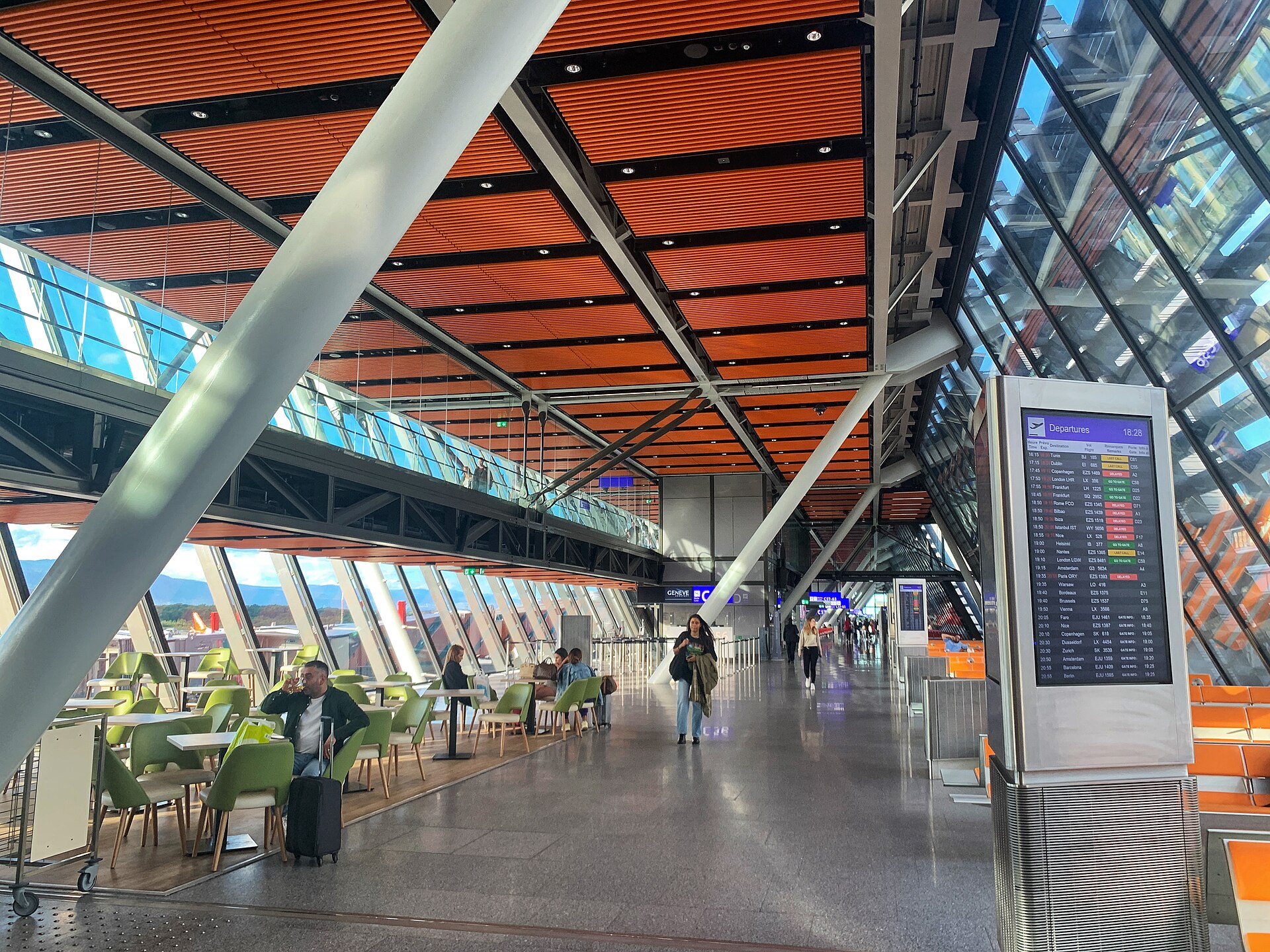
- The main shopping area sits centrally, with the piers radiating from it — this is the point from which every walking time is measured.
- Swiss watch and chocolate retail in quantity, plus duty-free doing a lively trade in the direction of France.
- Cafés, bakeries and a handful of proper restaurants. Prices are Swiss; the tap water is excellent and free.
- Lounges, split between the sectors and between operators.
- A viewing terrace with a genuinely good outlook across the apron to the Jura.
- Free wi-fi throughout, and charging points at most seating areas.
Which of those lounges you can actually get into — on a Priority Pass, on a paid entry, or on an airline ticket — is worked through in our guide to Geneva Airport lounges.
09 — Facilities worth knowing about by name
- Luggage storage. Available at the airport, and separately at the railway station below it, where the left-luggage office accepts skis and boards. That second one is the useful trick for a long layover or a late flight after an early checkout.
- Showers. Available to lounge users, which is worth factoring into whether a paid lounge is good value after a long-haul arrival.
- Pharmacy and medical service. Both landside, and both genuinely useful if a ski week ended badly.
- Prayer and quiet rooms. Provided; ask at an information desk for the current location, which has moved with building works.
- Play areas. Modest but present, and the viewing terrace does more for a restless child than any soft-play corner.
- Water fountains. Swiss tap water is excellent and free. Airport bottled water is neither.
- Information desks. Staffed, multilingual and genuinely helpful, which is not true everywhere.
One thing Geneva does not have in quantity is quiet seating away from retail. If you want somewhere calm to wait, the far end of a pier is better than the central hall, and the viewing terrace is better than either when the weather allows.
10 — Step-free routes and assistance
Terminal 1 is step-free throughout, including the tunnels to the satellite piers, which have travelators on the longer stretches and lifts where levels change. The railway station below arrivals has lifts to both platforms, and TPG’s buses are low-floor.
- Assistance for reduced mobility should be booked through your airline at least 48 hours ahead.
- Meeting points are signposted at the kerbside, in the check-in halls and in arrivals.
- Book assistance for the correct sector. If your flight is French-sector, the arrangement is made there, and a request logged against the Swiss sector will not find you.
- Bus gates at Pier D involve a lift-equipped vehicle where assistance has been arranged, but they are the part of the airport where advance notice matters most.
11 — The station, the buses and the roads
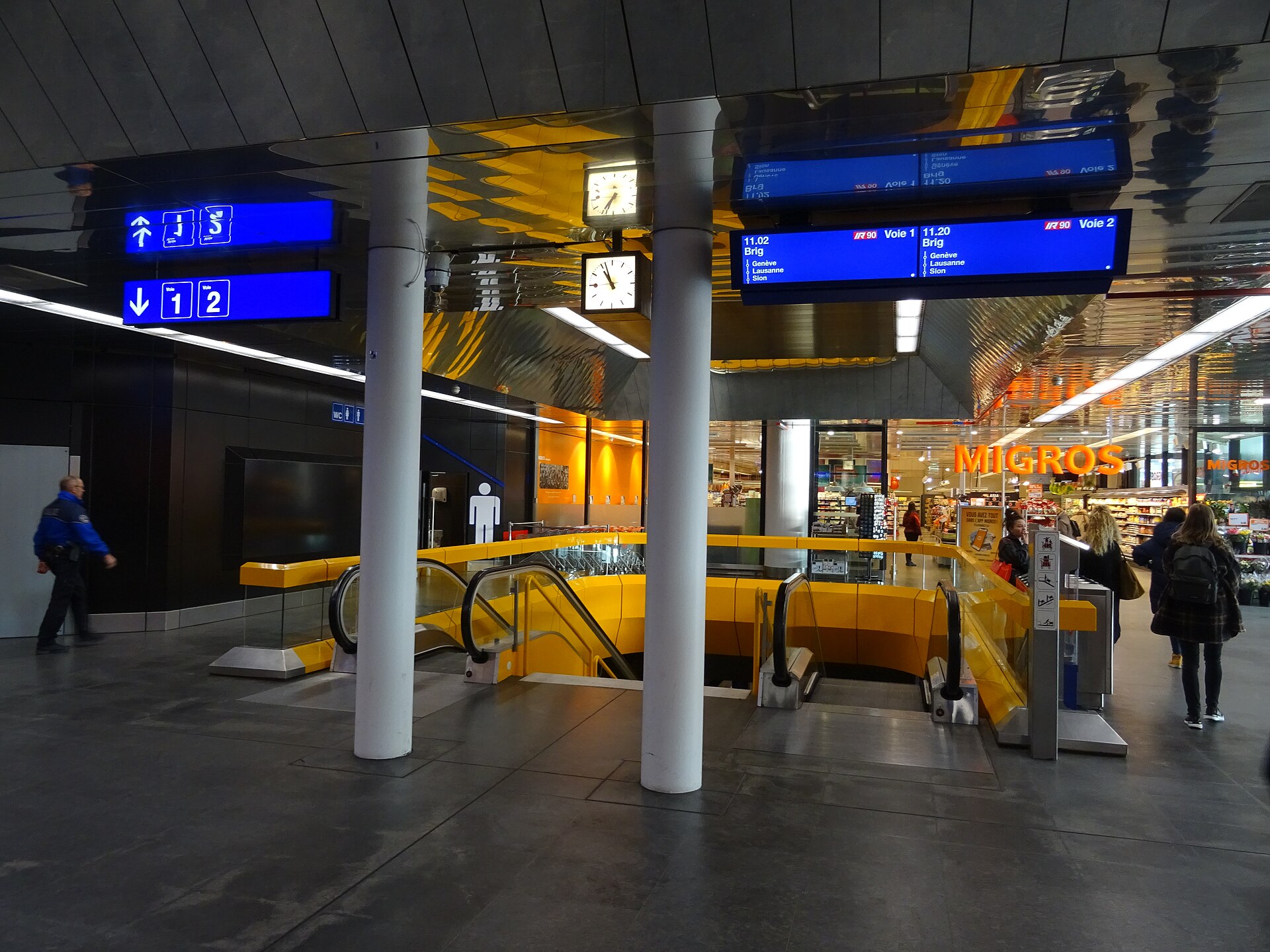
The railway station is part of the terminal complex, not a separate building, and it is the single most useful thing about arriving here. Trains reach Genève-Cornavin in about six minutes and continue along the mainline towards Lausanne, Sion and Brig.
Outside the arrivals hall you will find the TPG bus stops, the taxi rank, the kerbside pick-up area used by most transfer operators, and the exits towards the car parks. The ski-transfer coaches use their own dedicated area, which is signposted and a short walk from the exit — confirm with your operator which pick-up point they use, because “outside arrivals” covers several different kerbs.
Car parks run from the multi-storey decks beside the terminal to long-stay lots and the noticeably cheaper French-side options: see the Geneva Airport parking guide for what each really costs.
Frequently asked questions
How many terminals does Geneva Airport have?
Two — Terminal 1, which handles the overwhelming majority of flights all year, and Terminal 2, a small seasonal building open at weekends in winter for charter traffic. Most passengers only ever use T1.
Are Geneva’s terminals connected?
Yes. T1 and T2 are about 300 metres apart with a walking route and a shuttle between them, and arrivals from both feed into the same area. The division that actually requires planning is not T1 versus T2 but the Swiss sector versus the French sector.
How long does it take to walk to the gate?
Between about five and fifteen minutes from the central shopping area, depending on the pier — and the airport posts the figure for each pier on its departure boards. Pier A is the closest, D and F the furthest.
Which pier will my flight leave from?
Check the board rather than guessing. As a rule of thumb, Schengen short-haul goes from A, non-Schengen from B or C, mixed traffic from D, and French-sector flights from F — but allocation changes constantly and this is a hint, not a rule.
Is there a shuttle inside the terminal?
No, and there does not need to be. Everything in T1 is within a fifteen-minute walk, and the underground tunnels to the satellite piers are level and step-free with travelators on the longer stretches.
Where is the oversize baggage drop-off?
On the departures level, separate from the standard bag belts and signposted for special and outsize items. In ski season it is one of the busiest points in the building, so find it before you join a check-in queue rather than after.
Can I get between the Swiss and French sectors?
There is a controlled passage, but it is a border crossing rather than a stroll and it is not the way to save time on a tight connection. If you have flights in both sectors on separate tickets, treat it as two separate airport visits.
Gates F belong to a part of the building that is legally French, with its own check-in, customs channels and road out — the whole arrangement is set out in Geneva Airport’s French sector, explained.
Knowing the building matters most when you are deciding whether to leave it — see what to do on a Geneva Airport layover for the time budget in and out.
The pier you fly from also decides your lounge, because only one buyable lounge serves the non-Schengen gates: see which Geneva Airport lounges you can actually use.
Where you park decides how long the walk in takes, and the long-stay lots add ten to fifteen minutes to everything in this guide — see Geneva Airport parking compared.
The luggage lockers aren’t in the terminal at all but in the SBB station beneath it, open around the clock. Our Geneva Airport luggage storage guide has the details.
12 — Related Geneva guides
- Geneva Airport: the complete guide — the whole airport in one place.
- Geneva Airport to the city centre — the six-minute train and every other route.
- Flying to Geneva with skis — the oversize baggage problem in detail.
- Hotels near Geneva Airport — for early departures.
- Geneva ski transfers — from the kerbside to the Alps.
- Geneva transport guide — the city network once you are in.