Geneva's History, Heritage & International Importance
History of Geneva — From Roman Settlement to Global City
This article contains advertising. Our booking links are routed through a partner that adds commission tracking automatically, so if you book through one we earn a commission from the provider, at no extra cost to you. It never affects what we recommend. Affiliate disclosure
Geneva did not become the world’s diplomatic capital by accident. Two thousand years of being squeezed between empires, a runaway religious reformation, a literal ladder attack on Christmas Eve 1602, and a stubborn refusal to join its neighbours’ wars all played a part. Walk Geneva’s old town today and the layers are still visible — Roman foundations under the cathedral, medieval arcades, sixteenth-century plaques marking where Calvin preached, and the diplomatic quarter built around an institution that no longer exists. This is the long version of how a town of 70,000 stone-cutters and watchmakers ended up hosting the United Nations.
01 — What’s in this guide
- Geneva at a glance
- Roman Genava (58 BC – 5th century)
- Burgundian capital and the Tauredunum tsunami
- Prince-bishops, Savoyards, and the long medieval squeeze
- The Swiss alliance and the road to independence
- Calvin’s Reformation Republic (1536)
- L’Escalade — the night that defined Geneva
- Aristocratic republic and the Genevan Enlightenment
- French annexation (1798–1813)
- Joining Switzerland in 1815
- The birth of “International Geneva”
- The League of Nations era (1920–1946)
- The UN era and Cold War diplomacy
- CERN, the web, and modern Geneva
- How to walk the history yourself
- FAQ
02 — Geneva at a glance: a 2,000-year timeline
Before we get into the weeds, a quick orientation. Geneva is one of those rare European cities where you can map the broad arc of Western history onto a single street. Here are the dates worth memorising before you keep reading.
| Date | What happened | Why it mattered |
|---|---|---|
| 58 BC | Julius Caesar arrives at Genava and demolishes the bridge over the Rhône | First written mention — in De Bello Gallico |
| c. 380 AD | Christianity arrives; a cathedral compound rises on the hill | Foundations still visible under Saint-Pierre today |
| 443 AD | Burgundians make Geneva a capital | The town becomes a regional centre, not a frontier post |
| 563 AD | The Tauredunum event sends a tsunami across Lake Geneva | Eyewitness accounts describe waves wrecking the lakefront |
| 1387 | Prince-Bishop Adhémar Fabri grants the franchises | The first written constitution of Genevan liberties |
| 1526 | Geneva signs a combourgeoisie with Bern and Fribourg | The diplomatic break with Savoy begins |
| 21 May 1536 | The General Council votes “to live according to the Gospel” | Geneva officially becomes Protestant |
| 11–12 December 1602 | L’Escalade — Savoyard troops attempt a night assault | The defining patriotic moment of the Republic |
| 1798 | France annexes Geneva | End of the independent Republic of Geneva |
| 19 May 1815 | Geneva joins the Swiss Confederation | Becomes the 22nd canton |
| 1863 | Henry Dunant founds the Red Cross in Geneva | The origin of modern humanitarianism |
| 1920 | League of Nations headquartered in Geneva | City becomes the world’s first diplomatic capital |
| 1946 | UN takes over the Palais des Nations | Geneva re-launches as the operational hub of the UN |
| 1989 | Tim Berners-Lee invents the World Wide Web at CERN | The internet, in its modern form, is a Geneva export |
03 — Roman Genava (58 BC – 5th century)
The first time Geneva appears in writing, it is being broken. In Book I of De Bello Gallico, Julius Caesar describes arriving at “the farthest town of the Allobroges, next to the borders of the Helvetii. From this town a bridge stretches to the Helvetii.” His soldiers tore down that bridge in 58 BC to stop the Helvetii — a Celtic tribe migrating west — from crossing the Rhône. The town’s name in his text is Genava, and that single Latin sentence is the founding document of recorded Genevan history.
Before Caesar, the site had been occupied for at least a millennium. Iron Age Celts of the Allobroges tribe had a fortified settlement on the hill where the cathedral now stands. The location was already obvious: a defensible plateau where the Rhône narrows as it leaves Lake Geneva, controlling traffic between the Alps and the Mediterranean. Stand on the cathedral terrace today and you can see exactly why someone would put a town here.
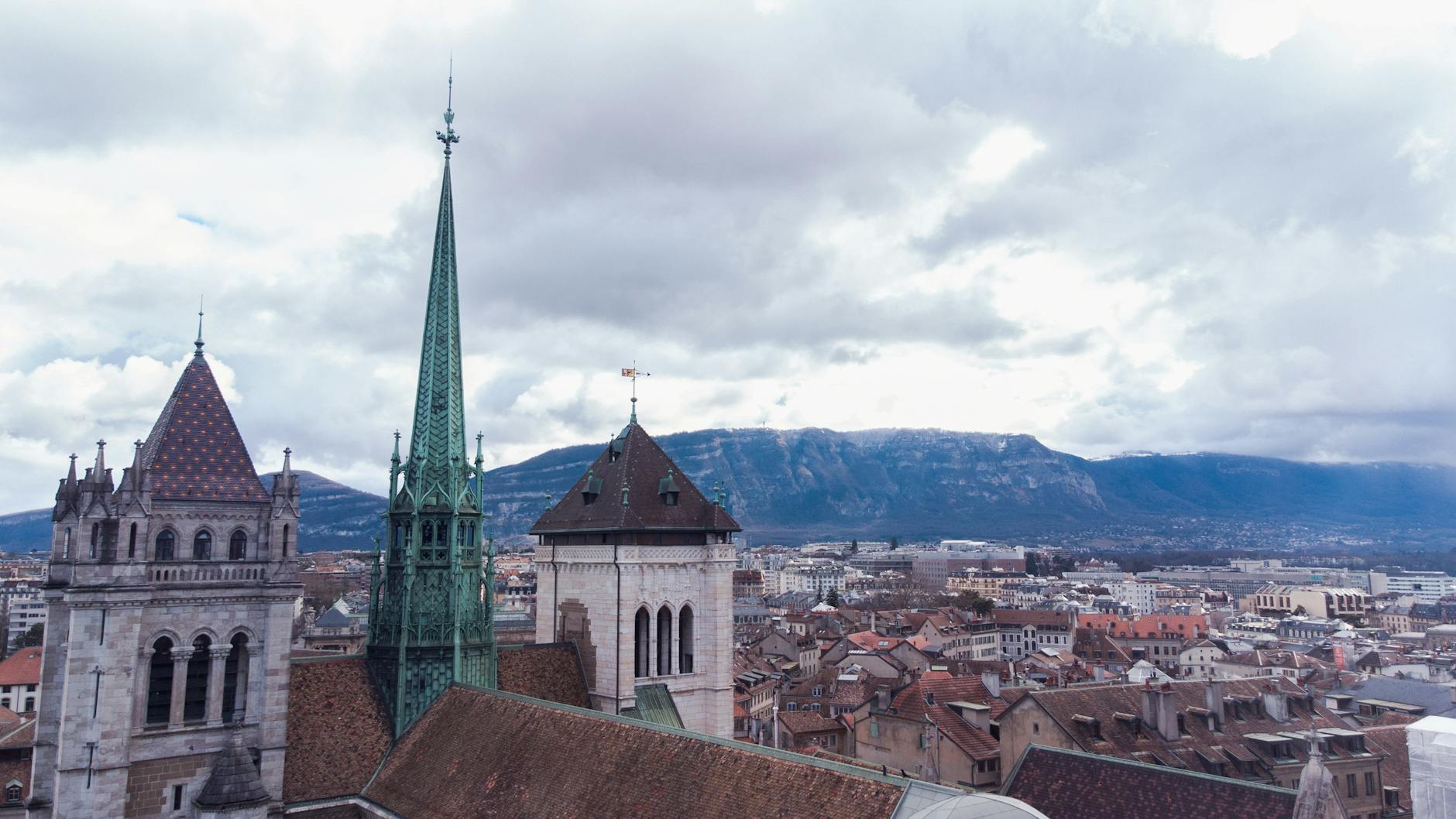
Under Rome, Genava became a vicus — a market town, smaller than a colony but large enough to host a forum, baths, and a wooden bridge that Caesar’s engineers eventually rebuilt. The Allobroges were Romanised quickly and the town slipped into the rhythm of the empire. By the third century AD a Christian community had appeared; by 381 AD a bishop, Isaac, was attending councils as a representative of Genava. The earliest layers of the Site Archéologique de Saint-Pierre — open to the public today beneath the cathedral — date from this period, including a fourth-century baptistery and the foundations of a sequence of Christian basilicas. It is one of the most concentrated archaeological sites of late-antique Christianity in Europe, and it is sitting under one of the most-visited tourist attractions in the city.
04 — Burgundian capital and the Tauredunum tsunami
Rome’s withdrawal in the fifth century was less a collapse than a slow handover. By 443 AD the Burgundians — a Germanic people who had cut a deal with the empire — were installed in the region with Roman blessing, and Geneva briefly became one of their capitals. King Gundobad codified Burgundian law from the town in the early 500s. The Romans had built the town; the Burgundians made it administer.
Then came what is probably the most extraordinary natural event in Geneva’s history. In late 563 AD, a massive rockfall above the eastern end of Lake Geneva — at a place called Tauredunum — sent debris into the lake. The displaced water surged west as a tsunami. Two near-contemporary chroniclers, Gregory of Tours and Marius of Avenches, describe waves striking villages along the shoreline, sweeping away the bridges of Geneva, and drowning people in the lower town. Modern sediment cores have confirmed that the event happened roughly when the chroniclers said. A team from the University of Geneva published the geological evidence in 2012. It is the only recorded tsunami in central European history.
The Burgundian kingdom did not last. In 534 AD the Franks absorbed it, and Geneva became a peripheral town in an enormous, unstable empire that would eventually fracture into the Holy Roman Empire and France. Through all of this, the bishops kept the lights on.
05 — Prince-bishops, Savoyards, and the long medieval squeeze
From the eighth century onwards, the Bishop of Geneva was the effective ruler of the town. The arrangement was formalised in 1162, when Emperor Frederick Barbarossa granted the bishop the secular title of Prince of the Holy Roman Empire. Geneva was now technically an imperial city ruled by a bishop-prince, in practice a constant negotiation between three powers: the bishop, the noble counts of Geneva (and later the dukes of Savoy who absorbed them), and the burghers — the merchants and artisans of the town itself.
The burghers won concession after concession. The high point of medieval Genevan liberty was the Franchises of Adhémar Fabri in 1387, a charter that gave the citizens the right to elect their own council, run their own courts, and manage their own taxes. The document is short, in Latin, and one of the founding texts of Swiss self-government. If you visit the Hôtel de Ville in old town, the Salle Baudet displays a copy.
What made the medieval period uncomfortable was Savoy. The dukes of Savoy ruled an expanding Alpine state from Chambéry (later Turin) and they wanted Geneva as a possession, not an ally. From the late fifteenth century the bishops were often Savoyard appointees, and Savoy’s pressure on the town’s independence steadily increased. The Genevans started looking north for help.
06 — The Swiss alliance and the road to independence
In 1526 Geneva signed a treaty of combourgeoisie — a mutual-defence pact giving citizens of one place legal rights in the other — with the Swiss cities of Bern and Fribourg. The treaty was a polite diplomatic instrument and a clear act of rebellion. Savoy understood it as such. The years that followed saw Genevan patriots — the Eidguenots, from a German word that gave us “Huguenot” — fighting an intermittent war of independence against Savoyard loyalists, while courting their Swiss protectors.
Things accelerated in 1530 when an attempted Savoyard coup failed, and in 1535 when the last Catholic bishop fled the city. By the time the General Council voted to embrace the Reformation on 21 May 1536, Geneva was effectively a sovereign republic — a tiny city-state of about 10,000 people, surrounded by hostile territory, allied with the Swiss but not yet of them. The Bernese were so worried about Savoy reasserting itself that in that same year they sent an army that took over much of the Vaud region around the lake, creating a protective buffer that lasted until 1798.
07 — Calvin’s Reformation Republic (1536)
Geneva’s Reformation has its own dedicated article (linked below), but the short version: in 1536 a fiery French preacher named Guillaume Farel passed through Geneva and convinced an even more fiery French theologian named Jean Calvin to stay and help build the new church. Calvin was 27 and had just published The Institutes of the Christian Religion. He arrived intending to spend a single night.
He stayed for most of the next 28 years, with one expulsion in the middle. Under his direction Geneva became what John Knox famously called “the most perfect school of Christ that ever was in the earth since the days of the apostles.” It also became a magnet for Protestant refugees from across Europe — French Huguenots, Italian and Spanish converts, English Marian exiles. The city’s population roughly doubled in a generation. Many of the refugees were skilled craftspeople, and they laid the foundations of the watchmaking, banking, and printing industries that would define Geneva for the next four centuries.
For a deeper dive into Calvin, the Consistory, the burning of Michael Servetus, and the Reformation’s economic legacy, see our dedicated guide to Geneva and the Reformation.
08 — L’Escalade — the night that defined Geneva
On the night of 11–12 December 1602, the Duke of Savoy — Charles Emmanuel I — sent a force of around 2,000 soldiers to scale Geneva’s walls with black-painted ladders. It was the last and most ambitious of decades of Savoyard attempts to take the city by force. Their plan was to drop into the lower town under cover of darkness, open the gates from inside, and let the main army in.
It almost worked. The attackers got over the wall and into the streets before the alarm was raised. What followed in the dark, narrow lanes of Geneva is a tangle of folklore and fact. Citizens fought in nightshirts with whatever was to hand. A woman named Mère Royaume reportedly emptied a cauldron of hot vegetable soup from her window onto a Savoyard soldier’s head — the origin of the marmite (cauldron) of chocolate that Genevans still smash and eat at the Escalade festival every December. By dawn the attack had failed, the Savoyards had retreated, and Geneva’s independence was effectively secured for the next two centuries.
L’Escalade is more than a costume parade. It is the founding myth of the Republic of Geneva — the moment when a town of merchants and artisans defeated a duke and proved that the Reformation experiment was here to stay. For a full account of the festival and the history behind it, see our L’Escalade guide.
09 — Aristocratic republic and the Genevan Enlightenment
The seventeenth and eighteenth centuries are the unsung great period of Genevan history. The Republic was small — about 25,000 people at its peak — but it punched extravagantly above its weight. Genevan watchmakers became the most sophisticated in Europe (a story we tell in detail in our watchmaking heritage guide). Genevan bankers — many of them refugee Huguenot families — became central figures in European finance, with branches as far afield as London, Amsterdam, and Paris. Genevan printers exported books to half the literate world.
Intellectually, the city produced an astonishing number of important figures for its size. Jean-Jacques Rousseau (born 1712, the philosopher whose The Social Contract opens “Man is born free, and everywhere he is in chains”) was a Genevan citizen who wrestled with the Republic his whole life. The mathematician Leonhard Euler studied here. The naturalist Horace-Bénédict de Saussure, whose 1787 ascent of Mont Blanc essentially invented the sport of alpinism, was Genevan. Voltaire spent his last 25 years just over the border at Ferney specifically to be near Genevan printers and salons.
Politically, the Republic was no democracy. By the eighteenth century power had concentrated in a handful of patrician families who sat on the Small Council and ran the city as a closed oligarchy. The tension between the Représentants (a broadly Rousseauist reform party) and the Négatifs (the conservatives) produced four political “Edicts of Mediation” between 1738 and 1782, an attempted revolution, foreign interventions by France and Bern, and a steady drip of exiled radicals — including, briefly, Rousseau himself.
10 — French annexation (1798–1813)
The independent Republic of Geneva ended on 15 April 1798 when French revolutionary troops marched in and annexed the city to the French Republic. Geneva became the capital of the new département du Léman. The annexation was unpopular but not actively resisted; the political elite was exhausted, the great powers had carved Europe up in their own interests, and France was the strongest player on the table.
French rule lasted fifteen years. It was administratively modernising and culturally homogenising — French became the only official language, the Napoleonic Code replaced Genevan civil law, the metric system arrived — but it was also extractive. Geneva contributed soldiers and taxes to Napoleon’s wars and got the same back as everyone else, which by 1813 meant defeat. Russian and Austrian troops liberated the city on 30 December 1813, and the Restoration began.
11 — Joining Switzerland in 1815
People often ask why Geneva was not part of Switzerland from the start. The short answer is that the Old Swiss Confederation was a defensive alliance of German-speaking rural cantons that had spent centuries gradually absorbing neighbours, and Geneva — French-speaking, urban, mercantile, Protestant since 1536, and protected by its combourgeoisie with Bern — was always an ally and never a member. There was simply no path for a city to “join” the Confederation in the way modern states join the EU.
The Congress of Vienna in 1815 changed all that. The great powers were redrawing the European map and the Swiss were redrawing their own constitution. Geneva’s leaders saw an opportunity and took it. On 19 May 1815, Geneva formally joined the Swiss Confederation as the 22nd canton. To make the canton territorially contiguous with the rest of Switzerland — Geneva is a thin sliver wedged between France and the lake — France and the Kingdom of Sardinia (which had recovered Savoy) ceded a string of villages around the city to the new canton, including Versoix, Carouge, and Chêne-Bougeries.
Switzerland adopted permanent neutrality at the same Congress. Geneva, the new western outpost of a neutral state, was now perfectly positioned for what came next.
12 — The birth of “International Geneva”
The phrase “International Geneva” is now a brand, but it has a precise origin date: 24 June 1859. That was the day a young Genevan businessman named Henry Dunant rode through the aftermath of the Battle of Solferino in northern Italy. What he saw — 40,000 dead and wounded men abandoned on the field with almost no medical care — convinced him to write a book, A Memory of Solferino, and to propose a permanent international body of neutral volunteers to care for war wounded.
That proposal became the International Committee of the Red Cross, founded in Geneva in 1863. The First Geneva Convention followed in 1864. Dunant won the first Nobel Peace Prize in 1901. The Red Cross gave Geneva an institutional identity as a neutral humanitarian capital — a reputation no city would later be able to compete with. For the full Dunant–ICRC story see our Red Cross and Geneva guide and our broader humanitarian capital guide.
The Red Cross was not alone. The Universal Postal Union picked Bern in 1874 but kept its model in mind for Geneva-style governance. The first Hague Conventions of 1899 and 1907 codified rules of war negotiated with heavy Genevan input. By 1914 the city was already a quiet hub of international NGOs and diplomatic activity, even before the global institutions arrived.
13 — The League of Nations era (1920–1946)
When the victorious Allies designed a permanent international organisation at Versailles in 1919, they needed a host city that was central, neutral, and had a track record of running international institutions. Geneva won the competition without much difficulty.
The League of Nations opened in Geneva in November 1920, initially in the lakeside Hôtel National. Over the next two decades the organisation grew, the staff grew, and the diplomatic community grew with them. A new headquarters was needed. Architects from across the world entered the competition; the winning design — a vast, calm, slightly austere classical complex by a five-architect international team — was the Palais des Nations, built in the Parc de l’Ariana between 1929 and 1938. It is still the largest UN building in Europe.
The League’s political record is a tragedy. It failed to stop Japan in Manchuria (1931), Italy in Ethiopia (1935), and Germany absolutely anywhere. By 1939 the Palais des Nations was a half-empty monument to a failed idea. But the League’s specialised agencies — the International Labour Organization, the precursors of the World Health Organization, the refugee work that would become UNHCR — survived and thrived. When the League was formally wound up in April 1946, its physical infrastructure, its staff, and many of its specialised agencies transferred directly to the new United Nations.
14 — The UN era and Cold War diplomacy
The UN’s headquarters went to New York, but the UN’s European headquarters — and the operational base for most of its specialised agencies — went to Geneva. The Palais des Nations became the UN Office at Geneva (UNOG), and over the following decades the surrounding neighbourhood filled with the headquarters of WHO, WTO, WIPO, UNHCR, OHCHR, ITU, IOM, and dozens of others. The Place des Nations, the Avenue de la Paix, and the Quai Wilson are essentially a diplomatic campus.
The Cold War cemented Geneva’s role. Because it was on neutral ground, the city became the default venue for any negotiation where Americans and Soviets needed to sit down across a table without political home advantage. The 1955 Geneva Summit (Eisenhower, Khrushchev, Eden, Faure) reopened East-West dialogue after Stalin’s death. The 1985 Reagan–Gorbachev summit, also in Geneva, launched the conversations that ended the Cold War. The Iran nuclear talks in the 2010s, the Syria peace talks (still ongoing), and the Russia–US strategic stability talks all happen here for the same reason: neutral ground with the infrastructure already in place.
15 — CERN, the web, and modern Geneva
Geneva’s scientific identity is younger than its diplomatic one but punches just as hard. CERN — the European Organization for Nuclear Research — was founded in 1954 with twelve member states pooling resources for fundamental physics research that no single country could afford. Its campus straddles the Swiss-French border in the western suburbs of Geneva, with tunnels for the Large Hadron Collider passing under both countries.
The most consequential thing CERN ever produced was not a physics paper. In March 1989, an English computer scientist named Tim Berners-Lee circulated a proposal at CERN for “a large hypertext database with typed links,” intended to let researchers share documents across CERN’s incompatible computer systems. By 1991 he had the first web server running. By 1993 CERN had placed the World Wide Web in the public domain, free for anyone to use. The internet existed before the web, but the web is why your grandmother is on it. It is a Geneva invention.
Modern Geneva — population roughly 200,000 in the city, 500,000 in the urban area, the second-largest in Switzerland after Zurich — is one of the most international cities on earth. About 40% of residents are foreign nationals. The headquarters of WHO, WTO, ICRC, UNHCR, and over 35 other international organisations are here. So is the European HQ of every major bank and law firm with international ambitions. And the watchmaking tradition that started with the Huguenots in the 1540s is still alive — Patek Philippe, Rolex (officially Genevan since 1919), Vacheron Constantin (founded in Geneva in 1755), Piaget, Chopard and a hundred smaller maisons still operate in and around the city.
16 — How to walk the history yourself
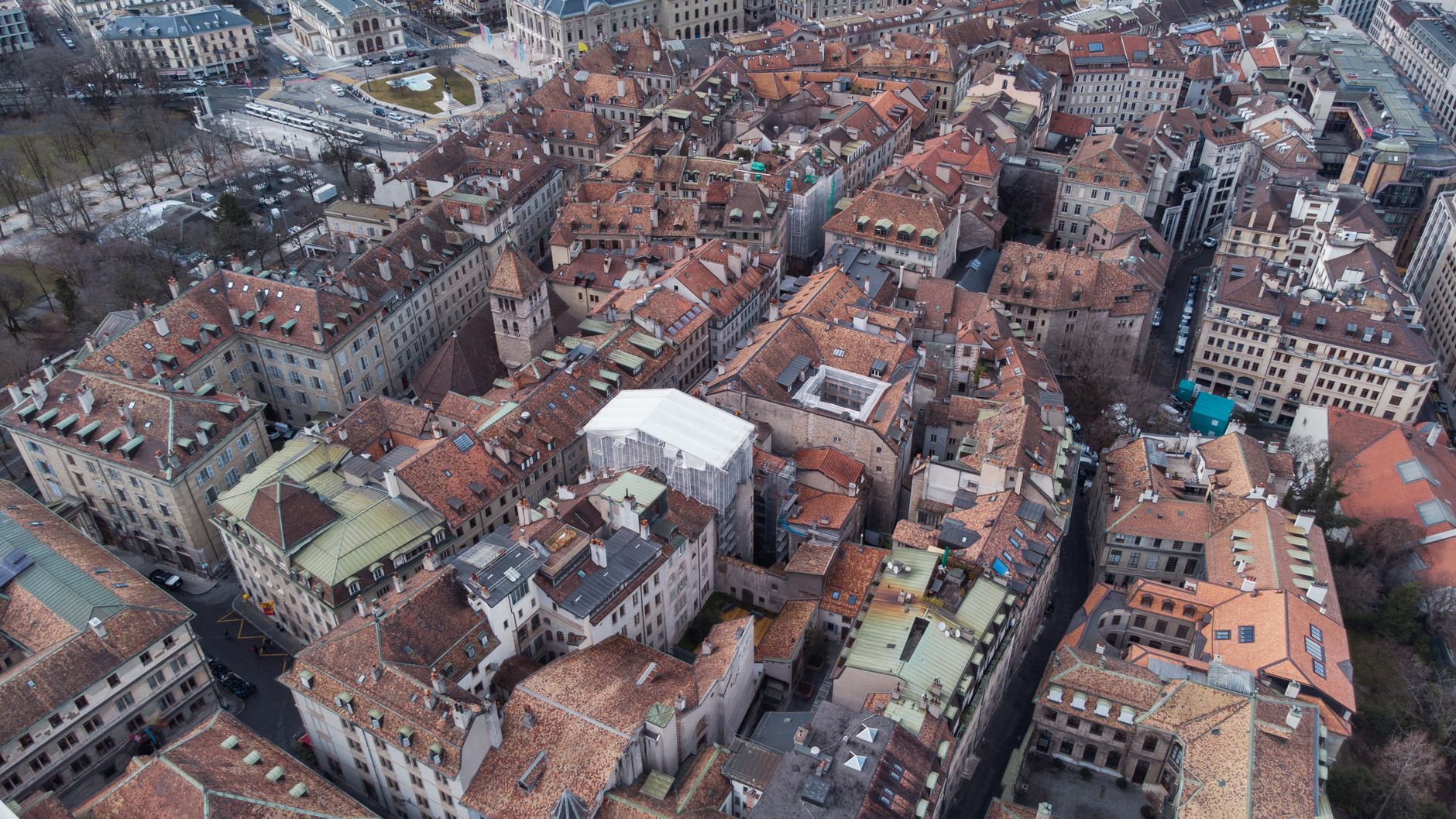
If you want to do all of this with your feet, here is a roughly two-hour route through 2,000 years of Geneva history. Start at Place du Bourg-de-Four, the medieval marketplace built on the site of the Roman forum — the oldest continuously inhabited square in the city. Climb the short hill to Cathédrale Saint-Pierre, descend into the Site Archéologique for the Roman and early Christian layers, then climb the cathedral towers for the view.
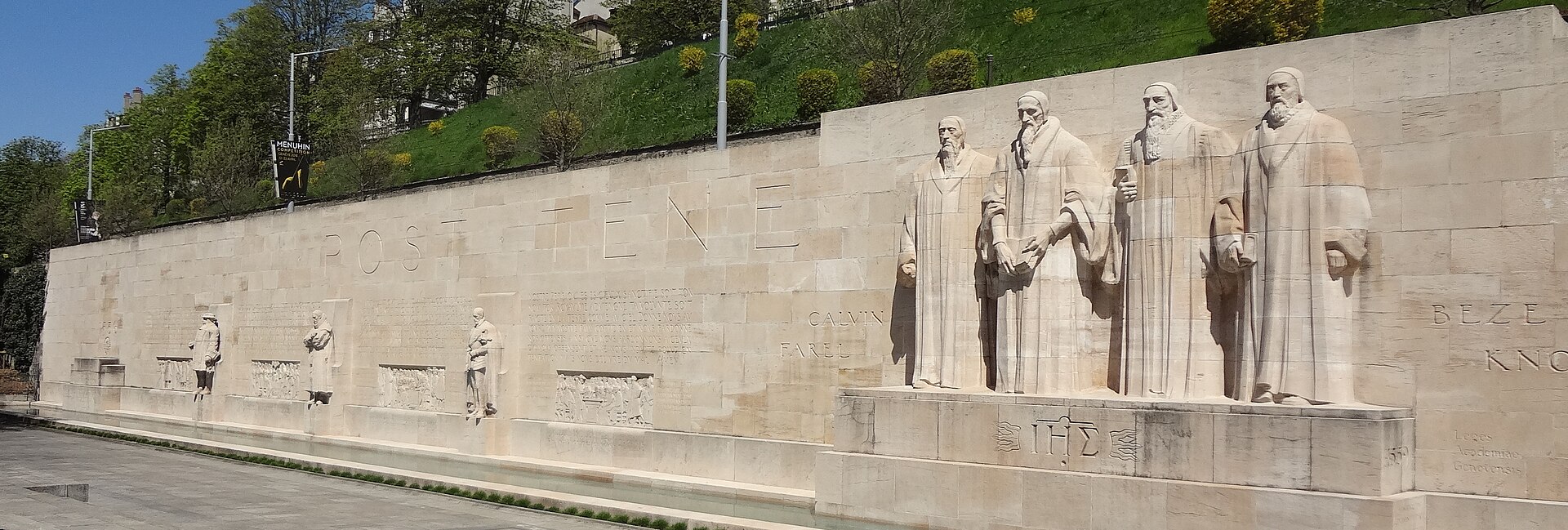
Walk west along Rue Jean-Calvin and Rue de l’Hôtel-de-Ville. The Maison Tavel — the oldest surviving private house in Geneva, 14th century — is now the museum of Geneva’s urban history and is free. Continue to the Hôtel de Ville, where the General Council voted for the Reformation in 1536 and where the first Geneva Convention was signed in 1864. Drop down to Parc des Bastions for the Reformation Wall — Calvin, Farel, Beza, and Knox in monumental stone — and the giant outdoor chess sets the locals use on summer afternoons.
For the international layer, take Bus 8 or Tram 15 up to Place des Nations. The Broken Chair sculpture faces the gates of the Palais des Nations; the UN guided tour (book ahead online) takes you inside the Council Chamber where the League of Nations met. Five minutes’ walk away, the Musée International de la Croix-Rouge et du Croissant-Rouge tells the Dunant story properly. For the modern Geneva, finish at CERN’s Science Gateway, opened in 2023 — Renzo Piano architecture, free entry, hands-on physics for adults and children.
For more structured walks see our things to do in Geneva pillar, and for planning the trip itself see our trip planning guide and how many days you need.
Frequently asked questions
How old is Geneva?
Geneva has been continuously inhabited for at least 3,000 years. The first written reference is Julius Caesar’s account from 58 BC, but Iron Age Celtic settlements on the cathedral hill date from around 1000 BC. The city has been an administrative centre — first Roman, then Burgundian, then episcopal, then republican, then Swiss — for over 1,600 years.
Was Geneva ever part of France?
Yes, briefly. France annexed Geneva in 1798 during the Revolutionary Wars, and the city was the capital of the French département du Léman until December 1813. Geneva joined the Swiss Confederation as the 22nd canton in 1815, and has been Swiss ever since.
Why is Geneva not part of France today?
Geographically it could be — the canton is a sliver of Swiss territory almost entirely surrounded by France. But politically Geneva’s identity has been resolutely independent since the Reformation in 1536. The city was an independent republic for two and a half centuries, joined Switzerland voluntarily in 1815, and has never seriously considered changing affiliation. The 1815 Congress of Vienna also ceded several French villages to the new canton specifically to make Geneva territorially viable inside Switzerland.
Who founded Geneva?
No single founder. Iron Age Celts of the Allobroges tribe settled the cathedral hill around 1000 BC. The Romans urbanised it after 58 BC. The Burgundians made it a capital in the fifth century AD. The medieval bishops gave it administrative continuity. The modern Republic of Geneva was effectively founded by the General Council’s vote for the Reformation on 21 May 1536.
Why is Geneva called the “Capital of Peace”?
Because of the concentration of peace and humanitarian institutions headquartered in the city — the International Committee of the Red Cross (founded 1863), the League of Nations (1920–1946), the UN Office at Geneva (1946–present), WHO, UNHCR, OHCHR, and the venues for most major Cold War and post-Cold War peace negotiations. The label dates from the League of Nations era and stuck.
When did the Reformation happen in Geneva?
The General Council voted to adopt the Protestant Reformation on 21 May 1536. Jean Calvin arrived in July of that year and, with one interruption, led the Genevan church until his death in 1564. The full story is in our Reformation guide.
What happened during L’Escalade?
On the night of 11–12 December 1602, troops of the Duke of Savoy attempted to scale Geneva’s walls with black-painted ladders and capture the city by surprise. They were repelled by the citizens in street fighting, and the attack failed by dawn. L’Escalade is commemorated every December with a costume procession, a vegetable-soup tradition, and the smashing of chocolate cauldrons. See our L’Escalade festival guide.
What was the League of Nations and why was it in Geneva?
The League of Nations was the world’s first general-purpose international organisation, created at the Treaty of Versailles in 1919 to prevent another world war. It chose Geneva as its headquarters in 1920 because of Switzerland’s permanent neutrality, the city’s existing reputation as the home of the Red Cross, and its central European location. The League dissolved in 1946 and the UN took over the same buildings.
How did Geneva become so international?
By accident at first, then by design. The Reformation made it a magnet for skilled Protestant refugees from across Europe. The Red Cross made it the first home of organised international humanitarianism. The League of Nations made it the institutional centre of multilateral diplomacy. By the time the UN arrived in 1946 the infrastructure — diplomatic, linguistic, legal, and practical — was already in place. Today about 40% of Geneva’s residents are foreign nationals and over 35 international organisations are headquartered in the city.
Where can I see Geneva’s history in person?
The Site Archéologique de Saint-Pierre (Roman and early Christian layers under the cathedral), the Maison Tavel (medieval Geneva), the Musée d’Art et d’Histoire (the full sweep), the International Museum of the Red Cross and Red Crescent (modern humanitarianism), and the UN guided tour at the Palais des Nations are the essential five. All are in our museums and cultural attractions guide.