Geneva's History, Heritage & International Importance
Geneva, the Humanitarian Capital — Why the World Comes Here for Help
This article contains advertising. Our booking links are routed through a partner that adds commission tracking automatically, so if you book through one we earn a commission from the provider, at no extra cost to you. It never affects what we recommend. Affiliate disclosure
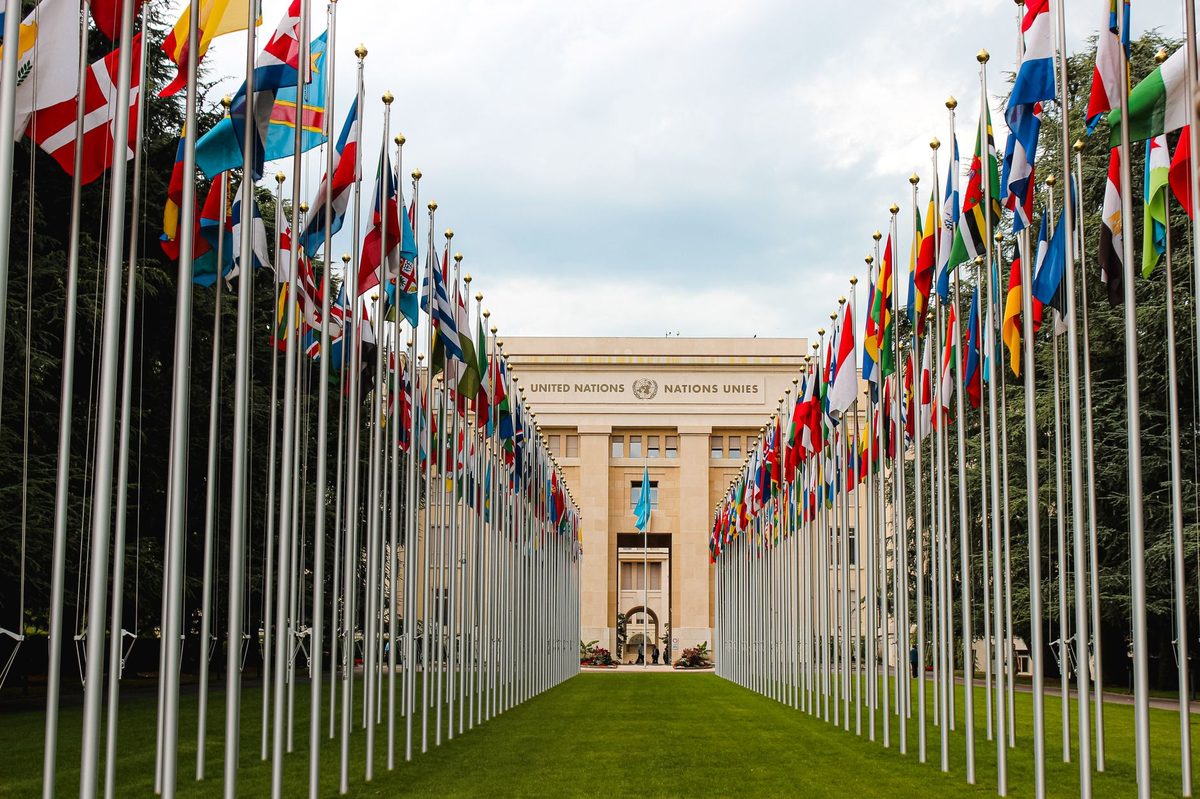
There are maybe four neighbourhoods on earth where you can stand in one spot and see the whole machinery of multilateral humanitarianism: Brussels for the EU, New York for the UN’s political headquarters, The Hague for international justice, and Geneva, where a lot of the actual work gets done. Across roughly two square kilometres around Place des Nations sit the global headquarters of WHO, UNHCR, the ICRC, the WTO, WIPO, the ILO, the ITU, OHCHR, IOM and dozens of smaller bodies. About 38,000 people work in international organisations here. Another 12,000 work in the roughly 750 NGOs that set up nearby to be close to them.
The phrase “humanitarian capital” gets thrown around loosely. In Geneva it is literal. This guide explains how Geneva became the humanitarian capital, what is actually here, and how to see it as a visitor. For the longer backstory, start at the Geneva history and heritage pillar; to turn the reading into a day on foot, pair it with things to do in Geneva and the trip planner.
01 — How did Geneva become the humanitarian capital?
Three things stacked on top of each other across a hundred and sixty years. Each was contingent, none of them had to happen, but together they made the city’s identity as the humanitarian capital almost inevitable.
First, permanent neutrality. Switzerland’s neutrality was guaranteed by the great powers at the Congress of Vienna in 1815, the same year Geneva joined the Confederation. By the late nineteenth century neutrality had become a strategic resource: a country that does not take sides in wars can host conversations that warring countries cannot host themselves. Geneva, as the western edge of a neutral state with good rail connections to the rest of Europe, was the natural beneficiary.
Second, a private founding act. The Red Cross was started in 1863 by five Genevan citizens (Henry Dunant, Gustave Moynier, General Guillaume-Henri Dufour, Louis Appia, and Theodore Maunoir) without any government commission. It was a Swiss civic initiative that the Swiss government later supported. This pattern of private Genevan leadership setting the agenda for governments became a template.
Third, institutional path dependence. Once the Red Cross was operating successfully out of Geneva and the Geneva Conventions had been signed (1864, 1906, 1929, 1949), the logical home for any subsequent multilateral institution dealing with war, refugees, health, or international law was the city that already had the infrastructure. The League of Nations choosing Geneva in 1920 confirmed an existing trend rather than starting one. The UN inheriting Geneva from the League in 1946 was the same again. Each new institution reinforced the city’s gravitational pull on the next.
02 — The Red Cross and the birth of organised humanitarianism
On 24 June 1859 the young Genevan businessman Henry Dunant rode through the aftermath of the Battle of Solferino in Lombardy, where a French-Sardinian army had defeated the Austrians at a cost of 40,000 dead and wounded in a single day. There were almost no medics. Dunant (who was in northern Italy on business, hoping to meet Napoleon III about a financial project in Algeria) organised civilian volunteers to care for the wounded of both armies, set up a field hospital in a church at Castiglione, and went home shaken.
His 1862 book Un souvenir de Solferino proposed two things: a permanent international body of neutral volunteers trained to care for war wounded, and a binding international treaty obliging armies to respect medical personnel and the wounded as non-combatants. He sent copies to every European head of state.
By February 1863 a committee of five Genevans (Dunant plus the lawyer Gustave Moynier, the general Guillaume-Henri Dufour, and the doctors Louis Appia and Theodore Maunoir) was meeting at the Societe Genevoise d’Utilite Publique to act on the idea. In October 1863 they convened an international conference. In August 1864 a diplomatic conference at the Hotel de Ville produced the First Geneva Convention for the Amelioration of the Condition of the Wounded in Armies in the Field, signed by twelve states. The Red Cross was operational. The Geneva Conventions had begun.
Dunant was awarded the first Nobel Peace Prize in 1901, by then bankrupt and living in an old people’s home in Heiden. The ICRC has won the Nobel Peace Prize three times since (1917, 1944, 1963). The League of Red Cross and Red Crescent Societies has won it once (1963, shared with the ICRC). No other organisation in history has won the Peace Prize as often as the institution Dunant founded. For the full story see our Red Cross and Geneva guide.
03 — The League of Nations: the first attempt
The First World War destroyed the late-Victorian belief that European civilisation had outgrown large-scale violence. The League of Nations, written into the Treaty of Versailles in 1919 at the insistence of US President Woodrow Wilson, was the response: a permanent intergovernmental body meant to prevent another world war through collective security and arbitration. The League had to be headquartered somewhere, and Geneva won the choice unanimously. Switzerland’s neutrality, the city’s reputation as the Red Cross capital, central European geography, and the personal lobbying of the Genevan statesman Gustave Ador all pointed the same way.
The League opened in November 1920 in the rented Hotel National on the lakeshore (now the UN’s Palais Wilson). Over the next two decades it grew steadily, peaked at 58 member states in 1934, and then collapsed politically as Japan, Italy and Germany walked out one after another. By 1939 the League was a hollowed-out monument. Its famous physical home, the Palais des Nations, built between 1929 and 1938 in Parc Ariana by a five-architect international team, was barely occupied before the Second World War shut everything down.
But the League’s specialised technical bodies were where the real work happened, and they thrived. The International Labour Organization (ILO, founded 1919) survived the League and is still operating today. The Health Organisation of the League became the World Health Organization in 1948. The High Commissioner for Refugees, an office created in 1921 to deal with displaced Russians and Armenians after the war, became the UNHCR in 1950. The Permanent Court of International Justice became today’s ICJ. The League’s institutional DNA still circulates through every major UN agency in Geneva.
04 — The UN era and Geneva’s reinvention
The UN’s political headquarters went to New York in 1945. There was never any serious chance it would go anywhere else; the United States was the indispensable founding power, and the geography followed. But the UN’s European headquarters and its operational base for most specialised work transferred almost wholesale from the League: same buildings, in many cases the same staff. The Palais des Nations became the United Nations Office at Geneva (UNOG). The technical agencies (WHO, UNHCR, OHCHR, ITU, WIPO, WMO, ILO, UNCTAD) set up or expanded their headquarters around it.
The Cold War cemented the model. Because Geneva was on neutral ground, it became the default venue for any negotiation where Americans and Soviets needed to sit down without political home advantage: the Geneva Conference on Indochina (1954), the Geneva Summit (1955, the first since Potsdam), the SALT negotiations, the 1985 Reagan and Gorbachev summit, the Iran nuclear talks, the Syria peace talks, the disarmament conferences. Each event reinforced the city’s role and added another layer of diplomatic infrastructure: interpretation services, secretariats, hotels with secure meeting rooms, law firms specialising in international law.
By the early twenty-first century, Geneva was hosting around 3,000 international meetings a year, roughly eight a day, every working day of the year. The Place des Nations had become the most institutionally dense diplomatic neighbourhood on earth.
05 — A map of International Geneva
Almost the entire international quarter sits between Place des Nations and the lake, roughly bounded by Avenue de France, Rue de Lausanne, Avenue Giuseppe-Motta and the lakeshore. Walking distance end to end is about thirty minutes.
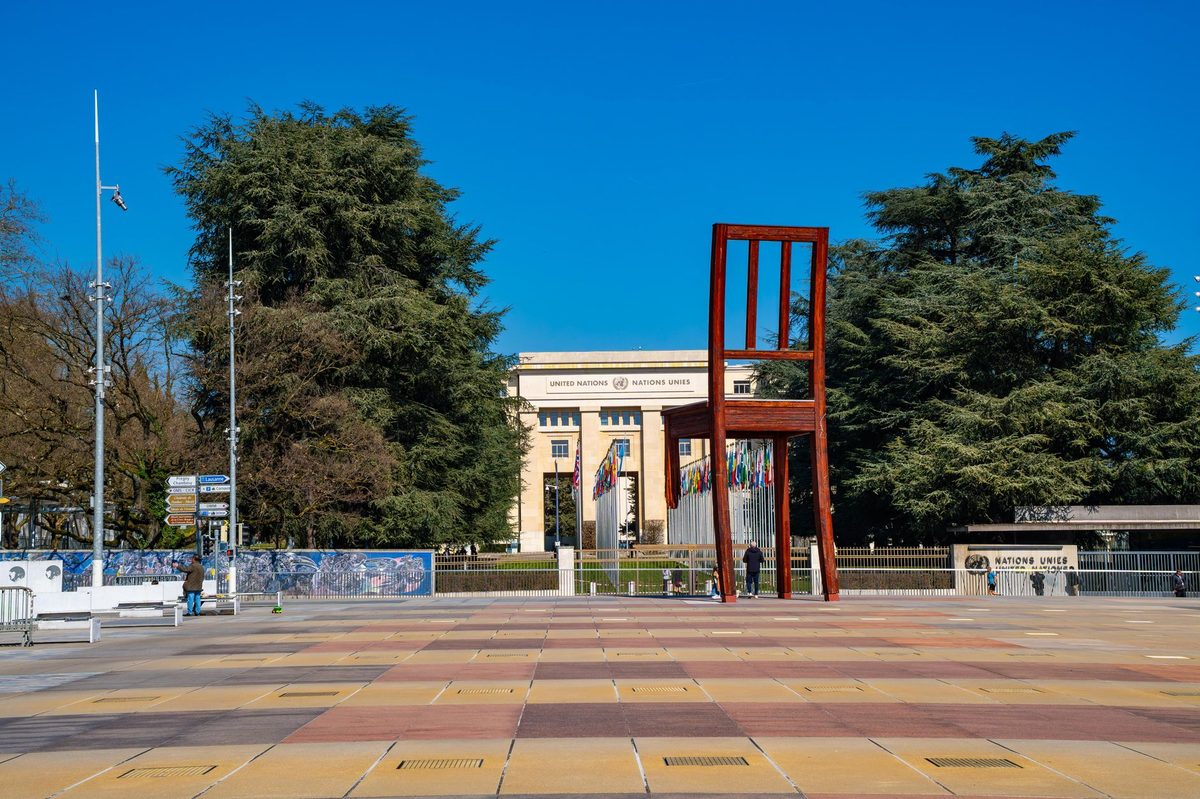
The northern anchor is Place des Nations itself, with the giant Broken Chair sculpture facing the gates of the Palais. Inside the gates is the UN’s European HQ. North of that, on Avenue de la Paix, is the headquarters of the ICRC and IFRC (the two halves of the Red Cross movement). South-east, along Avenue Appia, is the WHO headquarters complex. East along Route de Pregny is WIPO (the World Intellectual Property Organization). West, along Rue Lausanne, are UNHCR, OHCHR (the High Commissioner for Human Rights), and IOM (the International Organization for Migration). South of UN HQ, towards the lake, is the Palais Wilson, the original 1875 hotel that housed the League of Nations and now houses OHCHR. Further south on Quai Wilson is UNCTAD and the WTO headquarters in the former Centre William Rappard.
This concentration is not accidental. The Swiss federal government and the Canton of Geneva offer favourable terms (long-term leases, tax exemptions, immigration help for staff and family) explicitly to draw international organisations to this neighbourhood. The diplomats of every member state are housed nearby, and the 175 permanent missions to the UN in Geneva are clustered in the surrounding streets.
06 — The major international organisations
Quick orientation. These are the institutions whose decisions move actual money and policy on a global scale, all headquartered or with their primary operational seat in Geneva.
United Nations Office at Geneva (UNOG). The UN’s European headquarters and the operational base for many specialised agencies. About 1,600 staff, plus an annual flux of 8,000+ diplomats attending meetings. Hosts the Human Rights Council, the Conference on Disarmament, and the European Economic Commission.
World Health Organization (WHO). The UN’s health agency. Sets global health policy, coordinates pandemic response, certifies vaccines, runs eradication campaigns. About 2,500 staff at HQ, 8,500 globally. Founded in Geneva in 1948.
UN High Commissioner for Refugees (UNHCR). Coordinates the global response to refugee crises. About 18,000 staff worldwide, with HQ on Rue de Montbrillant. Founded 1950.
International Committee of the Red Cross (ICRC). A private Swiss humanitarian institution with a unique international legal status. Operates in conflict zones worldwide. About 20,000 staff, headquartered on Avenue de la Paix since 1933.
International Federation of Red Cross and Red Crescent Societies (IFRC). The umbrella body for the 191 national Red Cross and Red Crescent societies. Headquartered next to the ICRC.
World Trade Organization (WTO). Governs international trade rules and dispute resolution. About 630 staff in the former Centre William Rappard on Rue de Lausanne. Founded 1995, succeeding the GATT.
World Intellectual Property Organization (WIPO). Administers international IP treaties and systems including the PCT and Madrid systems. About 1,500 staff. A UN specialised agency since 1974.
International Labour Organization (ILO). The UN agency for world-of-work issues. The only major League of Nations institution to survive into the UN era intact. About 3,000 staff.
UN Conference on Trade and Development (UNCTAD). Research, policy advice and technical assistance on trade and development for developing countries. About 470 staff.
UN Office of the High Commissioner for Human Rights (OHCHR). The UN’s human rights secretariat. Headquartered in the Palais Wilson. About 1,300 staff.
International Telecommunication Union (ITU). The UN agency for telecommunications and ICT. Sets global standards for radio spectrum, satellite orbits and telecoms. The oldest of the UN agencies, founded in 1865.
International Organization for Migration (IOM). UN agency for migration policy and assistance. About 19,000 staff worldwide.
World Meteorological Organization (WMO). UN agency for weather, climate and water. About 300 staff. Headquartered on Avenue de la Paix.
Plus dozens more: UNECE, ITC, UNOPS regional, UNISDR, UNAIDS, JIU, the Conference on Disarmament secretariat, the secretariat of the Inter-Parliamentary Union, and the smaller specialist bodies you only notice exist when their issue is in the news.
07 — Why the NGO ecosystem grew up here
An international NGO that wants to influence WHO, UNHCR, or the Human Rights Council pretty much has to be in Geneva. The diplomatic calendar runs through the city, the key staff are here, and the meeting rooms where decisions get made are within walking distance. Over the past fifty years that gravitational pull has produced one of the densest NGO ecosystems on earth: roughly 750 international NGOs registered locally, employing about 12,000 people, contributing several billion francs to the local economy each year.
You see the full spectrum. Tier-one global NGOs like Medecins Sans Frontieres (whose international office is in Geneva, though its operational HQ is in Amsterdam), the World Council of Churches, the Lutheran World Federation, the World YWCA, the World Alliance of Reformed Churches, CARE International, Save the Children International, World Vision International, the World Economic Forum (yes, that is a Geneva NGO), the Caritas Internationalis liaison office, the Centre for Humanitarian Dialogue, the Global Fund to Fight AIDS, Tuberculosis and Malaria, the Gavi vaccine alliance, Plan International, Terre des Hommes, and Defence for Children International. Plus smaller specialist outfits: disarmament campaigners, trade policy think tanks, faith-based humanitarian groups, refugee legal aid clinics.

08 — The economic footprint
International Geneva is the city’s single largest sector. Recent surveys by the Foundation for Geneva put direct employment in international organisations at around 38,000 jobs, indirect employment at another 33,000, and the total annual contribution to the cantonal economy at roughly 10 to 11 percent of cantonal GDP. The Swiss federal government and the Canton of Geneva spend close to a billion Swiss francs a year supporting the sector through property leases, building maintenance, security, and tax-free import allowances. Most analyses suggest the return on that investment is a multiple of the spend.
What you notice as a visitor is more diffuse but unmistakable. The number of languages spoken in any given cafe. The interpreter booths in every conference hotel. The fact that the average pre-school in the international neighbourhood teaches in English, French and a third language at once. The number of bookshops with non-fiction sections in five languages. The international school sector, one of the largest per head in Europe, that grew up around UN parents.
09 — Critiques and challenges
Geneva’s humanitarian identity is real, but the city does not get off scot-free. Three critiques deserve mention.
The first is distance from the field. Critics inside the humanitarian sector (including, occasionally, the heads of the agencies themselves) argue that Geneva’s comfortable diplomatic bubble can produce policy that is theoretically excellent and operationally disconnected. Reform pushes to move staff and decision-making closer to crisis zones have recurred since the 1990s.
The second is cost. Geneva is expensive. UN staff salaries and per-diems are calibrated to local costs and end up very high, which sometimes draws political fire from donor countries.
The third is institutional politics. The Human Rights Council has been repeatedly criticised, often justifiably, for its handling of certain country situations. WHO’s pandemic response decisions have generated ongoing controversy. None of these problems are Geneva’s fault as a city, but they all play out in Geneva’s rooms.
The city handles the criticism the way the Swiss handle most things: with quiet self-improvement, occasional public acknowledgement, and a long view of institutional time. The institutions that came out of Solferino in 1862 are still being reformed, and probably always will be.
10 — How to experience humanitarian Geneva as a visitor
You can spend a full day understanding the humanitarian capital and never set foot in a tourist trap. Here is the order I recommend.
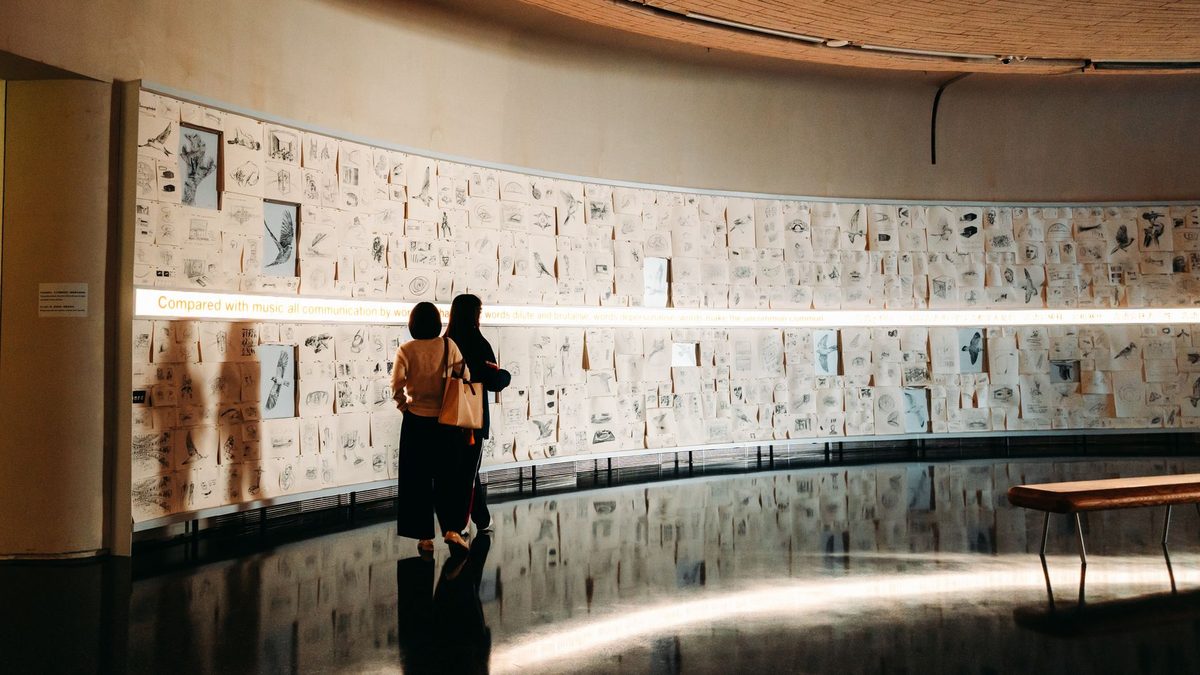
Start at the Musee International de la Croix-Rouge et du Croissant-Rouge (International Red Cross and Red Crescent Museum) on Avenue de la Paix. Allow two hours. The permanent exhibition is built around three themes (restoring family links, defending human dignity, reducing natural risks) and uses original objects, video testimony, and immersive installations. CHF 15 for adults, free under 12. Closed Mondays.
Walk five minutes down to Place des Nations. Photograph the Broken Chair (Daniel Berset’s twelve-metre wooden sculpture protesting anti-personnel landmines), then book onto a UN guided tour if you have not already done so online. Tours run in English, French and often other languages; tickets are around CHF 18 for adults; book at the UN’s website at least a few days in advance because slots fill up. The tour takes about an hour and goes inside the Council Chamber where the League of Nations met and the Assembly Hall used for the Human Rights Council.
For lunch, walk down to the lakeshore at Parc Mon Repos or grab something at one of the cafes on Rue de Vermont: diplomatic-quarter neighbourhood eating, often surprisingly good and reasonably priced.
In the afternoon, walk along Quai Wilson (past the Palais Wilson, home to OHCHR, and the WTO headquarters) and finish at the Jet d’Eau for the postcard photo. If you have energy left, jump on tram 15 back up to the diplomatic quarter and walk past the WHO compound on Avenue Appia.
For the broader sweep of Geneva history that produced all of this, see our history of Geneva guide, the Red Cross guide, and the United Nations in Geneva guide. For practical logistics see the trip planner and where to stay in Geneva.
Frequently asked questions
Why is Geneva the humanitarian capital?
A combination of Swiss neutrality (guaranteed in 1815), the private founding of the Red Cross by Genevan citizens in 1863, the League of Nations choosing Geneva as its headquarters in 1920, the UN inheriting that headquarters in 1946, and decades of institutional path dependence as each new multilateral body chose to locate near the existing ones. The city is now home to over 35 international organisations and around 750 NGOs.
How many international organisations are in Geneva?
About 38 major international organisations and treaty bodies have their headquarters or main operational base in Geneva, including WHO, UNHCR, ICRC, WTO, WIPO, ILO, OHCHR, UNCTAD, IOM, ITU and WMO. Around 175 countries maintain permanent missions to the UN in Geneva. Including NGOs, the international sector employs roughly 38,000 people directly.
What is the difference between UN Geneva and UN New York?
New York hosts the UN’s political headquarters: the General Assembly, the Security Council, and the Secretary-General’s office. Geneva hosts the UN’s European headquarters and the operational base for most of its specialised technical agencies (WHO, UNHCR, OHCHR and others), the Human Rights Council, and the Conference on Disarmament. New York does the politics; Geneva does the work.
Can I visit the UN in Geneva?
Yes. The Palais des Nations runs daily guided tours in multiple languages (book online in advance). Tours go inside the Council Chamber, the Assembly Hall, and the gardens. Bring photo ID. The tour takes about an hour and costs around CHF 18 for adults.
What are the Geneva Conventions?
Four international treaties (1864, 1906, 1929, and the four definitive 1949 Conventions) plus their additional protocols (1977, 2005) that establish legal protections for wounded and sick soldiers, prisoners of war, and civilians in armed conflict. The 1949 Conventions are universally ratified. The ICRC is their guardian. They are called Geneva Conventions because they were negotiated and signed in Geneva.
What is the best museum for humanitarian history?
The Musee International de la Croix-Rouge et du Croissant-Rouge on Avenue de la Paix, next to the ICRC headquarters. Allow two hours minimum. The permanent exhibition uses video testimony, original objects, and immersive installations to tell the story of modern humanitarianism. See our museums and culture guide for context within the broader Geneva museum scene.
11 — Related Geneva guides
Keep going with the Geneva history and heritage pillar, the full history of Geneva, the Red Cross in Geneva story, the United Nations in Geneva guide, our museums and culture picks, the things to do in Geneva overview, and the practical trip planner.