Geneva’s Flower Clock & Jardin Anglais
This article contains advertising. Our booking links are routed through a partner that adds commission tracking automatically, so if you book through one we earn a commission from the provider, at no extra cost to you. It never affects what we recommend. Affiliate disclosure
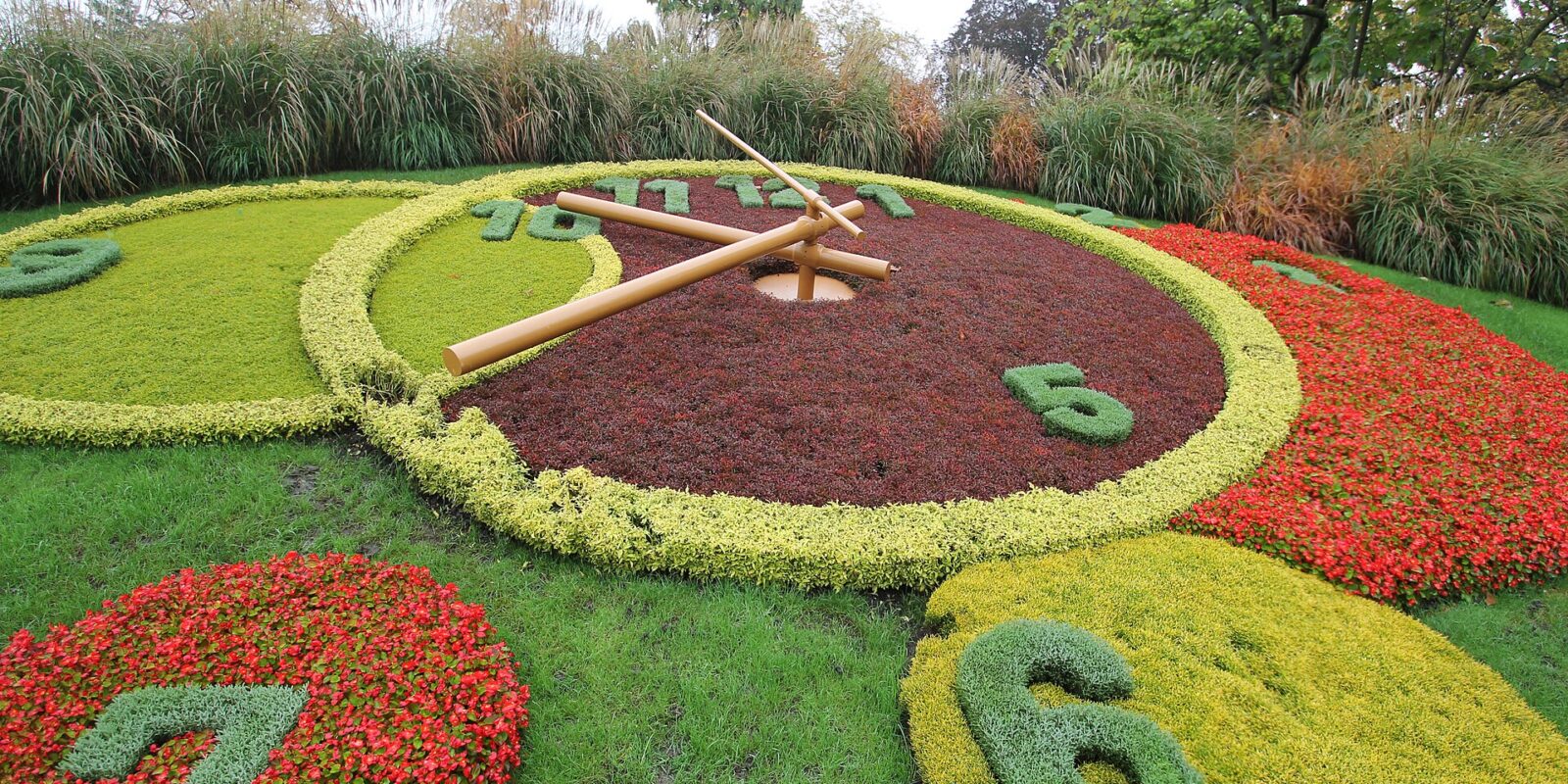
The Flower Clock is one of the most photographed sights in Geneva and, for a lot of visitors, one of the most underwhelming ten minutes of the trip. That isn’t because there’s anything wrong with it. It’s a lovely piece of municipal gardening, replanted four times a year by the city’s specialist gardeners, and it keeps perfect time thanks to a satellite. The problem is that it has been oversold. Coach tours stop here, guidebooks give it a page, and people arrive expecting an attraction. What they find is a clock face made of flowers on a sloping lawn beside a busy road. Enjoy it for what it is, a charming photo stop on the walk along the lake, and you won’t be disappointed. Cross town specially for it, and you might be.
The Geneva flower clock, the Horloge Fleurie, sits on the west side of the Jardin Anglais, beside the Quai du Général-Guisan on the left bank of the lake. It’s free and always visible, it was created in 1955 as a tribute to the city’s watchmaking, and its 2.5-metre second hand is said to be the longest in the world. It’s replanted four times a year with more than 3,000 plants and keeps time by satellite. Give it ten minutes as part of a walk that takes in the rest of the Jardin Anglais, the Jet d’Eau and the Old Town, rather than a trip of its own.
01 — The Flower Clock at a glance
| Detail | What to know |
|---|---|
| Cost | Free, and visible at any time of day |
| Where | The west side of the Jardin Anglais, on the Quai du Général-Guisan, left bank |
| Created | 1955, by the city’s parks department |
| Size | About five metres across; the second hand is 2.5 metres long |
| Plants | More than 3,000, replanted four times a year |
| Timekeeping | Electronically adjusted by satellite |
| Time needed | About ten minutes; half an hour with the rest of the Jardin Anglais |
| Best combined with | The Jet d’Eau, the Pont du Mont-Blanc and the Old Town |
02 — What it is
The Flower Clock was created in 1955 by the city’s parks department, at the initiative of the Association des Intérêts de Genève, and designed by the landscape architect Armand Auberson. The idea was simple and very Genevan: a symbol that brought together the two things the city was proudest of, its watchmaking and its gardens. A working clock mechanism is hidden beneath a sloping bed of plants, with numbers and a dial picked out in flowers and its hands sweeping over the top.
It has been updated over the years. In 2017 it was renovated with a built-in irrigation system and new hands, made and donated to the city by the watchmaker Patek Philippe in a design close to the original. Its time is adjusted electronically by satellite, so it’s more accurate than most of the watches pointed at it. The second hand, 2.5 metres long, is said to be the longest in the world.
Our guide to Geneva’s watchmaking heritage tells the bigger story behind it, and the Patek Philippe Museum is the place to see what the city’s watchmakers can really do.
03 — Four plantings a year
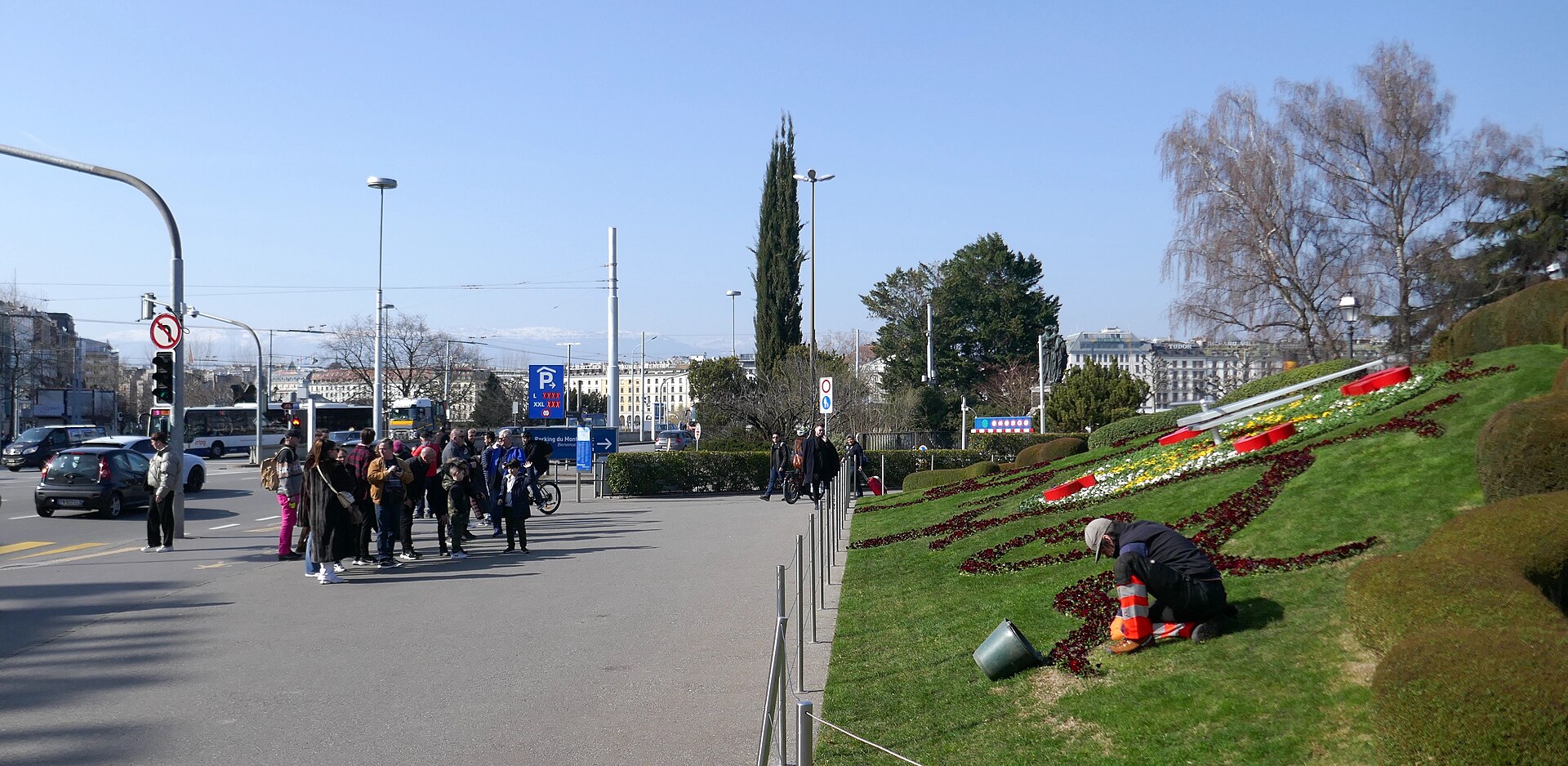
The Flower Clock changes with the seasons, which is one of the nicest things about it. The city’s specialist gardeners, trained in the craft of mosaiculture, the art of making designs from tightly packed plants, replant it four times a year:
- March: primroses.
- April to mid-May: pansies.
- Summer: begonias and succulents, usually the most colourful display of the year.
- Autumn and winter: pansies again.
The gardeners tend it every week, the plants are grown in the city’s own nursery, and it’s maintained without any chemical pesticides. If you happen to pass while they’re replanting, stop and watch: it’s precise, painstaking work, and far more interesting than the finished clock.
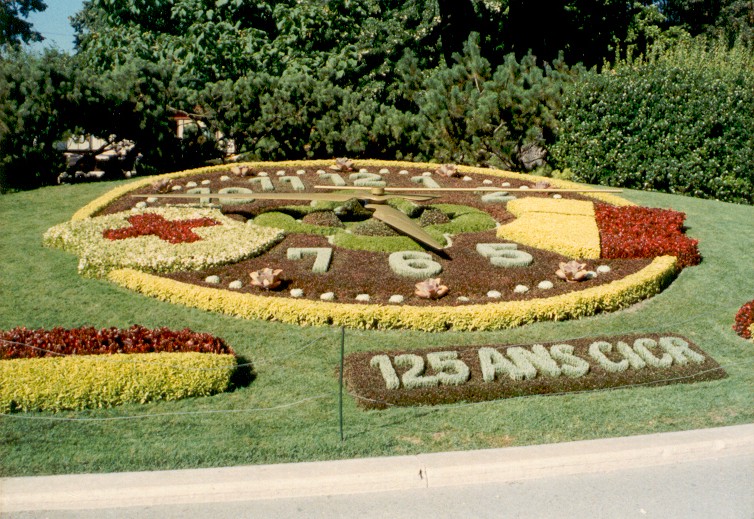
Every so often the design itself changes to mark an anniversary or an event.
04 — How mosaiculture works
The craft behind the Flower Clock has a name: mosaiculture, the art of building pictures and patterns out of living plants. Instead of a loose bed of flowers, the gardeners set low, compact plants very close together, so that the surface reads like a carpet and the design keeps sharp edges. The numbers and rings of the dial come from blocks of contrasting colour, in flowers or in foliage, and each new planting is laid out to a plan before a single plant goes in.
Keeping it neat is the hard part. Plants grow, flowers fade and the weather takes its toll, which is why the city’s mosaiculture gardeners visit every week to trim, tidy and replace, and why the whole design is renewed four times a year. Next time you walk past, look closely at how tightly the plants are packed: it’s the difference between a flowerbed and a clock.
05 — The honest verdict
Is the Flower Clock worth seeing? Yes, if you’re passing, and you almost certainly will be, because it sits on the main lakefront walk between the Pont du Mont-Blanc and the Jet d’Eau. Is it worth a special trip? No. It’s a pretty flowerbed with a clock in it, and ten minutes is plenty. Take your photo, admire the gardeners’ work, and keep walking.
Three things can make the visit better:
- Go early. Coach tours and walking groups arrive from mid-morning, and the pavement in front of the clock gets crowded. Before 9:00 you’ll often have it to yourself.
- Come in summer. The summer planting is usually the most colourful, and the whole Jardin Anglais is at its best.
- Look at the rest of the garden. The Jardin Anglais has more to offer than its clock, from a fine old fountain to a boulder that measures the height of every mountain in Switzerland. Read on.
For an honest view of every major sight in the city, with prices and time needed, see our guide to Geneva attractions and tickets.
06 — The Jardin Anglais
The Jardin Anglais, or English Garden, is a small, pleasant park at the point where Lake Geneva narrows into the Rhône, laid out in the 1850s in the informal English style of the time. It’s a good place to sit for a few minutes on the walk along the lake, with benches under the trees, views across the harbour to the Jet d’Eau and the hotels of the right bank, and the Old Town rising behind. Here’s what to look out for.
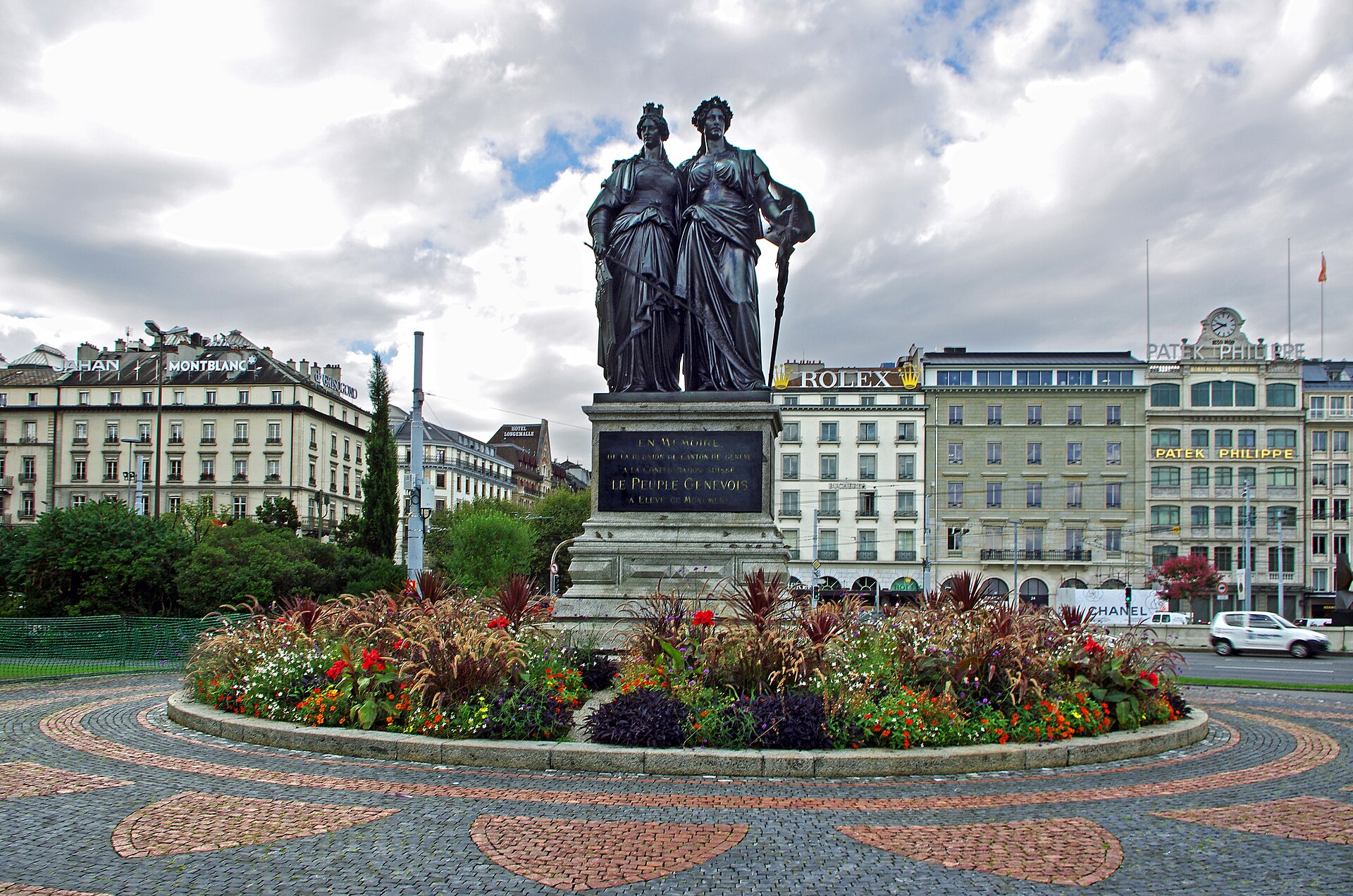
The Monument national
The Monument national in the garden is a bronze group of two women, one representing Geneva and the other Helvetia, Switzerland, inaugurated in 1869. It commemorates Geneva’s entry into the Swiss Confederation in 1815, after centuries as an independent city-state.
The fountain
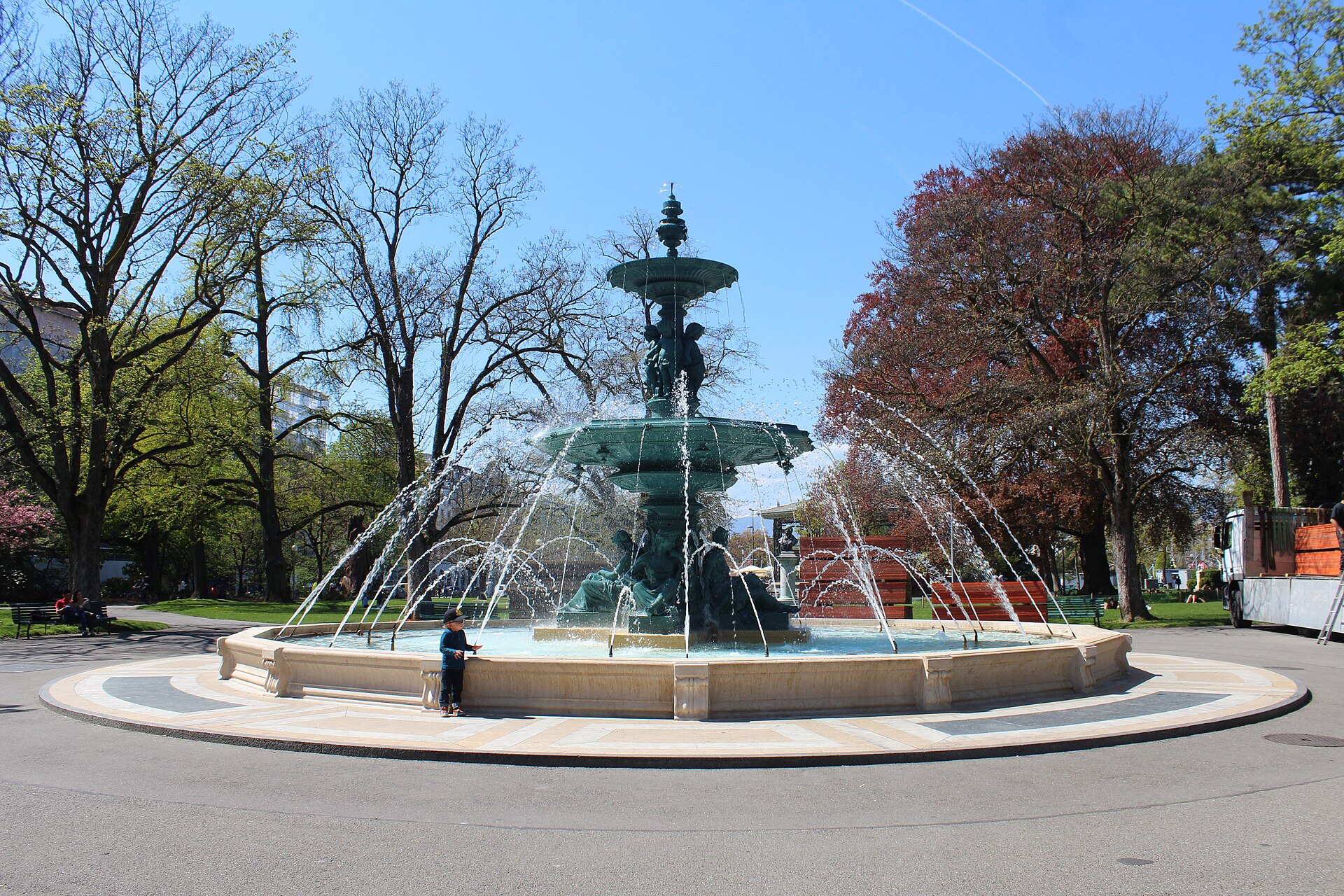
In the middle of the garden, a large, ornate fountain plays among the trees and lawns. It’s a pleasant place to pause, and on a hot day, the spray is very welcome.
The Pierres du Niton
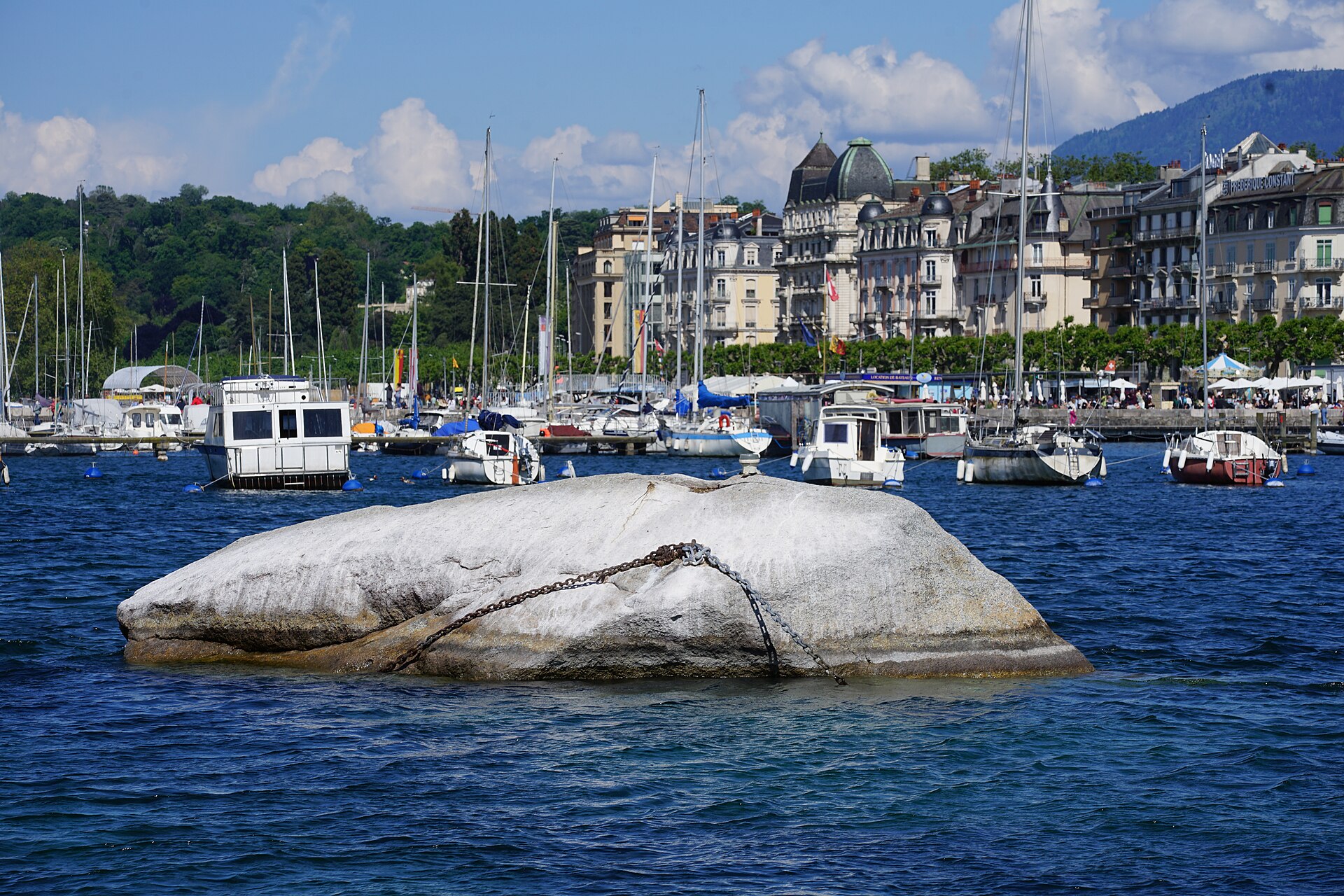
Look out into the harbour just off the Jardin Anglais and you’ll see two large granite boulders sticking out of the water. They’re the Pierres du Niton, rocks carried here by a glacier in the Ice Age, and the larger one has an unexpected claim to fame. In 1820, General Dufour, the engineer behind Switzerland’s first national maps, had a mark placed on it to monitor lake levels, and in 1879 it became Switzerland’s altitude reference. After more precise surveys, its height was fixed in 1902 at 373.6 metres above sea level. Every time you read the height of a Swiss mountain, it was measured from this boulder.
The boat landing
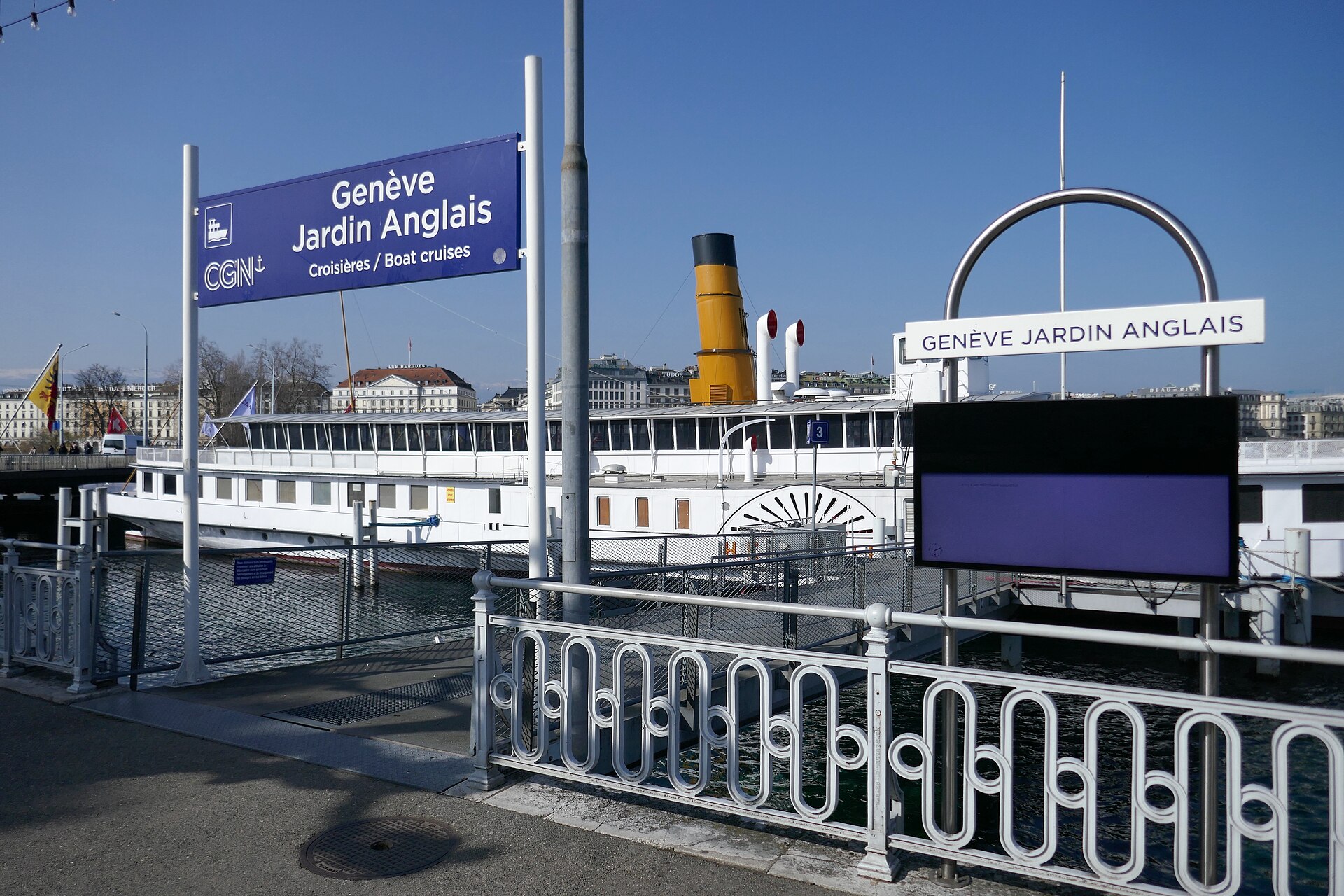
On the lakefront beside the garden is the Genève Jardin Anglais landing stage, where many of the CGN’s cruises and lake boats call, including the Belle Époque paddle steamers in season. If you’re planning a trip on the lake, this is one of the places to start. See our guide to Lake Geneva boat cruises.
07 — Watch-spotting around the clock
The Flower Clock is an emblem of both Geneva’s watchmaking and its horticultural expertise, but it’s far from the only tribute to the trade within a few minutes’ walk. The city has been a centre of fine watchmaking since the sixteenth century, and the streets around the Jardin Anglais are where you see it.
- The Rue du Rhône, just behind the garden, is lined with the boutiques of the great watch and jewellery houses. Window-shopping is free.
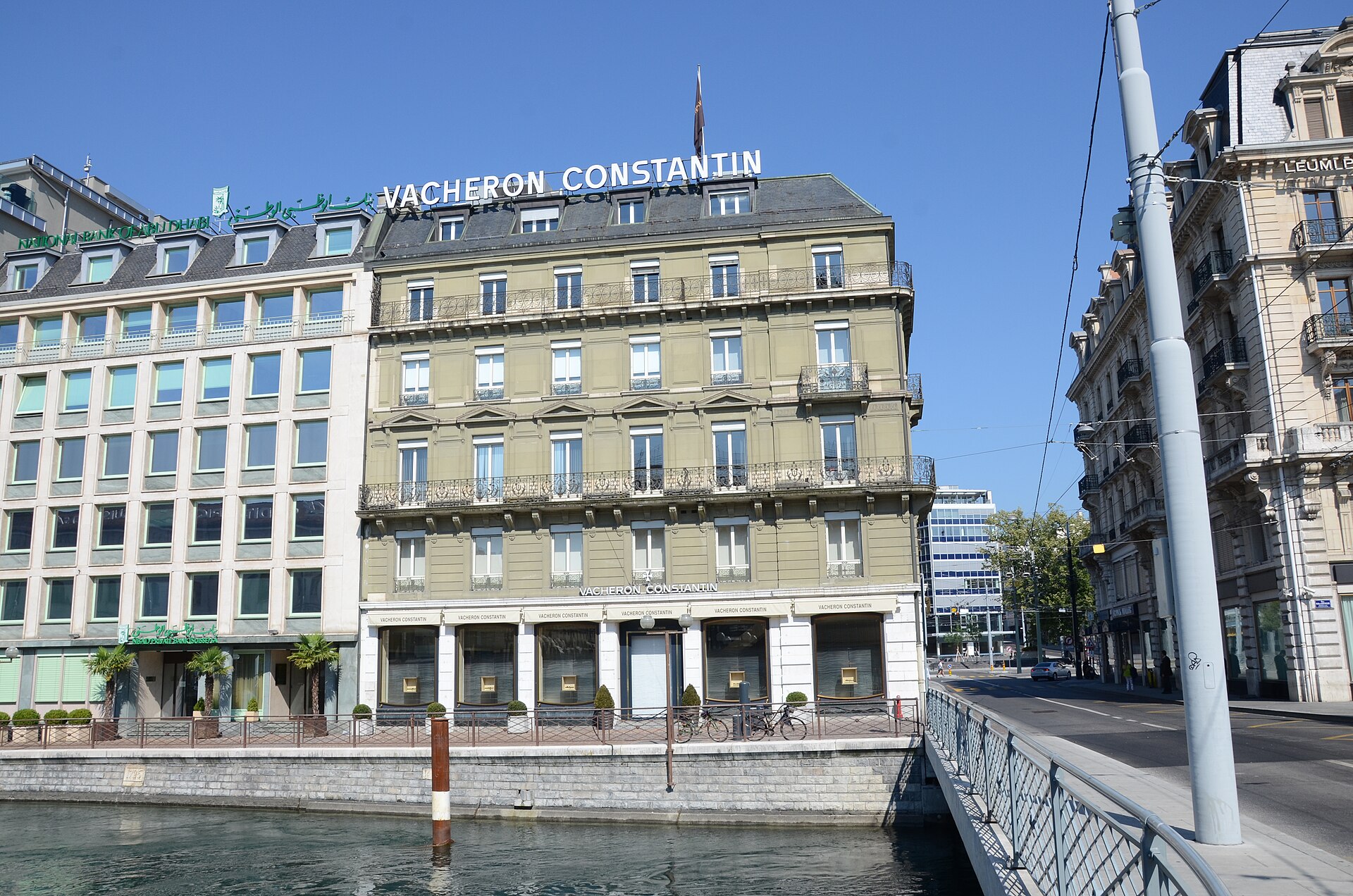
- Vacheron Constantin, founded in Geneva in 1755, claims the longest unbroken history of any watchmaker in the world. Its historic building stands by the Rhône on the Quai de l’Île, a few minutes’ walk west of the Flower Clock.
- The Geneva Seal, created by law in 1886, is a hallmark still stamped on watch movements made in the canton to its exacting standards. Look for it in the boutique windows.
- The Patek Philippe Museum, in Plainpalais, holds one of the world’s great collections of watches and automata.
- Watches and Wonders, the industry’s great annual fair, takes over Palexpo and the city each spring; in 2027 it runs from 5 to 11 April.
Our guide to watch shopping in Geneva covers the boutiques, the prices and the etiquette.
08 — How to fit it into a walk
The Flower Clock makes most sense as one stop on a lakefront walk. A good loop, about two hours with stops:
- Start on the right bank, at the Bains des Pâquis, for the view of the Jet d’Eau across the harbour.
- Cross the Pont du Mont-Blanc, with a detour onto the Île Rousseau, the little island at the mouth of the Rhône, with its statue of the philosopher.
- The Jardin Anglais and the Flower Clock, ten minutes for the clock and as long as you like in the garden.
- The Jet d’Eau, a few minutes further east, with a walk out along the Jetée des Eaux-Vives if the wind is kind.
- Up into the Old Town, for St Pierre Cathedral and the Place du Bourg-de-Four.
Our Jet d’Eau visitor guide and our Old Town guide cover the next two stops in detail, and our guide to St Pierre Cathedral explains the towers and the archaeological site.
09 — The Flower Clock through the year
- Spring: primroses in March, then pansies from April into May, as the trees of the Jardin Anglais come into leaf. Watches and Wonders week in April brings a crowd of watch lovers, nearly all of whom photograph it.
- Summer: the begonias and succulents of the summer planting make the most colourful display of the year, and the Jet d’Eau, a few minutes away, is lit every evening from early May to mid-September.
- Autumn: pansies return, and the garden’s trees turn gold around the clock, usually at their best at the end of October.
- Winter: the pansies hold the design through the cold months, and from mid-November to Christmas Eve the Christmas market on the Quai du Mont-Blanc is just across the bridge. See our guide to Geneva’s Christmas markets.
10 — Getting there
The Flower Clock is on the Quai du Général-Guisan, at the western end of the Jardin Anglais, on the left bank of the lake by the Pont du Mont-Blanc. From Cornavin station it’s a walk down to the lake: cross the Pont du Mont-Blanc, and you’ll see the garden on your left on the far side. Plenty of buses and trams stop nearby, around Bel-Air, the Molard and Rive, and the free Geneva Transport Card from your hotel covers them all. See our Transport Card guide.
11 — What’s nearby
- The Jet d’Eau, a few minutes’ walk east along the quay.
- The Rue du Rhône, Geneva’s luxury shopping street, just behind the garden, lined with the boutiques of the great watch and jewellery houses. See our Rue du Rhône shopping guide.
- The Old Town, ten minutes uphill, for the cathedral, Maison Tavel and the Bourg-de-Four.
- The Île Rousseau, a peaceful little island off the Pont des Bergues, a few minutes west.
- The Bains des Pâquis, across the harbour by Mouette or over the bridge.
12 — With children
Children usually enjoy the Flower Clock for about as long as adults do, a few minutes, so make it part of a bigger outing. Count the numbers in flowers, watch the second hand sweep round, then head for the fountain in the middle of the garden, the swans along the quay and the Jet d’Eau. A trip across the harbour on one of the little yellow Mouettes, free with the Transport Card, rounds it off nicely. Our guide to Geneva with kids has more ideas.
13 — Photographing the Flower Clock
- Shoot from the pavement. The clock is set on a slope facing the quay, so the best view is from the pavement in front of it, a little to one side to avoid the crowds.
- Go early or late. Before the tour groups arrive, and in the softer light of morning or evening, the colours look better and you’ll have the space to yourself.
- Get the second hand moving. A slightly slower shutter speed shows the long second hand sweeping across the dial.
- Include the garden. A wider shot that takes in the trees and the lakefront tells more of a story than a straight close-up.
- Don’t step on the planting. It’s a garden, not a stage, and the gardeners have spent hours on it.
Our guide to the most photogenic places in Geneva has more ideas, and our guide to Geneva’s parks and gardens covers the city’s other green spaces.
14 — Geneva’s other flower displays
If the Flower Clock gives you a taste for Geneva’s gardens, there’s much better to come. The rose garden at Parc La Grange, on the left bank above the lake, is one of the finest in Switzerland, with more than two hundred varieties at their peak in mid-June. The city’s botanical garden, by the lake near the UN, is free and lovely from spring to autumn. And in spring, the little lakeside town of Morges, a short train ride along the lake, fills its lakeside park with more than 140,000 tulips for its annual tulip festival. See our guides to Geneva’s parks and gardens and Geneva in April.
Our guide to Parc La Grange and its rose garden has the best times to visit.
15 — A short history of the lakefront
- 1820: General Dufour has a mark placed on the Pierre du Niton to monitor lake levels; it becomes Switzerland’s altitude reference in 1879.
- 1850s: the Jardin Anglais is laid out at the point where the lake meets the Rhône.
- 1869: the Monument national is unveiled, marking Geneva’s place in the Swiss Confederation.
- 1891: the Jet d’Eau becomes a decorative fountain in the harbour.
- 1891: the Jet d’Eau opens at its present site on the Jetée des Eaux-Vives; a new pumping station takes it to 140 metres in 1951.
- 1955: the Flower Clock is planted in the Jardin Anglais.
- 2017: the Flower Clock is renovated, with new hands made by Patek Philippe.
Our guide to Geneva’s history and heritage tells the wider story.
Frequently asked questions
Is the Flower Clock free?
Yes. It’s in a public park, beside the pavement, and you can see it at any time of day.
Is the Geneva Flower Clock worth visiting?
It’s worth ten minutes if you’re walking along the lake, which you probably will be, but it isn’t worth a special trip. Combine it with the Jardin Anglais, the Jet d’Eau and the Old Town.
When was the Flower Clock made?
In 1955, by the city’s parks department, as a tribute to Geneva’s watchmaking and its gardens. It was renovated in 2017, with new hands donated by Patek Philippe.
How often is the Flower Clock replanted?
Four times a year: with primroses in March, pansies from April to mid-May, begonias and succulents in summer, and pansies again in autumn and winter.
Does the Flower Clock keep the right time?
Yes. Its time is adjusted electronically by satellite, so it’s very accurate.
Where exactly is the Flower Clock?
On the west side of the Jardin Anglais, beside the Quai du Général-Guisan, on the left bank of the lake near the Pont du Mont-Blanc.