A Geneva to Yvoire day trip is the one you take when you want to feel like you have stepped out of Switzerland into a 14th-century French village, even though you are only 75 minutes from the city by boat. Yvoire is officially one of “Les Plus Beaux Villages de France,” and it sits on a small promontory poking into Lake Geneva on the French shore: intact medieval walls, a 14th-century chateau (private, not open to visitors), a Romanesque church with a silver onion-dome bell tower, and flower-draped stone houses on every cobbled lane. The whole place is so small you can walk it in 90 minutes, but the right way to do Yvoire is slowly, with a long lakeside lunch, an hour in the Garden of the Five Senses, and the boat ride home as the day’s afterthought.
This is my candid guide to doing Yvoire as a day trip from Geneva: the right way to get there (almost always the boat, despite easier-looking French bus routes), the village’s real highlights, where to eat that does not trade entirely on the view, and the detail most blogs skip, which is whether to pair Yvoire with Excenevex Plage (the only sand beach on Lake Geneva, 5 km away) for a full lake-and-village day. It is one of the gentler outings on our day trips from Geneva list, and a good counterpoint to a busier town like Annecy.

The 60-second plan
Catch the 09:30 CGN paddle-steamer from Geneva-Mont-Blanc pier to Yvoire (75 minutes, CHF 32 one-way or CHF 48 round trip, free with the Swiss Travel Pass). Walk the medieval village (90 minutes). Have lunch at Le Pre de la Cure overlooking the lake (90 minutes). Do the Garden of the Five Senses (60 minutes, EUR 15). Coffee on the port. Take the 16:00 or 17:30 boat back, and you are home by 18:30. The whole day runs about 9 hours and costs roughly EUR 60 to 80 per person.
Getting from Geneva to Yvoire
CGN paddle-steamer (my pick)
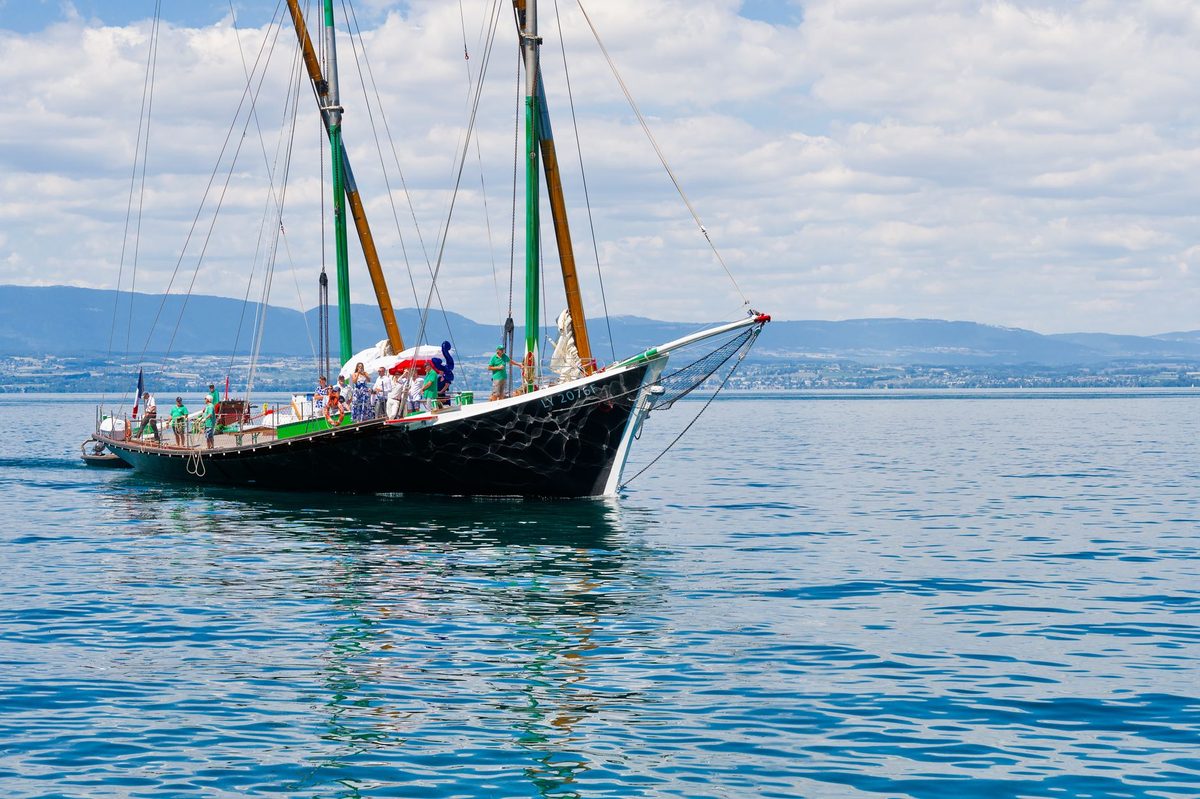
This is the way to reach Yvoire: by water, on a Belle Epoque CGN paddle-steamer crossing from Geneva-Mont-Blanc pier to Yvoire’s small port. It is 75 minutes each way, CHF 32 one-way or CHF 48 round trip, and free with the Swiss Travel Pass. In season (April to October) there are three to five daily departures, fewer in winter. The morning boat usually leaves at 09:30 or 10:30, and the return at 16:00 or 17:30 gets you back in Geneva for dinner. Check cgn.ch for the exact 2026 schedule.
The crossing is half the experience. Sit on the open upper deck, watch the shoreline shift from Swiss to French, and look for the Mont Blanc skyline if the weather plays along. Bring a coffee from a Geneva cafe and a book.
Drive and park
It is 30 km via the A41 motorway across the French border, about 35 to 45 minutes door to door. Cars are restricted in the centre, so you park at the edge of the village for about EUR 4 per day. Driving makes sense if you have a rental and want to add the Excenevex beach 5 km away. See our car rental guide for the cross-border paperwork.
Bus and tours
A public bus is technically possible (a TPG line plus a French connection) but it involves changes, takes longer than the boat, and gives you less to look at, so skip it unless you genuinely enjoy buses. Several Geneva operators also run combined boat-plus-village-plus-lunch packages for CHF 100 to 180 per person; convenient, but you pay for it once you do the maths.
The old village walking loop
Yvoire is genuinely tiny. The medieval village fits inside about four city blocks, hemmed in on three sides by the lake and on the fourth by the old wall. Here is the loop I walk.
Start at the lake-port entrance. The village rises straight up from the boat dock, so you will see the stone wall and the Vieille Porte (the medieval gate) directly ahead.
Go in through the Vieille Porte. The cobbled main street climbs gently past flower-draped stone houses, small artisan shops (ceramics, glassware, jewellery) and several restaurant terraces.
Saint-Pancrace Church. The 14th-century Romanesque church on the central square has that distinctive silver onion-dome bell tower. The original gold dome was destroyed in the French Revolution; the current stainless-steel one dates to 1989. Inside are simple stone vaults; outside, the small cemetery holds gravestones from the 18th and 19th centuries worth a look.
Chateau d’Yvoire. The 14th-century turreted castle anchors the lakeside. It has stayed with the same family for centuries, so it is privately owned and closed to visitors, but the exterior is the village’s most photographed building.
Promenade along the lake. The lakeside path that loops around the chateau gives you the postcard angle on the castle, then drops you back toward the port via the lower streets, past the small fishing boats in the harbour. Stop for coffee on the port terrace before your boat. Allow 90 minutes for the loop, including 20 minutes in the church and time to wander the shops.
The Garden of the Five Senses
This is the village’s only paid attraction and a real highlight if you have an extra hour. The Jardin des Cinq Sens occupies the former kitchen garden of the Chateau d’Yvoire, a privately owned, carefully kept labyrinth garden laid out in 1988 around five themed sections, one for each sense. The central maze is built from yew hedges; around it sit herbs for taste, scented flowers for smell, textured plants for touch, colourful displays for sight, and bird-friendly plantings for hearing.
- Tickets: EUR 15 adult, EUR 13 senior or student, EUR 5.50 child (5 to 13), under 5 free.
- Open: mid-April to early October only, 10:00 to 18:00 (earlier close in shoulder season).
- How long: 60 minutes for a relaxed visit. Bring water and bug spray in midsummer.
Worth it? Yes, if you have the time and the garden is open. The maze and the careful planting are beautifully done, and the garden stays peaceful in a way the village itself, full of day-trippers, often is not.

The port and lakeside
Yvoire’s small port is where the CGN paddle-steamers dock, and it is also the social heart of the village: a stone-paved harbour ringed by cafe terraces, small fishing boats, and a couple of pedalo and motorboat rentals. In summer it is the photogenic centre of the day. You can rent a pedalo (EUR 15 per hour) for a slow loop past the village from the water, have a coffee or an aperitif on a terrace, or take a dip at the small swimming area on the western side of the port (clean water, the occasional crowd). The lakefront promenade runs about 300 m east toward the next French village.
Combining with Excenevex beach
This is the detail most Yvoire day-trippers miss. Excenevex Plage, 5 km east on the French shore, is the only natural sand beach on Lake Geneva: a kilometre of fine sand backed by pines, with shallow water that warms quickly in summer. Entry is free (small parking fee around EUR 5), and changing rooms and snack bars open in season. If you have a rental car or take the local bus (CHF 3, 12 minutes), Excenevex turns Yvoire into a half-day village plus half-day beach plan that is excellent in July and August. Pack swimwear and a towel from Geneva.
My one-day itinerary
| Time | What happens |
|---|---|
| 08:30 | Coffee in Geneva, walk to the Mont-Blanc pier. |
| 09:30 | CGN paddle-steamer to Yvoire, 75 minutes on the open deck. |
| 10:45 | Arrive Yvoire, walk straight into the village. |
| 11:00 | Old village walking loop, 90 minutes including the church. |
| 12:30 | Lunch at Le Pre de la Cure, lakeside terrace, 90 minutes. |
| 14:00 | Garden of the Five Senses, 60 minutes. |
| 15:00 | Coffee on the port, 30 minutes. |
| 15:30 | Last circuit of the village, or rent a pedalo for 45 minutes. |
| 17:30 | CGN paddle-steamer back to Geneva, 75 minutes, sunset over the lake in summer. |
| 18:45 | Back in Geneva. Dinner at La Bourse in Carouge. |

Where to eat in Yvoire
Yvoire’s restaurants lean toward view-pricing, but four addresses deliver food worth the cost.
- Le Pre de la Cure. The village’s best table, Michelin Bib-listed several years running. Lakefront terrace, refined French-Savoyarde cooking. Lunch menu EUR 38, a la carte EUR 30 to 45. Book ahead.
- Hotel du Port. A reliable lakefront brasserie with a wide menu. The local perch fillets (perche du Lac Leman) are the order at EUR 28, with solid daily plats du jour around EUR 22.
- Restaurant Les Flots Bleus. An old-school French fish restaurant with a lakefront terrace, strong on lake fish. EUR 30 to 40 mains.
- Auberge des Anciens Combattants. Tucked off the main tourist circuit, with lower prices, friendlier service and classic Savoyarde dishes. EUR 20 to 28 mains.
If you only have 30 minutes, get a baguette sandwich and a slice of tarte from the bakery on Rue du Lac and eat it on a bench over the harbour. The one thing I would skip: anywhere with a chalkboard photo of fondue charging double what you would pay inland in Annecy. For a proper meal back in town, our best restaurants in Carouge guide is the natural follow-on.
Best time to visit
Spring (April to June): best for flowers and quiet streets. The Garden of the Five Senses opens mid-April, crowds are light, and boat schedules are ramping up.
Summer (July to August): peak season, with the village busy from 11:00 to 16:00. Pair it with Excenevex beach for a swim. Boat departures are most frequent now.
Autumn (September to October): my favourite for atmosphere, with smaller crowds, golden lakeside light and the garden still open. The boat schedule thins from October.
Winter (November to March): many shops and the garden close, restaurants cut hours, and the CGN boat schedule drops sharply, so drive instead of taking the boat. The village is photogenic in light snow, but the visit is shorter.
Why Yvoire looks the way it does: a short history
The village’s medieval intactness is not an accident. It is the result of strict heritage protection layered on a stroke of historical luck. Yvoire was founded around 1306 by Amedee V, Count of Savoy, as a fortified port to control lake traffic. The walls, the gate towers and the central street layout you walk today are essentially the originals. The Chateau d’Yvoire, built between 1306 and 1320, was the seat of the lord of the village, and it has been continuously lived in by descendants of the d’Yvoire family ever since, which is why it remains private and closed to visitors.
The village came through the centuries with very little destruction, partly because it was militarily irrelevant after the 16th century, and partly because its small size and lakeside isolation meant nobody bothered to modernise it. By the time French heritage laws caught up in the 20th century, Yvoire was already so well preserved that protecting it mostly meant not changing anything. It earned its “Les Plus Beaux Villages de France” classification in the 1990s, along with the top Quatre Fleurs award for its floral displays. The payoff for visitors is one of the rare medieval-village experiences where the buildings genuinely date from the period: the Saint-Pancrace church is 14th century, the Vieille Porte is 14th century, and most of the stone houses on the main street are 15th to 17th century with later tweaks.

Other French-shore villages worth combining
If you have a rental car, Yvoire pairs naturally with three other lakeside villages along the southern French shore, each with its own character.
Nernier (4 km east): an even smaller, even quieter medieval village than Yvoire. Almost no shops, two restaurants, a small church and a tiny port. Worth a 30-minute stop on the drive back to Geneva.
Excenevex (5 km east): the sand-beach village covered above. Take a swim in summer.
Sciez (10 km east): a working French Alpine village with a small but excellent Savoyarde restaurant (Le Bressi) and an organic farm shop. Less touristy than Yvoire.
A full lake-shore drive of Geneva to Yvoire to Nernier to Excenevex to Sciez and back takes four to five hours and lets you pick villages by mood. It is an ideal day for couples or small groups with a car, and a good excuse to bring the Swiss Travel Pass maths into the decision if you are weighing boat versus car for the week.
Yvoire rewards deliberate slowness. The village is small enough that rushing through misses the point. Half the pleasure is sitting on a quiet bench by the harbour watching the fishing boats come in, or finding the side alley behind the church where almost no other visitors wander. Plan to spend at least an hour longer here than you think you will need.

Geneva to Yvoire day trip: FAQ
Is Yvoire worth a day trip from Geneva?
Yes, especially via the CGN paddle-steamer. The village is small but beautifully preserved, and the boat ride turns it into a full, satisfying day.
How long is the boat from Geneva to Yvoire, and what does it cost?
It is 75 minutes by CGN paddle-steamer from Geneva-Mont-Blanc pier. Fares are CHF 32 one-way or CHF 48 round trip, and the trip is free with the Swiss Travel Pass.
Do I need a passport to visit Yvoire?
Yes. Yvoire is in France, so carry your passport (or national ID card if you are from the EU). Random border checks do happen on the CGN boats and in the village.
Is the Garden of the Five Senses worth EUR 15?
Yes, if you have an extra hour and it is open (mid-April to early October). The maze design and the quality of the planting justify the entry fee.
Can I swim in Lake Geneva at Yvoire?
Yes, there is a small swimming area at the port. For a proper beach, take the bus or drive 5 km to Excenevex Plage, the only sand beach on Lake Geneva.
Can I combine Yvoire with Annecy or Evian on the same day?
It is logistically possible but rushed. They work better as separate outings. See our Annecy day trip and Evian day trip guides to plan each one properly.

Official sources and further reading
- Yvoire Tourism (official)
- Garden of the Five Senses (official)
- CGN, Geneva to Yvoire boat
- Les Plus Beaux Villages de France, Yvoire
Related Geneva guides
Keep planning with the best day trips from Geneva, the lively Geneva to Annecy day trip, the spa town of Evian, the Swiss Travel Pass for Geneva, and our best restaurants in Carouge for dinner back in town.
Yvoire is the quiet day trip, the one you take when you want the pace to slow down. Catch the morning paddle-steamer, walk the medieval streets at human speed, eat lunch on a lakeside terrace, lose an hour in the maze garden, and float back to Geneva on the afternoon boat as the lake turns gold. Nothing extraordinary happens. Everything ordinary happens beautifully.