Geneva to Évian-les-Bains Day Trip — Thermal Spa Town Guide (2026)
This article contains advertising. Our booking links are routed through a partner that adds commission tracking automatically, so if you book through one we earn a commission from the provider, at no extra cost to you. It never affects what we recommend. Affiliate disclosure
A Geneva to Evian day trip is the one you take when you want to do nothing energetically. Evian-les-Bains is a Belle Epoque French spa town across Lake Geneva from Lausanne, 35 minutes by boat from the Swiss shore, where the water you have been drinking out of plastic bottles your whole life actually comes from a hillside spring you can taste for free. Evian is one of those rare places where the destination, the brand and the geography are the same thing. The water comes from the Cachat spring, that spring water is the famous Evian water, and the town built itself around the spa-and-cure economy in the 19th century, leaving a place of grand hotels, public gardens, a formal lakefront promenade, and a working thermal spa where you can spend an afternoon in mineral pools.
This is my guide to doing Evian as a day trip from Geneva. It is a slightly longer journey than other French-shore outings (the CGN boat goes via Lausanne, or you drive 1h15 along the southern shore), but it is exceptionally rewarding if you want a slower, gentler day with thermal water, garden walking and a serious lunch at one of the Hotel Royal’s restaurants. If your Geneva trip needs one deliberately calm day, this is the one, and it sits nicely alongside the lakeside village of Yvoire on our day trips from Geneva list.
01 — The 60-second plan
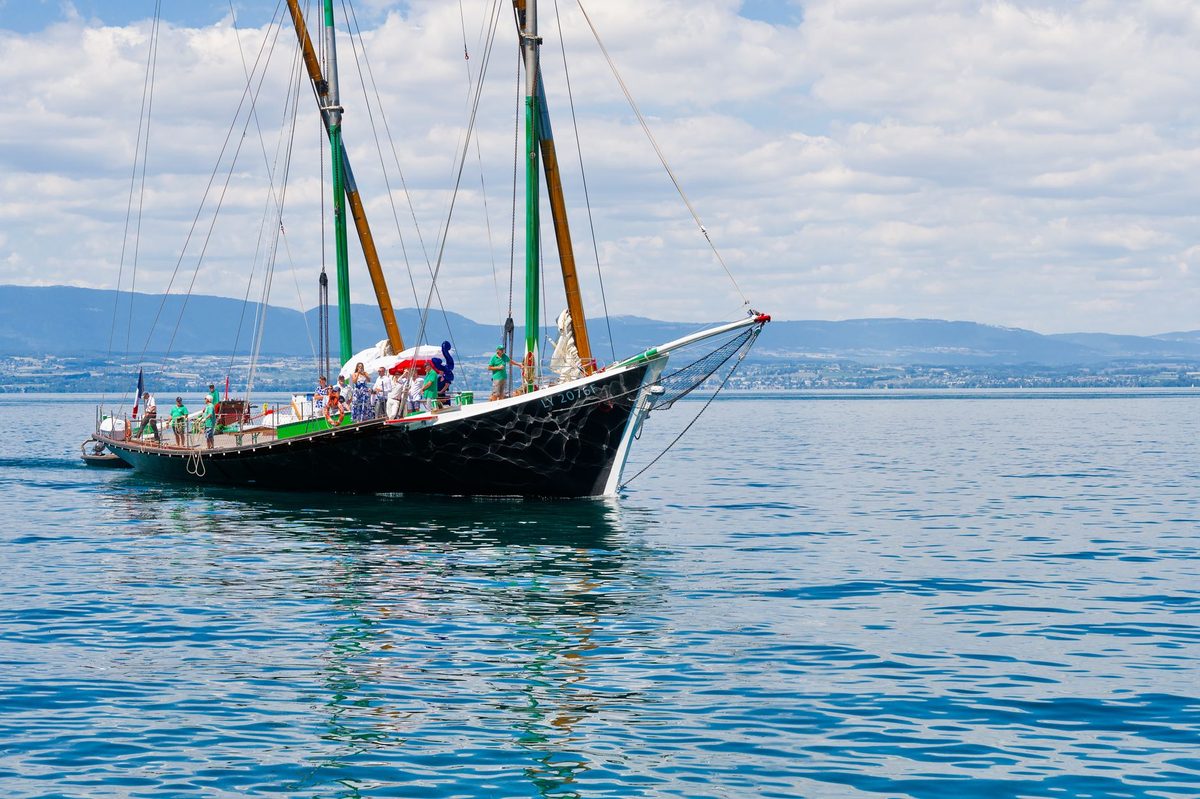
Take the CGN paddle-steamer from Geneva to Evian via Lausanne (about 3h30 the slow scenic way, CHF 32 each way, free with the Swiss Travel Pass), or drive 1h15 along the southern lakeshore. Walk to the Cachat spring (5 minutes from the centre) and fill your bottle from the source. Stroll the Belle Epoque lakefront promenade (45 minutes). Have lunch at Le Murat or one of the Hotel Royal restaurants. Spend two to three hours at the thermal spa (around EUR 45 for a day pass). Take the return boat or drive back. The whole day runs about 9 to 10 hours and costs EUR 70 to 110 per person.
02 — Getting from Geneva to Evian
Train plus ferry (my pick)
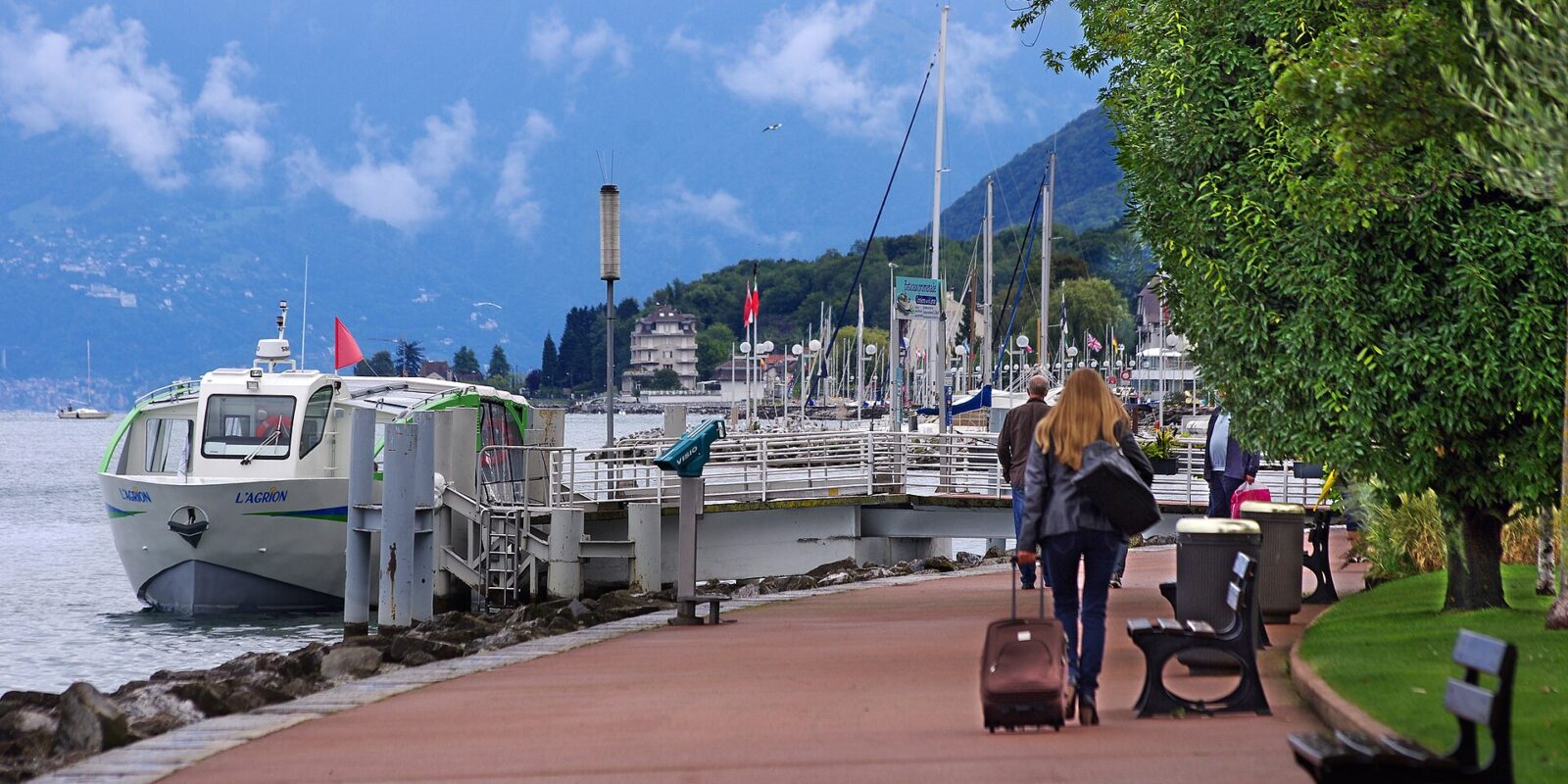
The fastest sensible route is to take the SBB train from Geneva-Cornavin to Lausanne (40 minutes, CHF 28), then the CGN ferry from Lausanne-Ouchy to Evian (35 minutes, CHF 14). That is 1h45 each way, about CHF 42 one-way, and it keeps the lake crossing for the scenic part of the trip. It is free with the Swiss Travel Pass.
CGN paddle-steamer, drive, or bus
The full CGN cross-lake service from Geneva goes via Lausanne and takes about 3h30 each way at CHF 32 one-way; it is the romantic option but it eats the day. By car it is 50 km along the French southern lakeshore (the D1005), about 1h15, with easy lakefront parking (CHF 3 per hour or around EUR 5 per day at the casino garage). The drive passes Hermance, Sciez, Excenevex and Yvoire, all worth a detour, and is the best choice for groups of three or more; see our car rental guide. SAT Leman also runs direct buses from Geneva to Evian (1h to 1h20, about EUR 13 one-way), which are less scenic than the boat but a fine fallback.
03 — The source: where Evian water actually comes from
The story is simpler than you might expect. In 1789 a French aristocrat, the Marquis de Lessert, took refuge in Evian during the Revolution and credited the local Sainte-Catherine spring with curing his kidney complaints. Local doctors investigated, found the water unusually pure with a distinctive mineral profile, and the town’s first thermal baths opened in 1824. Commercial bottling began in 1859.
The water that becomes bottled Evian is snowmelt that filters down through roughly 15 years of slow percolation through limestone in the Chablais mountains before emerging at the source springs. The original Cachat spring still flows today, free to the public, in a small pavilion 5 minutes from the lakefront. Bring an empty bottle and fill it straight from the spring; it is the same water you pay for, only cheaper and a little more virtuous. The Buvette Cachat pavilion is open daily with a small display on the water’s mineralogy. The Evian factory itself is at the edge of town and closed to the public, but the source is yours to drink.
04 — Evian thermal spa
This is the real reason to come. Les Thermes d’Evian is one of France’s premier thermal-water resorts, a contemporary complex with several mineral pools at different temperatures, sauna, hammam, and a full menu of treatments and massages, all using the source water.
- Day pass: around EUR 45 for a minimum 3 hours, or EUR 60 for the full day, including all pools, sauna, hammam and changing facilities. Treatments and massages cost extra, roughly EUR 80 to 180 depending on the service.
- What to expect: calm, adult-oriented, built for slow relaxation. Indoor and outdoor pools, with the outdoor lakefront-facing pool the highlight on warm days. Bring swimwear and a towel from your hotel; rentals are available for a small fee.
- Best time: Tuesday to Friday are quietest; weekends get busy. Book online ahead for guaranteed access in peak periods.
The spa is genuinely high quality, and the day-pass model (rather than an all-inclusive resort stay) makes it workable for day-trippers. Two to three hours is the standard visit.
05 — The promenade and Belle Epoque town
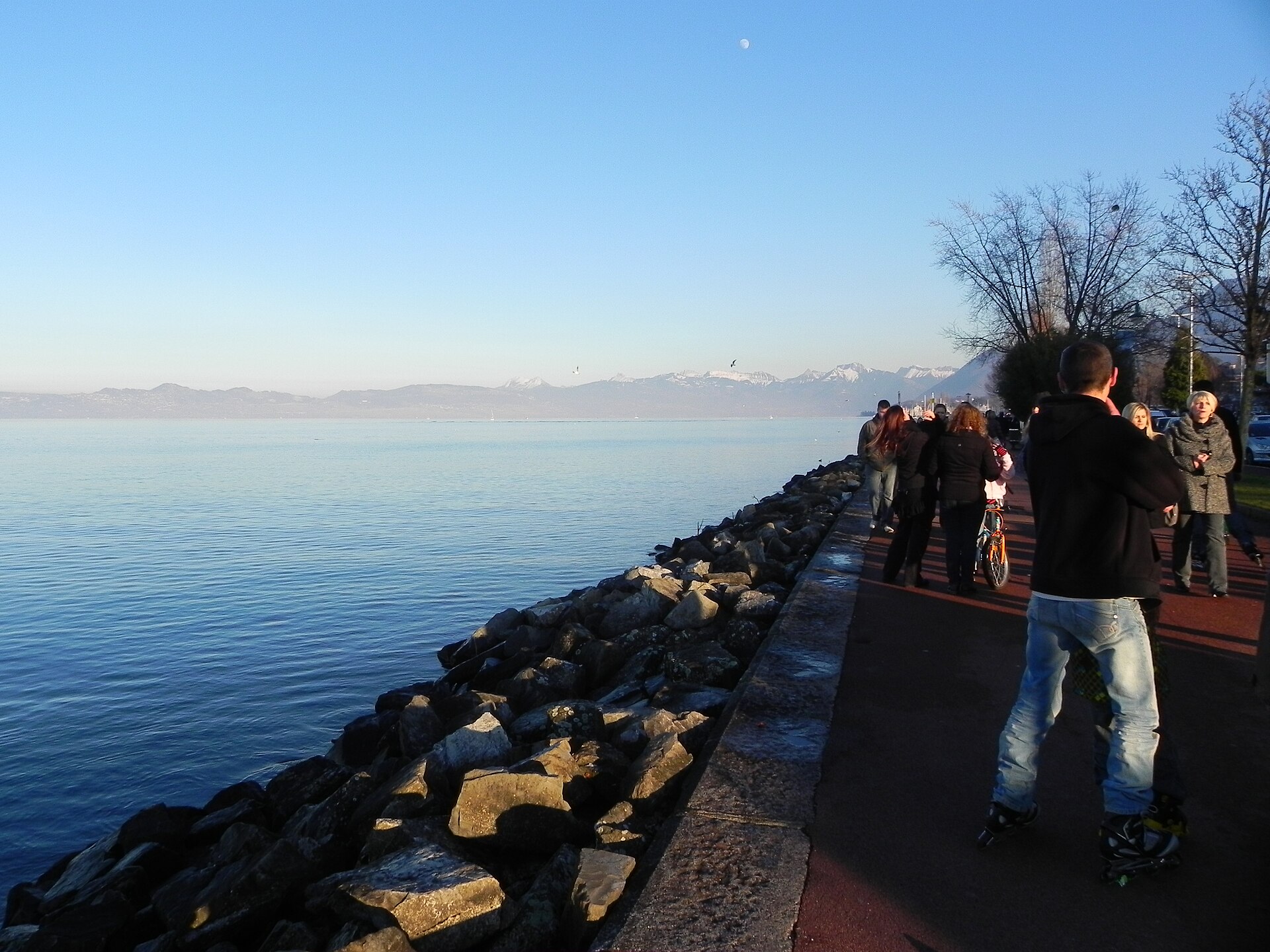
Evian’s lakefront promenade is the town’s other identity: a 2 km flower-lined walk between formal gardens and the lake, lined with Belle Epoque architecture from the spa-town era. Much of the town went up between 1860 and 1914 to house the wealthy invalids coming for the cure, and that legacy gives Evian a real architectural cohesion.
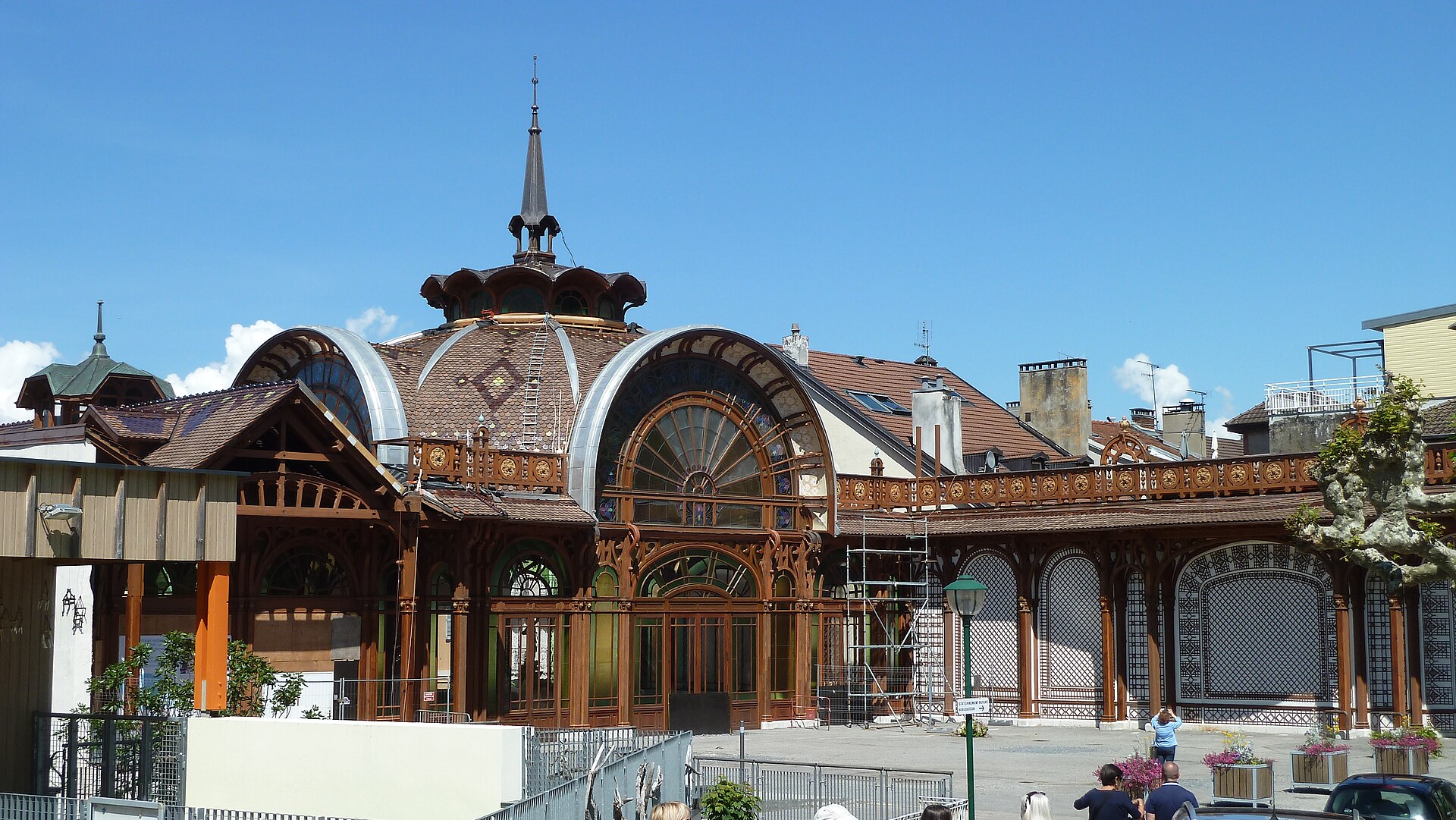
- Palais Lumiere. The 1902 Art Nouveau pavilion that held the original thermal baths, now an exhibition space with rotating art and history shows. Entry typically around EUR 10.
- Villa Lumiere. The grand Belle Epoque town hall of 1894, with formal gardens.
- Casino and Hotel Royal area. The Hotel Royal, the 1909 grand hotel where Marcel Proust stayed, anchors the western promenade, with the casino beside it.
- Pre-Curieux water gardens. An accessible lakeshore nature reserve, 20 minutes’ walk west of town.
Allow 90 minutes for an unhurried walk along the promenade, with stops at the Palais Lumiere exterior and the lake views.
06 — Pre Curieux water gardens and the funicular
Two add-ons if your day has spare time. The Jardin de l’Eau Pre Curieux is an ecological water-themed garden 20 minutes west of the centre, free to enter, with interpretive boards on water and ecology and an easy 45-minute loop. The Evian funicular, dating to 1907, climbs from the lakefront to the upper residential quarters for about EUR 5 round trip; it is mostly a local service, but the view from the top justifies the 20-minute round trip even as a visitor.
07 — Where to eat in Evian
- Cafe Royal (Hotel Royal). The grand hotel’s brasserie, French classics with lake views. Lunch menu around EUR 38, a la carte EUR 30 to 50.
- Le Murat. A locals’ bistro one street back from the lakefront, doing classic French country cooking at EUR 25 to 35 mains. Better value than the hotel restaurants.
- L’Instant Present. A modern little bistro with seasonal cooking and a small lakeside terrace. EUR 28 to 40 mains.
- La Verniaz et ses Chalets. Up in the hills outside town, the Sunday-lunch destination of well-off locals. Reservation essential.
If you only have 30 minutes, get a savoury galette and a glass of cider at one of the creperies near the casino, about EUR 15.
08 — My one-day itinerary
| Time | What happens |
|---|---|
| 08:30 | Geneva-Cornavin train to Lausanne, 40 minutes. |
| 09:30 | Lausanne-Ouchy CGN ferry to Evian, 35-minute crossing. |
| 10:15 | Arrive Evian, coffee on the lakefront. |
| 10:45 | Walk to the Cachat spring and fill your bottle, 15 minutes. |
| 11:00 | Belle Epoque promenade walk, 90 minutes including the Palais Lumiere exterior. |
| 12:30 | Lunch at Le Murat, 75 minutes. |
| 14:00 | Thermal spa day pass, 3 hours of mineral pool, sauna and hammam. |
| 17:00 | Quick walk back through the town. |
| 17:30 | CGN ferry back to Lausanne, then the train to Geneva. |
| 19:30 | Back in Geneva, ready for a light dinner and an early night. |
09 — The story of Evian water: why this town exists
Evian’s identity is almost entirely the story of its mineral water. The local Sainte-Catherine spring had been used by the Romans (who built baths here in the 1st century AD) and by medieval pilgrims, but the modern era began with the 1789 visit of the Marquis de Lessert. The Marquis, an aristocrat fleeing the Revolution, took the water for kidney trouble, found his symptoms improved, and his testimony drew other wealthy invalids. The first commercial baths opened in 1824, and by 1859 the water was being bottled for shipment to Paris.
What made Evian marketable was its mineral profile: measurably consistent year-round, because the water emerges from a 15-year-aged aquifer that smooths out seasonal swings, and unusually pure. The 19th-century medical establishment endorsed it for digestive, kidney and metabolic complaints, and industrial bottling at scale followed in the early 20th century. Today the Evian plant bottles on the order of 7 million litres a day, shipped to more than 140 countries. Walk around the modern town and the legacy is everywhere: the grand hotels built for cure tourists, the flat promenade laid out for gentle invalid strolling, the Palais Lumiere that was the original 1902 pump room, and the casino added in 1911 to entertain the spa crowd in the evenings.

10 — The Hotel Royal, worth a look even if you are not staying
The Hotel Royal, the 1909 grand hotel anchoring the western lakefront, is one of the great surviving Belle Epoque palace hotels in Europe, and worth a wander even as a non-guest. The original architecture is intact: a marble lobby, an oak-panelled main staircase, the famous frescoed dining room and a lake-facing terrace that has hosted royalty, statesmen, writers and oligarchs for over a century. Marcel Proust spent the summer of 1908 here, working on early drafts of his great novel; King George V, the Aga Khan and various French presidents have all stayed in the suites. The dining rooms are open to non-guests for lunch (about EUR 38 at the Cafe Royal brasserie) or evening drinks at the lobby bar.
The Evian Resort group, which owns the Royal and several other properties, also runs the thermal spa and the Evian Resort Golf Club, the LPGA tournament venue. The eastern half of town is essentially one integrated resort today; the western half is the public spa-town heritage you can wander for free.
11 — Things to do beyond the standard itinerary
Evian Resort Golf Club. One of the great European courses, host of the Amundi Evian Championship, one of the LPGA’s five majors. Visiting golfers can play (green fee EUR 180+); non-players can lunch at the clubhouse for panoramic lake views. It is 15 minutes by taxi from the centre.
Maison Gribaldi. The town’s small but excellent local-history museum, in a 16th-century building near the lakefront. Free entry, covering the cure history, the bottled-water industry and the town’s medieval origins. About 45 minutes inside.
Hike up Mont Cesar. The hill behind Evian (650 m above the town) gives panoramic lake views. It is a 90-minute uphill walk on marked trails from the funicular’s upper station; ride the funicular back down.
Lake fishing. Lake Geneva is known for fera (a local whitefish), perch and lake trout. Several local fishermen take visitors out for half-day trips (EUR 80 to 120 per person); book through the Evian tourist office.
12 — Practical tips for a smooth day
Bring euros, not Swiss francs. Evian is in France, and almost everywhere takes euros only. ATMs are plentiful and cards work everywhere.
Bring a refillable bottle. The Cachat spring is free, and drinking your own Evian for free is part of the day.
Book the spa ahead in summer. Day passes rarely sell out outright, but the most popular slots (10:00 to 12:00 and 14:00 to 16:00) can be capacity-limited. Reserve online at evianresort.com.
Mind the French Friday return. CGN ferries and SAT Leman buses fill on Friday afternoons with cross-border commuters heading home from Geneva, so book ahead or take an earlier return. If you drive back on a Sunday evening, the southern shore road can crawl with day-trippers, so add 30 minutes or return the longer-but-faster way via Lausanne.


13 — Geneva to Evian day trip: FAQ
Is Evian worth a day trip from Geneva?
If you are after thermal spa, a gentle pace and Belle Epoque architecture, yes. For high-energy sightseeing, Annecy or Chamonix are the better calls.
How long does it take to get from Geneva to Evian?
About 1h45 each way via the train-plus-ferry combination, 3h30 each way on the direct CGN boat, or 1h15 by car along the southern shore.
How much does the Evian thermal spa cost?
Around EUR 45 for a 3-hour day pass or EUR 60 for the full day. Treatments and massages run EUR 80 to 180 on top.
Can I drink Evian water from the source for free?
Yes. The Cachat spring in town flows freely in a public pavilion, so bring an empty bottle and fill it.
Do I need a passport to visit Evian?
Yes. Evian is in France, and random border checks happen on the boats and at the entry points, so carry your passport or EU ID card.
Can I combine Evian with Yvoire?
By car, yes. Both sit on the French southern shore, with Yvoire between Geneva and Evian, so a combined day works well with a rental car. See our Yvoire day trip guide.
14 — Official sources and further reading
- Evian Tourism (official)
- Evian Thermal Spa (official)
- CGN, Geneva to Evian boat
- Evian Water (about the source)
15 — Related Geneva guides
Keep planning with the best day trips from Geneva, the medieval village of Yvoire, the lakeside town of Montreux, the city of Lausanne, and the Swiss Travel Pass for Geneva if you are working out the rail and boat maths for the week.
Evian is the day trip for people who do not want to sightsee, the one where the activity is the absence of activity. Drink the water at the source, walk the Belle Epoque promenade, eat lunch at the Hotel Royal, soak in a mineral pool for three hours, and take the late-afternoon ferry back. You will reach Geneva slightly damp, deeply relaxed, and fairly sure this is the right way to round off a long European trip.