Jet d’Eau Geneva: Complete Visitor Guide
This article contains advertising. Our booking links are routed through a partner that adds commission tracking automatically, so if you book through one we earn a commission from the provider, at no extra cost to you. It never affects what we recommend. Affiliate disclosure
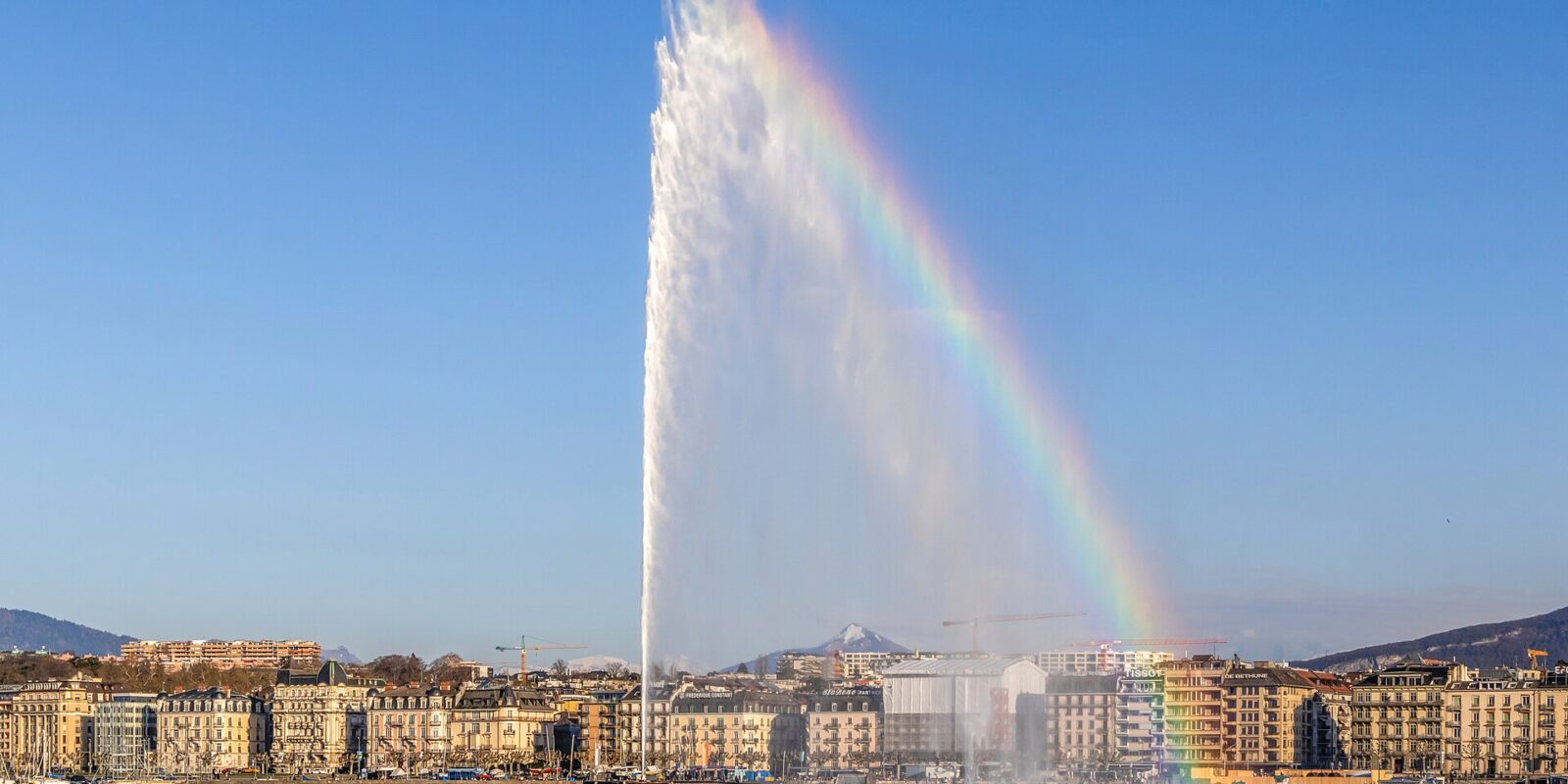
The most famous sight in Geneva began life as a piece of plumbing. In the 1880s, a hydraulic plant on the Rhône supplied pressurised water to the city’s workshops, and when the craftsmen shut their machines down in the evening, the pressure had to go somewhere, so engineers fitted a valve that let it off in a tall jet of water. People came to watch. A century and a bit later, that safety valve has become a 140-metre fountain, the symbol of the city, and the best news about it is the simplest: the Jet d’Eau is free. You can walk out along the jetty almost to its foot, watch it from a dozen places around the harbour, and see it lit up at night, all without paying a franc. What you can’t do is count on it. It stops for wind, it stops for frost, and every autumn it stops for weeks.
The Jet d’Eau Geneva is free to visit and fires about 500 litres of lake water a second some 140 metres into the air at 200 km/h, from the end of the Jetée des Eaux-Vives on the left bank. It typically runs from 10:00 to 16:00 in winter and from 9:00 into the evening for the rest of the year, and it’s lit every evening from early May to mid-September. It’s switched off in strong wind and frost and for several weeks of maintenance each autumn. Walk the jetty for the spray, but for the best view, stand back: the Bains des Pâquis, the Pont du Mont-Blanc and the cathedral towers all beat the close-up.
01 — The Jet d’Eau at a glance
| Detail | What to know |
|---|---|
| Cost | Free, including the walk along the jetty |
| Where | The end of the Jetée des Eaux-Vives, off the Quai Gustave-Ador on the left bank |
| Height | About 140 metres |
| Water | About 500 litres a second, leaving the nozzle at some 200 km/h |
| Pumps | Two motor-pump sets weighing more than 16 tonnes in total, with nearly 1,000 kW of power |
| Usual hours | About 10:00 to 16:00 in winter; from 9:00 into the evening from spring to autumn |
| Lit at night | Every evening from early May to mid-September; Friday to Sunday in March, April and from mid-September to October |
| When it stops | Strong wind, frost, and several weeks of maintenance every autumn |
| Time needed | 20 to 30 minutes, longer if you walk the jetty and the quays |
SIG, the city’s utility company, runs the Jet d’Eau and publishes its current operating and lighting times. Check them on the day, especially outside the summer.
02 — Where it is and how to get there
The Jet d’Eau rises from the end of the Jetée des Eaux-Vives, a stone jetty that juts out into the harbour from the Quai Gustave-Ador on the left bank of the lake, a few minutes’ walk east of the Jardin Anglais. You can’t miss it: from almost anywhere along the shore, you just walk towards the water column.
- On foot from Cornavin station: about 20 minutes. Walk down to the lake, cross the Pont du Mont-Blanc and turn left along the quays past the Jardin Anglais.
- By boat: the little yellow Mouettes cross the harbour from the Pâquis to the left bank, a short walk from the jetty. They’re part of the public transport network, so the free Geneva Transport Card from your hotel covers them.
- By bus or tram: any service to Rive or the Eaux-Vives end of the lakefront leaves you a few minutes’ walk away.
Our guide to Geneva public transport has the details, and our Transport Card guide explains the free card.
03 — Walking out on the jetty
The Jetée des Eaux-Vives runs out from the quay with a stone wall on one side and a wooden walkway on the other, past moored boats and resting swans, to a small lighthouse at its tip. The Jet d’Eau rises just off the jetty, close enough that you can feel the roar of it and, if the wind is in the wrong direction, the soaking. Walking out there is free and open to everyone.
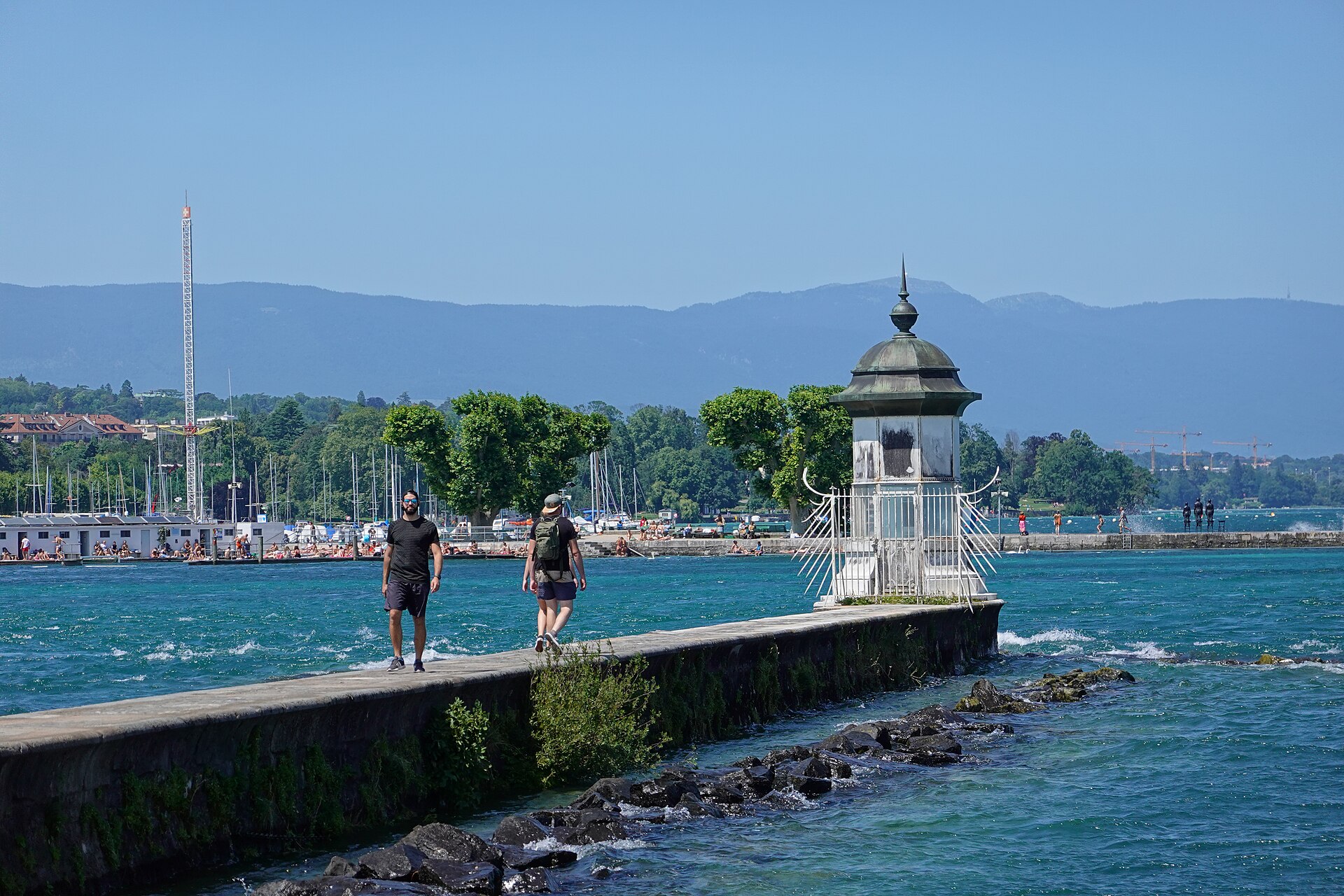
A few tips for the walk:
- Check the wind before you set off. The spray drifts with the breeze, and when it blows across the jetty, anyone on it gets drenched. If you can see the plume leaning over the walkway, stay back or come back later.
- Watch your footing. The jetty can be wet and slippery, especially close to the fountain.
- Keep hold of small children. The jetty is open on the water side, and the lake is deep.
- Protect your phone and camera. Even on a calm day there’s a fine mist near the base.
Here’s the honest verdict: the close-up is fun, but it isn’t the best way to see the Jet d’Eau. From the end of the jetty, you’re looking up at a column of white water. From across the harbour, you see it the way it’s meant to be seen, soaring above the lake against the mountains. Do both.
04 — When it runs
The Jet d’Eau runs for most of the year, but not all of it, and not in every weather.
Opening hours
In winter it typically runs from 10:00 to 16:00. From spring to autumn it starts at 9:00 and keeps going into the evening, when it’s lit up after dark. The exact times change through the year, and SIG has trimmed them in the past: in the energy crisis of 2022, the fountain’s hours were cut to save power. Check the current schedule before you go.
The illuminations
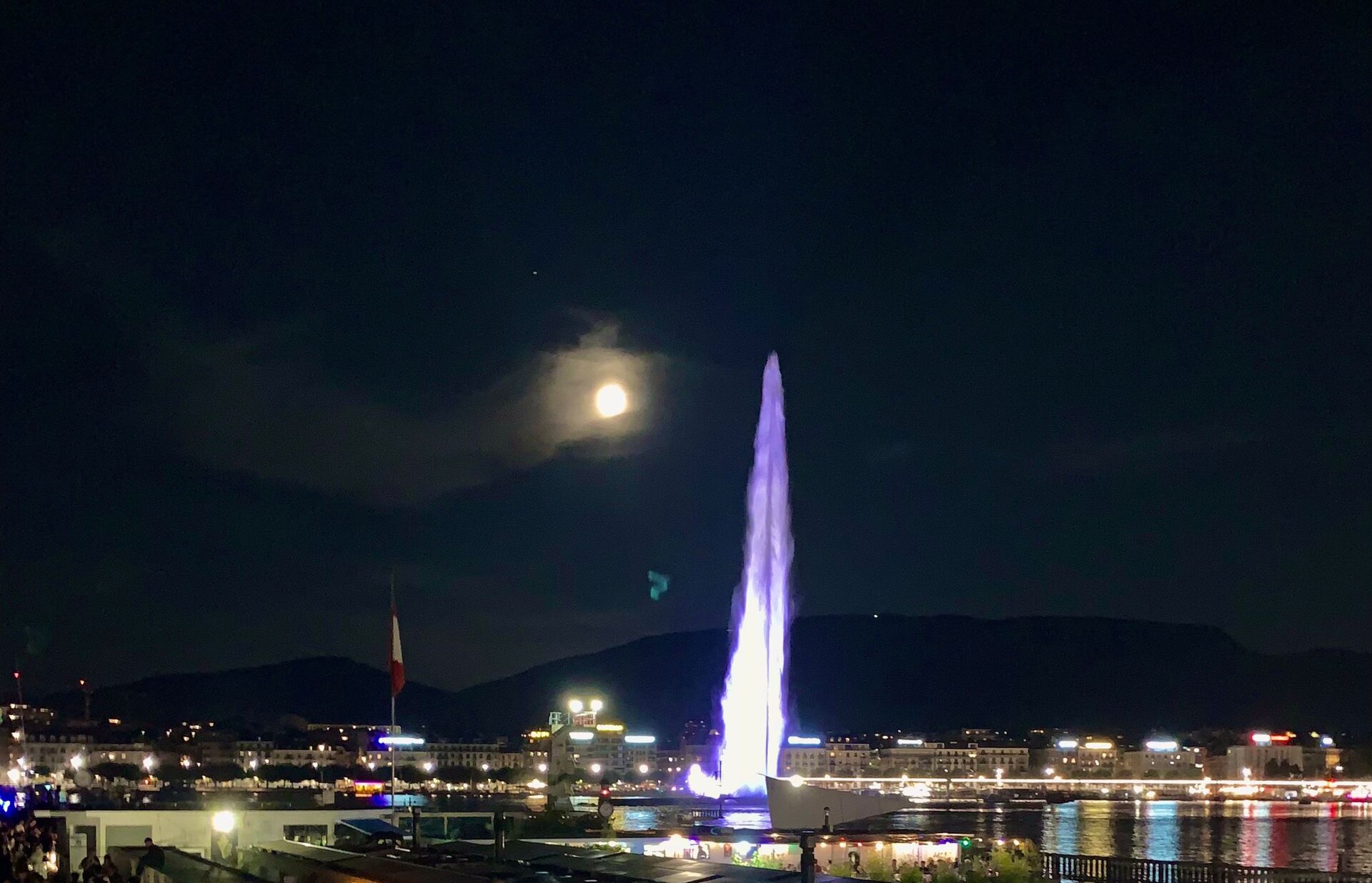
The Jet d’Eau has been lit at night since the 1930s, and it’s a lovely sight. The water carries millions of tiny air bubbles, which is why it looks so white, and at night the lights make it glow. From early May to mid-September it’s lit every evening, and in March, April and from mid-September to the end of October, on Friday, Saturday and Sunday evenings. On other days, the lights go on only for special occasions. The fountain is regularly lit in colours to mark international days and causes, from health awareness campaigns to national celebrations.
Wind and frost
The Jet d’Eau is at the mercy of the weather. When the wind is strong, the plume blows sideways over the jetty and the quays, so it’s switched off, and in freezing weather it’s turned off to stop ice forming on the jetty and the surrounding structures. For years, SIG has relied on a small team of retired employees who take turns keeping watch on the weather and shutting the valves when the wind gets up or the temperature drops. If you arrive and it isn’t running, that’s almost always why, and on a gusty day it may come and go.
The annual shutdown
Each autumn, the Jet d’Eau is switched off for several weeks while SIG’s engineers service the pumps, valves and motors in the pumping station beneath it and overhaul the lighting. In 2025 it stopped on 29 October, came back in stages from late November and returned to its normal hours in early December; the 2024 shutdown lasted about five weeks. The dates are announced each autumn, so if the Jet d’Eau matters to your trip, avoid November, or check before you book.
05 — The best places to see it
The Jet d’Eau is visible from all over the city, but some views are much better than others.
The Bains des Pâquis
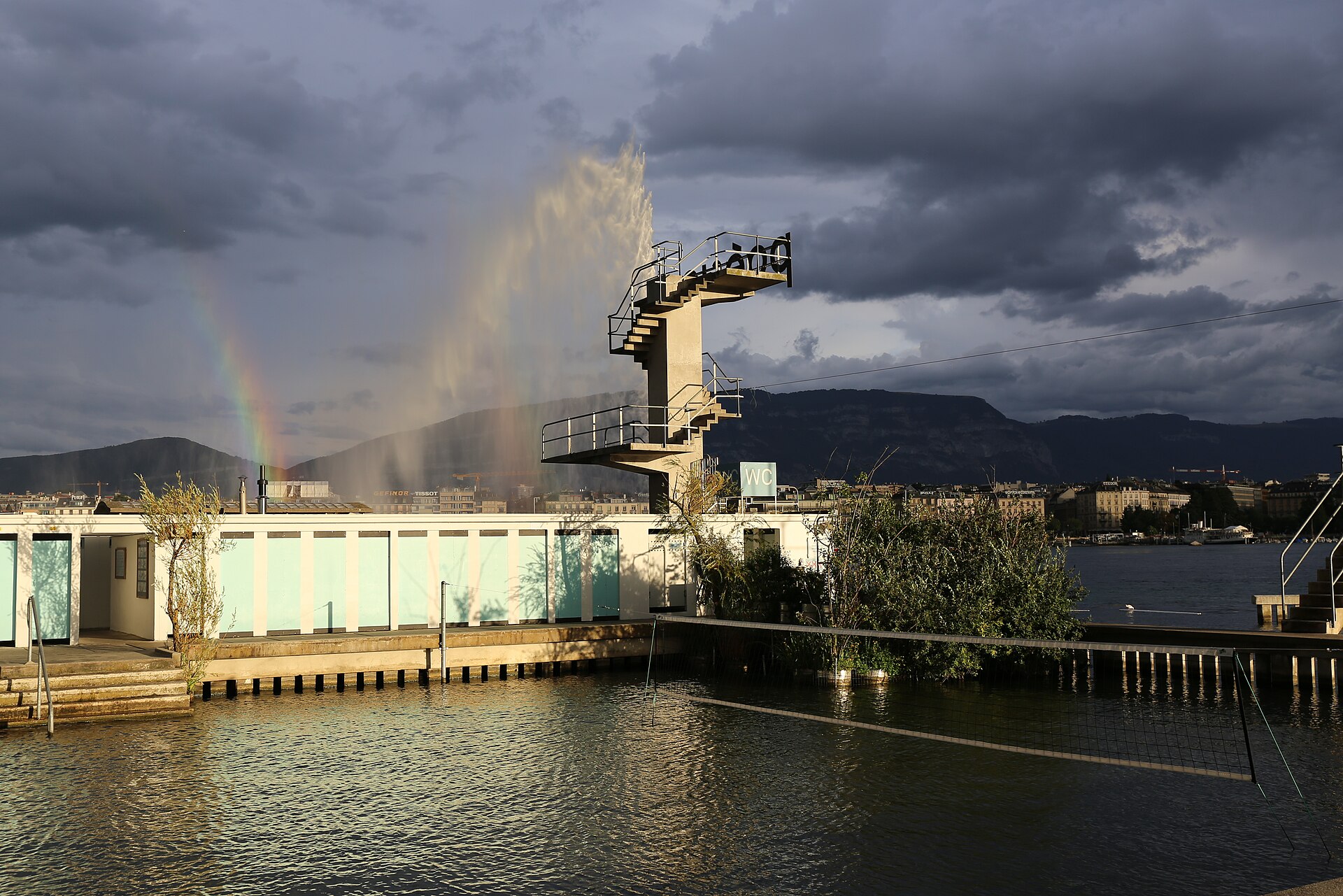
The jetty of the Bains des Pâquis, on the right bank directly across the harbour, has the classic view: the fountain rising over the water, with the wooded hills of the left bank behind. It’s also one of the nicest places in the city to sit and watch it, with a drink from the buvette, a swim in summer and the sauna in winter. Adults pay CHF 2 to get in, in summer and winter alike. See our Bains des Pâquis guide.
The Pont du Mont-Blanc and the right-bank quays
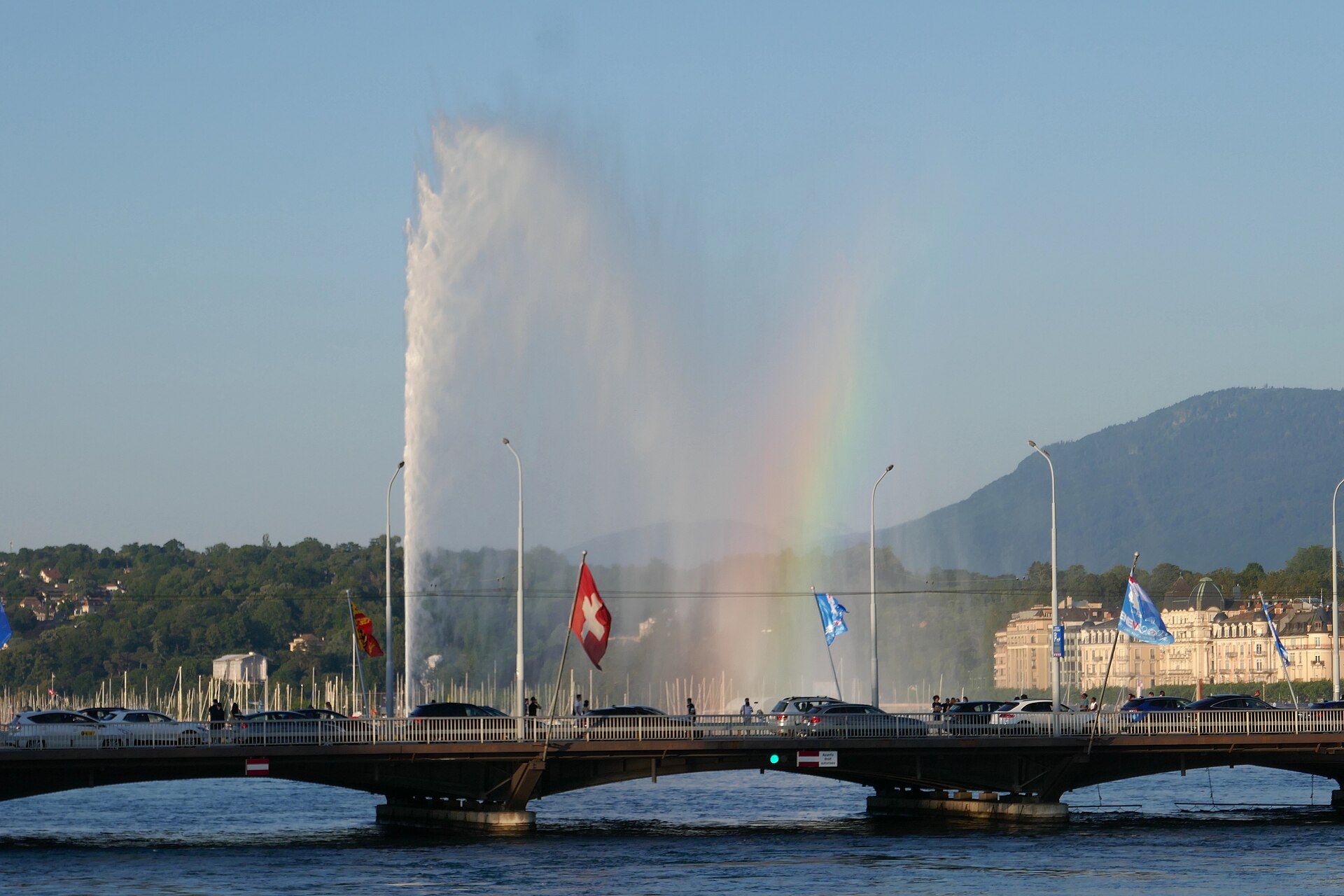
The Pont du Mont-Blanc, the bridge at the mouth of the Rhône, frames the Jet d’Eau beautifully, with the flags along the bridge in the foreground. The Quai du Mont-Blanc and the Quai Wilson on the right bank give you the fountain across the harbour, with the left bank behind, and they’re best in the afternoon and evening light.
The cathedral towers
For a view from above, climb the towers of St Pierre Cathedral in the Old Town, 157 steps and CHF 7 for adults. From the top, you look out over the roofs of the Old Town to the harbour, with the Jet d’Eau rising above the lake.
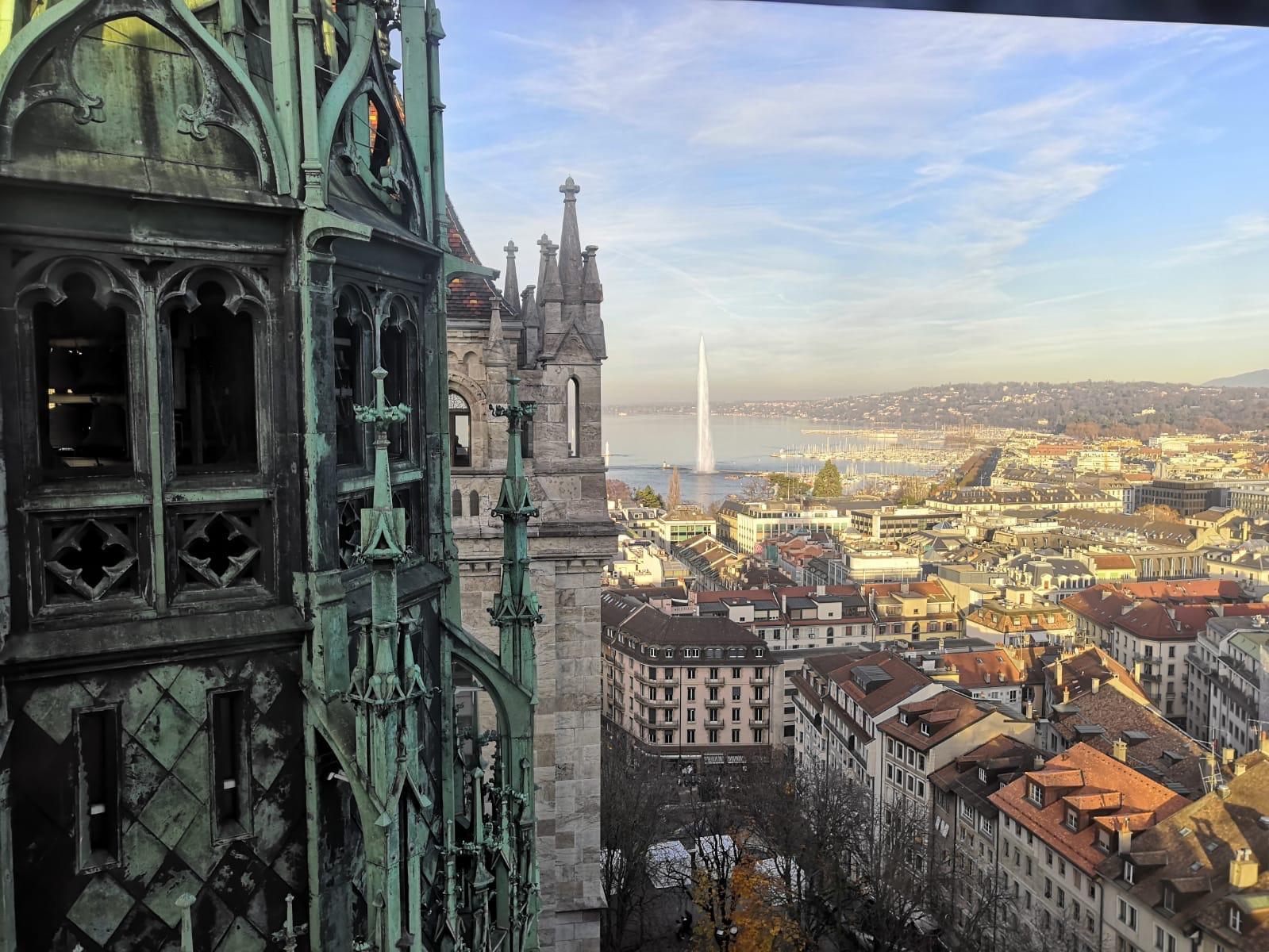
Our guide to the cathedral towers and the archaeological site has the opening times.
From the water
A Mouette across the harbour passes close to the fountain and costs no more than a bus ticket, or nothing with the Transport Card. A CGN boat trip on the lake gives you a slower, grander view as you sail in or out of the harbour, and in summer it’s one of the best ways to see the Jet d’Eau against the city. See our guide to Lake Geneva boat cruises.
From further away
- Parc La Grange and the Parc des Eaux-Vives, on the slope above the Quai Gustave-Ador, give you the fountain over the trees.
- The Salève, the mountain behind the city, gives you the whole harbour, the Jet d’Eau and the lake from above, on a clear day. See our Mont Salève guide.
- The air. On a clear day, if you’re flying in or out of Geneva Airport, look out of the window: the Jet d’Eau is easy to spot.
06 — Tips for photographing the Jet d’Eau
- Look for rainbows. On sunny days, rainbows form in the spray. Stand with the sun behind you and look towards the fountain; the jetty and the quays nearby are the best places to catch one.
- Use the wind. On a breezy day the plume fans out dramatically, which can make for a better photo than a perfectly straight column. Just don’t stand downwind.
- Give it scale. The fountain is so tall that it can look small in photos. Include the boats in the harbour, the lighthouse, the bridge or people on the jetty to show its size.
- Try a longer lens. From the Pâquis or the Pont du Mont-Blanc, a zoom compresses the fountain against the Old Town and the Salève.
- Go back at night. In summer, the illuminated fountain over the dark lake is a completely different picture. A steady hand or a small tripod helps.
- Check that it’s running. It sounds obvious, but many a photo trip has been spoilt by a windy afternoon. Check the forecast and the operating times.
Our guide to the most photogenic places in Geneva has more viewpoints around the city.
07 — How it works
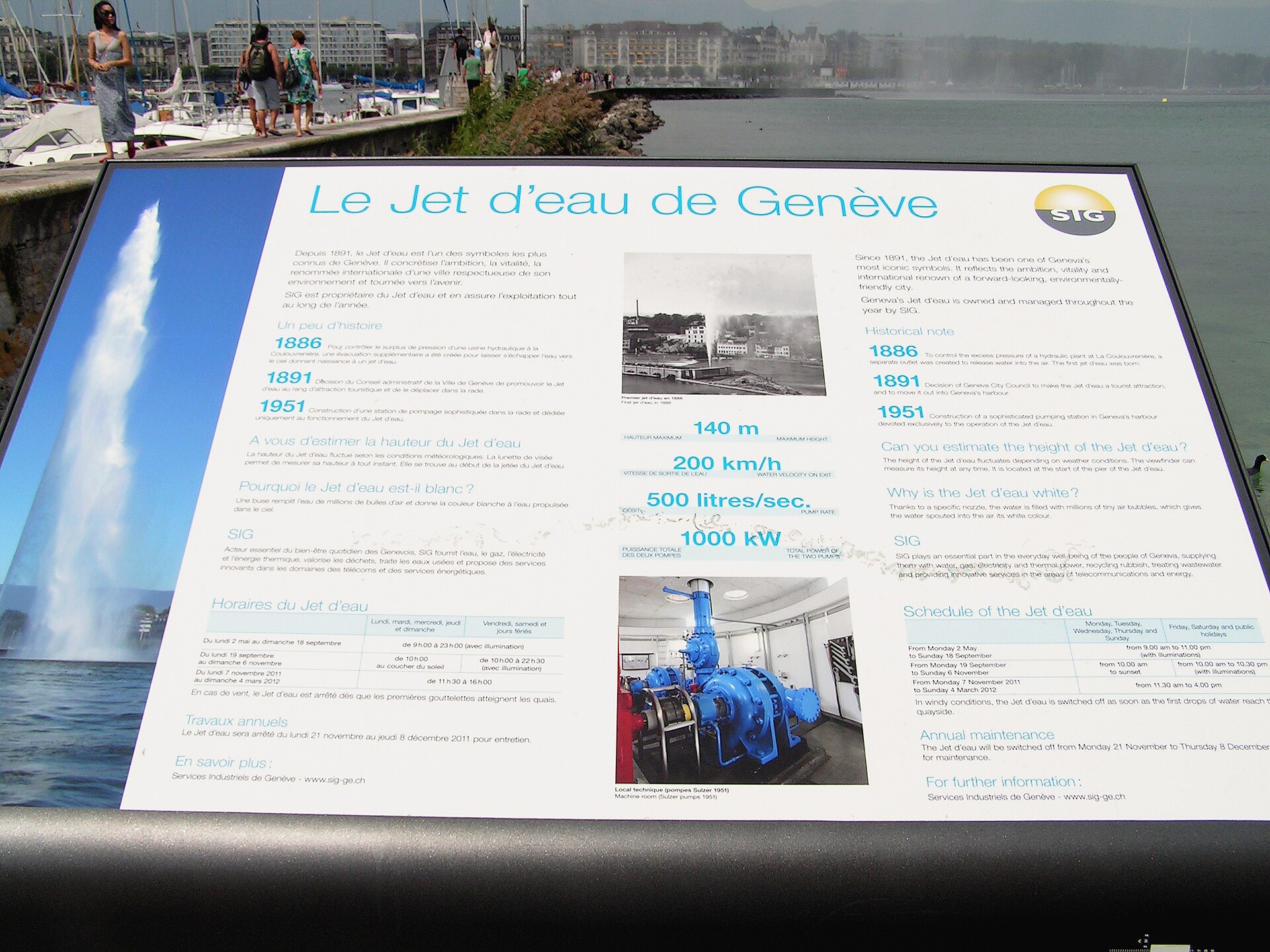
Today’s Jet d’Eau has nothing to do with the city’s water supply. It has its own pumping station beneath the jetty, where two motor-pump sets weighing more than 16 tonnes in total, with nearly 1,000 kW of power between them, draw water straight from the lake through two intake pipes and fire it through the nozzle at about 200 km/h. Around half a cubic metre of water, 500 litres, leaves the nozzle every second and climbs about 140 metres before falling back into the lake. The water is full of tiny air bubbles, which is what makes the column look so dazzlingly white, especially when it’s lit at night.
08 — A short history
- 1886: a hydraulic plant on the Rhône distributes pressurised water to the city’s workshops. To release the pressure when the machines stop in the evening, a valve sends a jet of water into the air, and it becomes an attraction in its own right.
- 1891: the jet becomes a decorative fountain in the harbour, with electric lighting, rising to around 90 metres.
- 1930s: regular night-time illumination begins.
- 1951: the Jet d’Eau, at its present position off the Jetée des Eaux-Vives since 1891, gets its own pumping station using lake water and reaches 140 metres.
- 2022: during the energy crisis, its operating hours are cut back to save electricity.
Our guide to Geneva’s history and heritage puts the story in context.
09 — A lakefront walk with the Jet d’Eau
The best way to see the Jet d’Eau is on a slow loop of the harbour, which shows it from every side. Allow about two hours with stops, more if you swim.
- Start at the Pâquis. From Cornavin station, walk down to the lake and along the Quai du Mont-Blanc to the Bains des Pâquis. Walk out to the end of the jetty for the classic view, and have a coffee at the buvette.
- Cross the Pont du Mont-Blanc. Stop halfway across for the view down the harbour to the fountain, then detour onto the Île Rousseau, the little island at the mouth of the Rhône with its statue of the philosopher.
- The Jardin Anglais. On the left bank, walk through the gardens past the Flower Clock to the lakefront.
- The Jetée des Eaux-Vives. Walk out along the jetty towards the fountain and the lighthouse, wind permitting.
- The Quai Gustave-Ador. Carry on east along the quay to the Plage des Eaux-Vives for a swim in summer, or climb into Parc La Grange for the view back over the harbour.
- Back by boat. Take a Mouette back across the harbour to the right bank, passing close to the fountain on the way.
In summer, do the loop in the evening and you’ll finish just as the lights come on.
10 — What’s nearby
The Jet d’Eau sits at the heart of Geneva’s lakefront, and it’s easy to combine with half a dozen other sights.
- The Jardin Anglais and the Flower Clock, five minutes’ walk west along the quay.
- The Old Town, ten minutes uphill from the Jardin Anglais, for the cathedral, Maison Tavel and the Place du Bourg-de-Four. See our Old Town guide.
- The Plage des Eaux-Vives and Genève-Plage, further east along the Quai Gustave-Ador, for a swim in summer. See our guide to Lake Geneva beaches and swimming.
- Parc La Grange and the Parc des Eaux-Vives, on the slope above the quay, for the rose garden and the view.
- The Bains des Pâquis, across the harbour by Mouette, for the best view of all.
Our Flower Clock and Jardin Anglais guide covers the next stop along the lake.
For prices and opening days for every major sight in the city, see our guide to Geneva attractions and tickets.
11 — With children
Children tend to love the Jet d’Eau, especially the walk out along the jetty, where they can feel the roar of the water and, inevitably, get a little wet. Keep a firm hold of small hands on the jetty, which is open to the lake and can be slippery, and bring a change of clothes if the wind is up. The Mouettes across the harbour are a hit with children too, and they’re free with the Transport Card. Combine the fountain with the swans and ducks along the quays, the Flower Clock and, in summer, a swim at the shallow, sandy Plage des Eaux-Vives. Our guide to things to do in Geneva with kids has more ideas.
12 — Five mistakes to avoid
- Planning your only lakefront visit for a windy day. If the Bise is blowing hard, the fountain may be off. Check the forecast and keep your plans flexible.
- Expecting it at night in winter. In winter it usually runs only in the daytime, and the evening illuminations are a summer treat.
- Visiting in November without checking. The annual maintenance shutdown usually covers much of the month.
- Standing downwind on the jetty. Watch which way the spray is drifting before you walk out, or you’ll spend the rest of the day damp.
- Only seeing it close up. The jetty is fun, but the fountain looks far better from across the harbour or from above.
13 — Is it worth it?
Yes, of course. It’s free, it’s spectacular and it’s the symbol of the city. But keep it in proportion. The Jet d’Eau is a sight to enjoy in passing as you explore the lakefront, not an attraction to build a day around, and twenty minutes is plenty unless you settle in at the Bains des Pâquis with a drink. See it from a distance first, walk out along the jetty if the wind is kind, and come back after dark in summer to see it lit. If you’re visiting in November, check that it’s running before you make a special trip.
Frequently asked questions
Is the Jet d’Eau free?
Yes. Seeing the Jet d’Eau and walking out along the jetty towards it are both free.
What time does the Jet d’Eau run?
Typically from 10:00 to 16:00 in winter, and from 9:00 into the evening from spring to autumn, when it’s lit after dark. It doesn’t run in strong wind or frost. SIG publishes the current times.
Why is the Jet d’Eau not working?
Usually because of the wind or the cold: it’s switched off when the wind is strong enough to blow the spray over the jetty and the quays, and when it’s freezing. It’s also turned off for several weeks of maintenance each autumn, typically from late October or early November.
Can you walk to the Jet d’Eau?
Yes, along the Jetée des Eaux-Vives from the Quai Gustave-Ador on the left bank. You can get close to the base, but you’ll get wet if the wind is blowing the spray your way.
How high is the Jet d’Eau?
About 140 metres. The water leaves the nozzle at around 200 km/h, at a rate of about 500 litres a second.
When is the Jet d’Eau lit up at night?
Every evening from early May to mid-September, and on Friday, Saturday and Sunday evenings in March, April and from mid-September to the end of October. It’s sometimes lit in colours to mark international days.
Where is the best view of the Jet d’Eau?
From across the harbour: the jetty of the Bains des Pâquis and the Pont du Mont-Blanc are the classic spots. For a view from above, climb the cathedral towers in the Old Town.